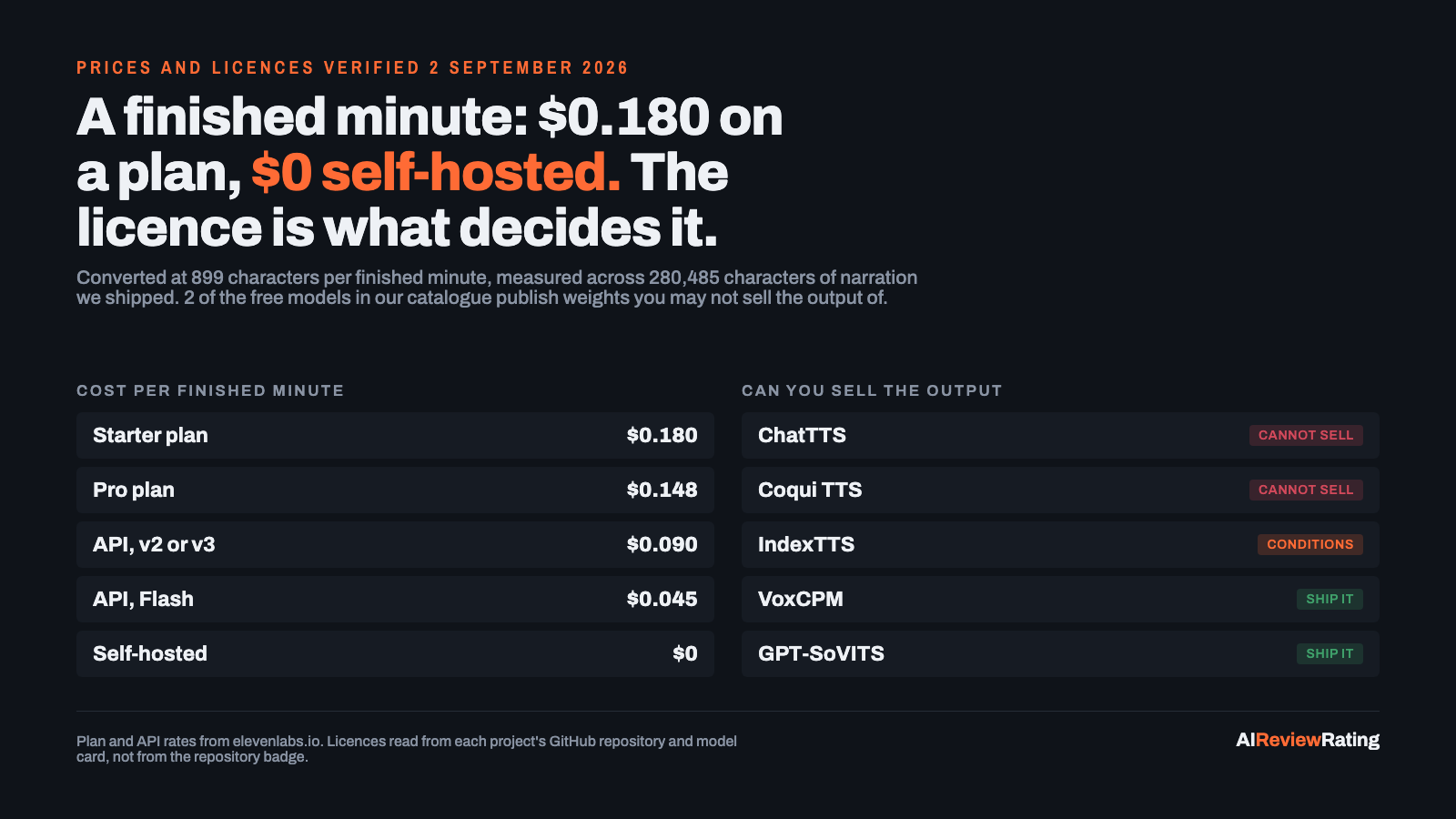
Short answer, verified 2 September 2026: one finished minute of ElevenLabs narration costs $0.148 to $0.180 on a monthly plan and $0.045 to $0.090 on the API. A self-hosted open source model costs $0 to licence and runs on hardware you already own. The part that decides the choice is not the price: of the 13 open source voice projects in our catalogue, 10 carry a licence you can ship a commercial product on, 1 attaches conditions, and 2 publish model weights you are not permitted to sell the output of, no matter what the badge on the repository says.
| Way to produce a minute of narration | Cost per finished minute | Commercial licence |
|---|---|---|
| ElevenLabs Starter plan | $0.180 | Included in the plan |
| ElevenLabs Pro plan | $0.148 | Included in the plan |
| ElevenLabs API, v2 or v3 | $0.090 | Pay as you go |
| ElevenLabs API, Flash or Turbo | $0.045 | Pay as you go |
| Self-hosted VoxCPM or GPT-SoVITS | $0 | Apache-2.0 and MIT, verified 2 September 2026 |
| ElevenLabs Free tier | $0 | None |
This page compares two ways to put a voice on a video or a product: ElevenLabs, and the open source models you run yourself. It is written for people who intend to sell what comes out, which is why half of it is about licences. If you only want the ElevenLabs half in detail, read what one finished minute costs on every ElevenLabs plan. For the wider category, including the paid tools we rank against it, read our guide to the 6 AI voice generators worth paying for.
The number both sides of this comparison rest on
Every price in text to speech is quoted per character or per thousand characters. Every budget is written in minutes. The conversion between them is a reading rate, and almost nobody publishing on this subject measures one, so they assume a round 1,000 characters a minute and the answers come out as ranges.
We produce long-form narrated video every week, so the corpus already existed. Across 15 shipped scripts, 50,237 words and 280,485 characters, the arithmetic gives 899 characters per finished minute at a 161 words per minute delivery.
We re-measured on 2 September 2026 to check the figure had not drifted. The same local engine we ship with, reading a 77 word passage of this article, produced 30.61 seconds of audio: 150.9 words a minute and 860 characters a minute, which is 4 percent off the corpus figure.
| Script character | Words per minute | Characters per finished minute |
|---|---|---|
| flowing narrative, no figures | 170.3 | 951 |
| ordinary narrative with a few numbers | 145.1 | 810 |
| dense proper nouns and spoken years | 114.5 | 639 |
| catalogue average across shipped films | 151.0 | 843 |
| Our shipped corpus, 15 scripts | 161 | 899 |
The spread is the finding. A script that speaks years, dollar figures and proper nouns runs at 114.5 words a minute; flowing narrative runs at 170.3. That is a 49 percent difference in how many minutes a fixed character budget buys you, on identical pricing. Before you size a plan, synthesize 200 words of your own copy, time the result and divide. It takes two minutes and it is the only figure on this page you should not take from us.
What ElevenLabs costs per finished minute
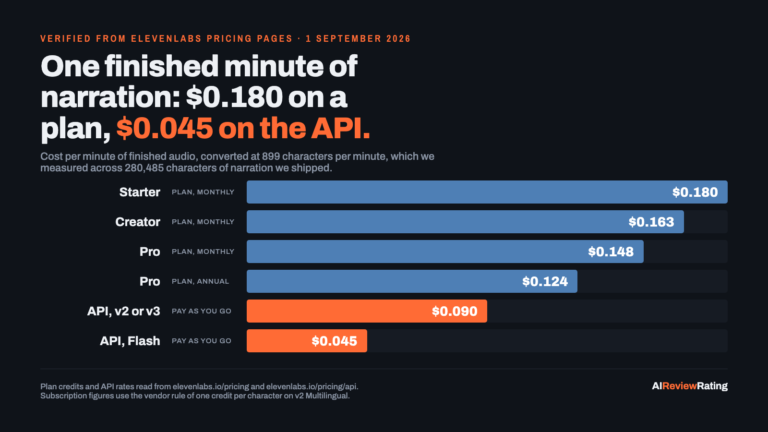
ElevenLabs states on its pricing page FAQ that for V2 Multilingual models one text character equals one credit. That rule, the credit allowance on each plan and 899 characters a minute give one number per tier.
| Plan | Monthly | Credits a month | Minutes of v2 audio | Cost per finished minute | Commercial licence |
|---|---|---|---|---|---|
| Free | Free | 10,000 | 11 | n/a | No |
| Starter | $6 | 30,000 | 33 | $0.180 | Yes |
| Creator | $22 | 121,000 | 135 | $0.163 | Yes |
| Pro | $99 | 600,000 | 667 | $0.148 | Yes |
| Scale | $299 | 1,800,000 | 2,002 | $0.149 | Yes |
| Business | $990 | 6,000,000 | 6,674 | $0.148 | Yes |
| API model | Price per 1,000 characters | Cost per finished minute |
|---|---|---|
| v3 | $0.10 | $0.090 |
| v3 Conversational | $0.05 | $0.045 |
| v2 Multilingual | $0.10 | $0.090 |
| Flash / Turbo | $0.05 | $0.045 |
Two things follow, and they are the reason the comparison against free is narrower than it looks. First, the free ElevenLabs tier is not a free way to make a product: it grants 10,000 credits a month and no commercial licence, so it prices at $0 and is unusable for the case this article is about. Second, the cheapest paid minute on a plan is $0.148, which is 3.3 times the same vendor’s Flash API rate of $0.045. If you are comparing paid against free, compare the API against free, not the plan.
What open source actually costs, since it is not zero
The licence fee is $0. The rest is not. Our local voice stack is Voicebox 0.5.0, MIT, running locally on an M4 Max Mac, and the models it has pulled down occupy 16.9 GB of disk, measured on 2 September 2026.
| Model on our machine | Hugging Face repository | Disk |
|---|---|---|
| Kokoro | hexgrad/Kokoro-82M | 314 MB |
| Whisper base | openai/whisper-base | 281 MB |
| LuxTTS | YatharthS/LuxTTS | 1.10 GB |
| Chatterbox | ResembleAI/chatterbox | 2.99 GB |
| Chatterbox Turbo | ResembleAI/chatterbox-turbo | 3.77 GB |
| Qwen CustomVoice 1.7B | Qwen/Qwen3-TTS-12Hz-1.7B-CustomVoice | 4.21 GB |
| Qwen TTS 1.7B | mlx-community/Qwen3-TTS-12Hz-1.7B-Base-bf16 | 4.23 GB |
| Total downloaded | 16.9 GB |
The smallest engine in that list is Kokoro at 314 MB, and it is the one we ship with. The largest is Qwen TTS 1.7B at 4.2 GB, which is 14 times the size for one voice engine. A first-time setup is a Python environment, a model download and a driver stack, and the honest way to describe the difference from a hosted API is that ElevenLabs asks for a card and open source asks for an afternoon.
Two costs we are not going to put a number on, because we cannot measure them honestly. Electricity and hardware: this runs on a machine bought for other work, so any figure would be an allocation argument. Video memory and throughput: those depend on the model and the machine, the figures circulating on this query are unsourced, and the one time we asked a synthesis tool to fill the gap it invented a set. Anything we cannot verify is cut from this page rather than hedged.
The licence audit: the badge on the repository is not the licence you need
This is the part of the comparison that is missing everywhere else, and it is the part that decides whether the $0 is real. An open source voice project ships two things: code, and model weights. They are licensed separately, the repository badge describes the code, and the thing that turns text into audio is the weights.
We read every one on 2 September 2026, from the GitHub REST API for the code licence and from the publisher’s own model card or licence file for the weights.
| Tool | Our score | Code licence | Model weights licence | Can you sell the output | Last pushed |
|---|---|---|---|---|---|
| IndexTTS | 5.8 | None detected | bilibili Model Use License Agreement | Conditional | 2026-08-18 |
| ChatTTS | 5.5 | AGPL-3.0 | CC BY-NC 4.0 | No | 2026-04-10 |
| Coqui TTS | 5.1 | MPL-2.0 | Coqui Public Model License 1.0.0 | No, for the XTTS-v2 weights | 2024-08-16 |
| pyVideoTrans | 7.1 | GPL-3.0 | GPL-3.0 | Yes, with copyleft obligations | 2026-09-02 |
| VoxCPM | 7.0 | Apache-2.0 | Apache-2.0 | Yes | 2026-09-02 |
| GPT-SoVITS | 6.2 | MIT | MIT | Yes | 2026-08-18 |
| Spleeter | 5.3 | MIT | MIT | Yes | 2026-06-18 |
| faster-whisper | 5.0 | MIT | Apache-2.0 | Yes | 2025-11-19 |
| CosyVoice | 4.4 | Apache-2.0 | Apache-2.0 | Yes | 2026-05-25 |
| Dia | 4.2 | Apache-2.0 | Apache-2.0 | Yes | 2025-11-19 |
| OpenVoice | 3.9 | MIT | MIT | Yes | 2025-04-19 |
| Real-Time Voice Cloning | 3.8 | MIT (undetected) | MIT (undetected) | Yes | 2026-03-09 |
| MockingBird | 3.7 | MIT (undetected) | MIT (undetected) | Yes | 2026-03-03 |
ChatTTS: the code is open, the model is not for sale
GitHub reports AGPL-3.0 against 2noise/ChatTTS, and 39,814 stars suggest a settled choice. The README splits it in two. The code is AGPLv3+. The model, in the project’s own words, is published under a “CC BY-NC 4.0” licence, intended for educational and research use. NC means non-commercial. Narration produced by it cannot go in a monetised video, a client deliverable or a paid product, and no amount of AGPL compliance changes that, because the restriction is on the weights.
Coqui TTS: a licence that says non-commercial, at a URL that returns 404
coqui-ai/TTS carries MPL-2.0, which is a permissive open source licence, and our catalogue scores it 5.1. Its flagship model is XTTS-v2, and the model is where the terms live. The model card names coqui-public-model-license and points at https://coqui.ai/cpml. The LICENSE.txt inside the model repository opens with a single sentence: “This license allows only non-commercial use of a machine learning model and its outputs.”
Then the part we did not expect. We fetched both URLs the licence cites, https://coqui.ai/cpml and https://coqui.ai/cpml.txt, on 2 September 2026. Both return HTTP 404, served by a GitHub Pages 404 page. Coqui the company wound down, and the canonical text of its model licence went with the site. The model was downloaded 7,587,665 times in the 30 days to 2 September 2026, which is a large number of people agreeing to terms they cannot read at the address those terms give for themselves. A copy survives in the model repository at https://huggingface.co/coqui/XTTS-v2/blob/main/LICENSE.txt, and that copy is the one we read. If XTTS is in your stack, save that file.
The repository has had no push since 2024-08-16, so treat the toolkit as frozen as well as restricted.
IndexTTS: an open weights model with a revenue threshold in it
The GitHub API returns no detected licence for index-tts/index-tts, and our own catalogue row carried a note to verify it before writing. The LICENSE file is the bilibili Model Use License Agreement. It grants a worldwide, non-exclusive, royalty-free limited licence, and then, at clause 2.2, requires a separate written licence from bilibili if you or an affiliate had more than 100 million monthly active users in the previous calendar month or more than 1 billion yuan of revenue in the previous calendar year.
For almost every reader that threshold is theoretical, and the model is usable. The reason to know about it is that it is not an OSI licence at all, so “open source” is doing work here that it should not be asked to do. If your company has a policy on non-standard model licences, this trips it.
Two projects GitHub reports as unlicensed that are not
CorentinJ/Real-Time-Voice-Cloning and babysor/MockingBird both return no detected licence from the API, which is the same signal IndexTTS gives. In their case the file is the standard MIT text with a modified copyright header naming four prior authors, which the detector will not match. The permission is real; the badge is not. Between them they carry 97,026 stars, so this is not an edge case, and it is the reason this audit reads licence files rather than badges.
What we would actually run, and why
Ranked by our desk score, restricted to projects that generate speech and carry a licence you can sell the output of, verified 2 September 2026.
- VoxCPM, 7.0 out of 10. Apache-2.0, 36,568 stars, last pushed 2026-09-02. The repository README states that weights and code are released under Apache-2.0 and are free for commercial use, which is the clearest licence statement of any project in this set.
- GPT-SoVITS, 6.2 out of 10. MIT, 61,460 stars, last pushed 2026-08-18. The most starred project in this set. You supply the reference audio, so the voice you ship is yours to clear rather than the project’s to license.
- CosyVoice, 4.4 out of 10. Apache-2.0, 23,421 stars, last pushed 2026-05-25. Code and the CosyVoice2-0.5B weights both carry Apache-2.0.
- Dia, 4.2 out of 10. Apache-2.0, 19,387 stars, last pushed 2025-11-19. Built for two-speaker dialogue rather than single-voice narration.
- OpenVoice, 3.9 out of 10. MIT, 37,410 stars, last pushed 2025-04-19. The README states that both V1 and V2 moved to MIT in April 2024 and are free for commercial use. No push to the repository since 2025-04-19.
- Real-Time Voice Cloning, 3.8 out of 10. MIT (undetected), 60,115 stars, last pushed 2026-03-09. The GitHub API returns NOASSERTION because the LICENSE file carries a modified copyright header. The body of the file is the standard MIT text, so the permission is real even though the badge is absent.
- MockingBird, 3.7 out of 10. MIT (undetected), 36,911 stars, last pushed 2026-03-03. Same situation as Real-Time Voice Cloning, from which its LICENSE file is inherited verbatim.
VoxCPM is the one we would start with, because it is the only project in the set whose README states in one sentence that the weights and the code are both Apache-2.0 and “free for commercial use”. Every other clean licence in the table had to be assembled from two documents. GPT-SoVITS is the choice when you need a specific voice rather than a good one, because you supply the reference audio, which also moves the permission question from the model to the person who recorded it.
The model this SERP recommends that we have not scored
Google’s AI Overview for this query, and two of the three videos its AI Mode answer cites, name Chatterbox by Resemble AI first. It carries MIT on resemble-ai/chatterbox, 26,234 stars, and 1,758,570 downloads from its model repository in the 30 days to 2 September 2026. We run it: it is one of the engines in our local stack and 3.0 GB of its weights sit on the machine this article was written on.
It has no page in our catalogue and no desk score, so it does not appear in the ranked list above and we are not going to rank it from a README. We are naming it because leaving out the model the answer engines lead with would make this page less useful, and because the licence question, which is what this article is for, has a clean answer: MIT on both the code and the published weights, read on 2 September 2026.
Where the paid tool is still the right buy
We moved our own narration to a free local engine and the line item is $0 a month. That is a real production decision, not a recommendation for everyone, and there are four cases where we would still put the $0.045 a minute on a card.
- Expressive delivery you can direct. The free preset voices we ship with read a script accurately and flatly. Getting warmth out of them is a matter of writing flowing sentences and slowing the output by 10 percent after the fact, not of asking for it. A paid engine takes direction.
- Volume with no machine time. Our stack occupies a Mac while it renders. At $0.045 a minute, an hour of finished narration on the Flash API is $2.70 and takes none of your hardware.
- A licence you can hand to a client. A paid plan comes with one document that says you may sell the output. Assembling the same assurance from a code licence plus a model card plus a dead URL, which is what this article had to do, is billable time.
- Languages and voices you do not have. Cloning needs a clean, loud, dry reference recording of a voice you are entitled to use. If you do not have one, a catalogue of ready voices is worth paying for.
That split is what the discussion Google itself surfaces for this query shows. Its AI Overview, captured 31 August 2026, summarises the r/ElevenLabs thread on conversational agents against open source text to speech as divided: some posters get results they are happy with out of open models after tuning, and others prefer ElevenLabs precisely because it needs none. We are reporting that as Google’s reading of the thread rather than quoting from it, because reddit.com returns HTTP 403 to anonymous requests and we are not going to paraphrase a comment we cannot re-read.
If you are pricing paid alternatives rather than free ones, Murf AI and WellSaid Labs are the two we would put beside ElevenLabs, and our voice generator guide ranks the 6 of them on what a finished minute costs.
Our own numbers, in full
| Our production | Figure |
|---|---|
| Narration shipped | 15 scripts, 280,485 characters |
| Finished audio | 312 minutes |
| Cost of that on the ElevenLabs v2 API | $28.05 |
| Cost of that on the ElevenLabs Flash API | $14.02 |
| Cost of one month of Pro | $99 |
| Pro allowance that would go unused | 53 percent |
| Disk our local stack occupies | 16.9 GB |
| What we pay a month | $0 |
Read that the right way round. It does not say ElevenLabs is overpriced. It says our workload is flat narration at moderate volume, which is exactly the workload a free local engine handles, and that a single month of Pro would have left 53 percent of its allowance unspent. Buying a plan for a workload that fits inside pay as you go is the most common way to overpay in this category, and it costs more than the $0.058 a minute of headline difference between a plan and the API.
How we verified this
- ElevenLabs plan prices, credit allowances and licence terms were read from https://elevenlabs.io/pricing in a real browser on 2 September 2026, with the monthly toggle applied, because text extraction of that page returns a first-month promotion rather than the recurring price.
- API rates were read from https://elevenlabs.io/pricing/api on 2 September 2026.
- Code licences, star counts and last-push dates for all 13 open source projects came from the GitHub REST API on 2 September 2026, one call per repository.
- Model weight licences came from each publisher’s own model card or LICENSE file, not from the repository badge, because on 4 of the projects here the two disagree.
- Characters per finished minute is our own measurement across 280,485 characters of shipped narration, re-checked on 2 September 2026 against a fresh generation.
- Disk figures were read from the local model manager on the machine that runs our production voiceover, on 2 September 2026.
- Every table on this page is computed at build time from one fact file. No figure in the article is typed by hand, so a price or licence change moves the whole page.
- Anything we could not verify was cut. That includes video memory requirements, throughput figures, electricity cost and any claim about which engine sounds better, because we have run no blind listening test.
Licences change and repositories go quiet. This page carries the date it was verified and we re-check it on a schedule. If a licence here disagrees with the project today, the project is right and we want to know.
Frequently asked questions
What is the best TTS open source?
The 2 we would run are VoxCPM at 7.0 out of 10 and GPT-SoVITS at 6.2, ranked by our desk score and restricted to projects that generate speech and carry a model licence you may sell the output of. VoxCPM is the cleaner licence: its README states weights and code are both Apache-2.0 and free for commercial use. GPT-SoVITS is the one to pick when you need a particular voice, because you supply the reference audio. We are ranking on licence, maintenance and adoption, not on sound quality, because we have run no blind listening test.
Is ElevenLabs TTS free?
There is a free tier of 10,000 credits a month, which is about 11 minutes of audio at our measured 899 characters a minute, verified 2 September 2026. It carries no commercial licence, so it is a trial rather than a free production tool. The cheapest paid entry is Starter at $6 a month, which works out at $0.180 a finished minute.
Can I use open source TTS commercially?
Sometimes, and you have to check the model, not the repository. Of the 13 projects in our catalogue audited on 2 September 2026, 10 carry licences that permit commercial use, 1 attaches a condition and 2 publish weights that do not: ChatTTS releases its model under CC BY-NC 4.0 and Coqui TTS releases XTTS-v2 under a licence whose first line restricts it to non-commercial use, even though both repositories carry open source badges for their code.
What is the best TTS API?
On price, the cheapest ElevenLabs option is the Flash or Turbo API at $0.05 per 1,000 characters, which is $0.045 a finished minute at 899 characters a minute, against $0.148 on the cheapest monthly plan. If you are buying narration minutes and nothing else, the API beats every subscription tier on unit price, verified 2 September 2026. A plan is worth it for the editor, voice cloning and seats.
What TTS model does ElevenLabs use?
Its API pricing page lists 4 models you can call, read on 2 September 2026: v3 and v2 Multilingual at $0.10 per 1,000 characters, and v3 Conversational and Flash or Turbo at $0.05. Those are product names. The architecture behind them is not published by the vendor, so we are not going to guess at it.
Is there a free open source alternative to ElevenLabs?
Yes, with the licence caveat above. VoxCPM (Apache-2.0) and GPT-SoVITS (MIT) both run locally, cost $0 to licence and permit commercial use, verified 2 September 2026. The cost moves rather than disappearing: our own stack is 16.9 GB of models on disk, it occupies the machine while it renders, and the free preset voices take direction less well than a paid engine does.
Why does the Coqui XTTS licence link not work?
Because Coqui wound down and the site went with it. The XTTS-v2 model card points at https://coqui.ai/cpml for the Coqui Public Model License, and that URL, along with https://coqui.ai/cpml.txt cited inside the licence text itself, returned HTTP 404 when we checked on 2 September 2026. A readable copy survives in the model repository at https://huggingface.co/coqui/XTTS-v2/blob/main/LICENSE.txt. Its first line restricts the model and its outputs to non-commercial use, so save the file if you rely on it.
How many characters is a minute of speech?
We measure 899 across 280,485 characters of shipped narration, against the 1,000 that vendors and articles assume. The figure moves with the script: our own productions run from 114.5 to 170.3 words a minute depending on how many numbers and proper nouns are spoken. Measure your own before you size a plan.
Sources
- ElevenLabs pricing, plans and credit rules. https://elevenlabs.io/pricing, read 2 September 2026.
- ElevenLabs API pricing and model rates. https://elevenlabs.io/pricing/api, read 2 September 2026.
- VoxCPM repository, code licence and activity. OpenBMB/VoxCPM, read 2 September 2026.
- GPT-SoVITS repository, code licence and activity. RVC-Boss/GPT-SoVITS, read 2 September 2026.
- OpenVoice repository, code licence and activity. myshell-ai/OpenVoice, read 2 September 2026.
- CosyVoice repository, code licence and activity. FunAudioLLM/CosyVoice, read 2 September 2026.
- Dia repository, code licence and activity. nari-labs/dia, read 2 September 2026.
- faster-whisper repository, code licence and activity. SYSTRAN/faster-whisper, read 2 September 2026.
- Spleeter repository, code licence and activity. deezer/spleeter, read 2 September 2026.
- Real-Time Voice Cloning repository, code licence and activity. CorentinJ/Real-Time-Voice-Cloning, read 2 September 2026.
- MockingBird repository, code licence and activity. babysor/MockingBird, read 2 September 2026.
- pyVideoTrans repository, code licence and activity. jianchang512/pyvideotrans, read 2 September 2026.
- IndexTTS repository, code licence and activity. index-tts/index-tts, read 2 September 2026.
- ChatTTS repository, code licence and activity. 2noise/ChatTTS, read 2 September 2026.
- Coqui TTS repository, code licence and activity. coqui-ai/TTS, read 2 September 2026.
- Coqui Public Model License 1.0.0, as published in the XTTS-v2 model repository. Coqui XTTS-v2 LICENSE.txt on Hugging Face, read 2 September 2026. The URL the licence cites for itself, https://coqui.ai/cpml.txt, returned HTTP 404 on the same day.
- Chatterbox repository and model card. resemble-ai/chatterbox, read 2 September 2026.
- r/ElevenLabs, on conversational agents against open source text to speech. r/ElevenLabs: ElevenLabs agent vs open source TTS.
- Better Stack, “An Open-Source Alternative to ElevenLabs”, the video Google’s AI Overview embeds for this query. https://www.youtube.com/watch?v=chH2tlh_Vvk.
- Google AI Overview, AI Mode, People Also Ask and related searches for “elevenlabs vs open source tts”, captured 31 August 2026 and stored in our research bundle.
- Our own narration corpus and local model stack: 15 shipped scripts, 280,485 characters, 16.9 GB of models, measured 2026.

Comments
Sign in to join the discussion.
Login to comment