The short answer
If you run a small business or a studio and you are deciding whether to bring image generation in-house, the licence decides more of the bill than the GPU does. On 25 September 2026 we read every model licence, every self-host price and every GPU rate behind this question from the vendors’ own pages. Three answers came out.
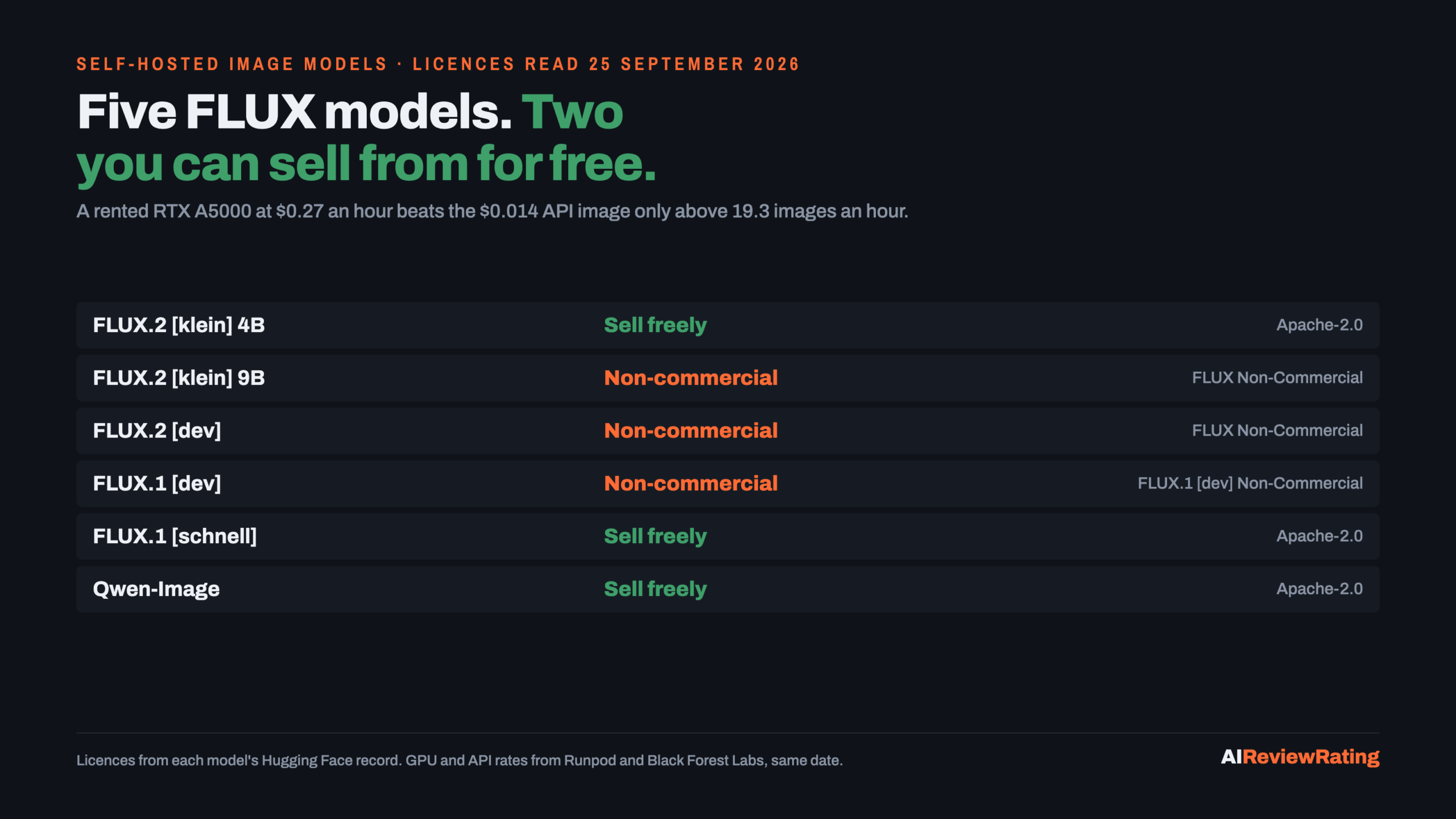
- One FLUX.2 model is free to sell from with no cap: FLUX.2 [klein] 4B, released under Apache-2.0 on its own model card, needing about 13GB of VRAM by Black Forest Labs’ own figure. Its 9B sibling, FLUX.2 [dev] and FLUX.1 [dev] are all non-commercial; FLUX.1 [schnell] is the older Apache-2.0 option.
- “Free” ends at exactly $1,000,000 of revenue at two vendors: Stability AI’s Community licence and Midjourney’s plan rules draw the identical line.
- A rented RTX A5000 at $0.27 an hour beats the $0.014 API image only above 19.3 images an hour. Left running all month it costs $197.10, which buys 14,079 images through the API.
| Self-hosted model | Licence | Commercial use | Downloads, 30 days |
|---|---|---|---|
| FLUX.2 [klein] 4B | Apache-2.0 | yes, no cap | 403,340 |
| FLUX.2 [klein] 9B | FLUX Non-Commercial | only with a paid BFL licence | 180,250 |
| FLUX.2 [dev] | FLUX Non-Commercial | only with a paid BFL licence | 408,845 |
| FLUX.1 [dev] | FLUX.1 [dev] Non-Commercial | only with a paid BFL licence | 700,626 |
| FLUX.1 [schnell] | Apache-2.0 | yes, no cap | 518,455 |
| Stable Diffusion 3.5 Large | Stability AI Community | free below $1M annual revenue | 99,347 |
| SDXL base 1.0 | OpenRAIL++ | yes, use-based restrictions, no revenue cap | 3,555,504 |
| Qwen-Image | Apache-2.0 | yes, no cap | 294,623 |
Google’s AI Mode opens its answer to this query with the promise of zero per-image generation costs
. For the most-downloaded FLUX model in the table, FLUX.1 [dev] at 700,626 downloads in 30 days, the honest answer is that commercial use is not on offer at any per-image cost, because the licence does not grant it.
The one FLUX.2 model you can sell from, and the page that does not say so
Black Forest Labs, the company behind FLUX (our profile: Black Forest Labs FLUX), split its compact FLUX.2 [klein] family down the middle. Its own model card for the 4B reads Fully open under Apache 2.0
and states the release decision in one line: the 4B under Apache 2.0, the 9B under a non-commercial licence. The card puts the 4B at about 13GB of VRAM, on NVIDIA RTX 3090/4070 and above. The 4B is ungated on Hugging Face; the 9B needs an access request.
Now open BFL’s own pricing page. Its open weights section sells a Builder licence covering FLUX.2 [klein] models
at 10,000 images a month, and it does not mention that one of those models is already Apache-2.0 with no volume cap at all. For the 4B, a Builder licence buys nothing Apache-2.0 has not already granted. For the 9B and for FLUX.2 [dev], it is the only commercial route.
A correction to our own research bundle, dated 21 September 2026: it read the Builder tier as a per-image meter on every self-hosted FLUX model. That was wrong for the 4B, and this article is built on the 25 September 2026 re-read.
The self-host licences Black Forest Labs sells, and the price it does not print
| Tier | Models | Volume cap | Domains | Price |
|---|---|---|---|---|
| Builder | FLUX.2 [klein] models | 10,000 images a month | 1 | not published |
| Platform | FLUX.2 [klein] 9B + FLUX.2 [dev] | 100,000 images a month | 1 | not published |
| Professional | FLUX.2 [dev] | 100,000 images a month | up to 3 | not published |
| Enterprise | all models and new releases | custom | custom | not published |
No tier carries a price. We followed the Purchase button: it points at the BFL dashboard, which answers with an HTTP 307 redirect to a sign-in page on auth.bfl.ai. We did not create an account. The Builder tier also carries a restriction worth reading before you buy: Not meant for client use or downstream applications
. An agency making images for clients needs Professional, where the first three clients are included and additional per-client fees apply.
There is a number the Builder licence has to beat, and BFL publishes it on the same page. The FLUX.2 [klein] 4B API costs $0.014 for the first megapixel of each image, so Builder’s own cap of 10,000 images a month would cost $140.00 a month through BFL’s API with no licence, no GPU and no volume ceiling. The same page’s comparison table puts BFL Open Weights
in one column and Open Source: Stable Diffusion, Qwen, Wan
in another. The vendor does not describe its paid weights as open source, and neither should anyone recommending them.
Free until exactly $1,000,000, at two vendors
Stability AI’s Community licence is Free for businesses with less than $1M in annual revenue
, and its FAQ adds that the threshold counts revenue regardless of the source of that revenue
. Above it, the Enterprise licence is Custom Pricing
. The FAQ also notes the Community licence is revocable if you violate its terms
, which is ordinary contract language, and a different asset from Apache-2.0, which carries no revenue test at all.
Midjourney, a hosted service, draws its line at the same number. Its plan comparison says the Pro or Mega plan is required for a company making more than $1,000,000 USD in gross revenue per year
. That moves the floor from $10.00 a month to $60.00, with Mega at $120.00 (our profile: Midjourney). Stability publishes no Enterprise price, so Midjourney’s $60.00 is the only published number on either side of the line.
The older Stability model sits outside this entirely. SDXL base 1.0 ships under OpenRAIL++, which restricts uses rather than revenue, and it drew 3,555,504 downloads in 30 days, more than the 2,211,516 of all five FLUX models in the table combined.
Three of the interfaces Google recommends are dormant
A model file needs an interface to run it. Google’s AI Overview names four and its AI Mode names three. We read all of them, plus the two code repositories the model vendors publish, from the GitHub API on 25 September 2026.
| Project | Stars | Licence | Last push | Idle |
|---|---|---|---|---|
| ComfyUI | 135,005 | GPL-3.0 | 25 September 2026 | within a day |
| InvokeAI | 28,295 | Apache-2.0 | 25 September 2026 | within a day |
| AUTOMATIC1111 Stable Diffusion WebUI | 165,130 | AGPL-3.0 | 2 March 2026 | 6.8 months |
| Fooocus | 53,181 | GPL-3.0 | 1 December 2025 | 9.8 months |
| Stable Diffusion WebUI Forge | 13,030 | AGPL-3.0 | 31 July 2025 | 13.8 months |
| black-forest-labs/flux (code) | 25,980 | Apache-2.0 | 31 July 2025 | 13.8 months |
| Stability-AI/generative-models | 27,298 | MIT | 16 December 2025 | 9.3 months |
The most-starred project in the category has not been pushed in 6.8 months. AUTOMATIC1111 Stable Diffusion WebUI has 165,130 stars, 22% more than ComfyUI, and Google’s AI Overview describes it as The classic, feature-rich web interface for local generation
.
Fooocus says so itself. Its README heading reads Limited Long-Term Support (LTS) with Bug Fixes Only
, and it sends anyone who wants Flux to two other projects, WebUI Forge and ComfyUI. Forge, the first of those, was last pushed on 31 July 2025, 13.8 months before our read, and Google’s AI Mode recommends it as a performance-optimized fork of Automatic1111
. The recommendation chain runs from one dormant project to another.
Two projects are active. ComfyUI was pushed within a day of our read and has quietly changed owner: the old comfyanonymous/ComfyUI address now redirects to the Comfy-Org organisation, so every old link still works and nothing announces the move. InvokeAI, Apache-2.0, was pushed the same day we read it. The Apache-2.0 badge on black-forest-labs/flux covers its code only; the weights carry the licences in the first table.
When a rented GPU beats paying per image
Google’s AI Overview says self-hosting needs at least 8GB to 16GB of VRAM
and cites no vendor for it. BFL’s own card gives the only vendor figure we found: about 13GB for FLUX.2 [klein] 4B. Every card in the table below clears that. So compare a rented card with the same model bought per image through BFL’s API, using two published numbers and no speed estimate.
| Runpod card | Per hour | Images an hour to beat the API | Always on, 730 hours | API images that buys |
|---|---|---|---|---|
| RTX A5000 (24GB) | $0.27 | 19.3 (one per 187s) | $197.10 | 14,079 |
| L4 (24GB) | $0.49 | 35.0 (one per 103s) | $357.70 | 25,550 |
| RTX 3090 (24GB) | $0.50 | 35.7 (one per 101s) | $365.00 | 26,071 |
| RTX 4090 (24GB) | $0.74 | 52.9 (one per 68s) | $540.20 | 38,586 |
| RTX 5090 (32GB) | $0.99 | 70.7 (one per 51s) | $722.70 | 51,621 |
Read the last two columns together. A pod left running all month costs $197.10 on the cheapest card, the same money as 14,079 API images. Below roughly that volume, an always-on rented card loses to the API, and the self-hosted case rests on starting pods only when there is work, or on hardware you already own. BFL’s card claims end-to-end inference in as low as under a second
without naming the card it was measured on, so we do not use it.
What a self-hosted stack replaces, priced
| Paid option | Monthly | What you get |
|---|---|---|
| Midjourney Basic | $10.00 | 3.3 Fast GPU hours |
| Midjourney Standard | $30.00 | 15 Fast GPU hours |
| Midjourney Pro | $60.00 | 30 Fast GPU hours, required above $1M revenue |
| Midjourney Mega | $120.00 | 60 Fast GPU hours |
| FLUX.2 [klein] 4B via BFL API | $140.00 | 10,000 images at 1024×1024 |
| FLUX.1 [dev] via BFL API | $250.00 | 10,000 images, a commercial route to a non-commercial model |
The last row is the quiet one. FLUX.1 [dev] cannot be self-hosted for commercial work without a BFL licence, but BFL sells its output through the API at $0.025 an image. For a team that wants that model specifically, the API is the priced commercial route and the self-host licence is the unpriced one.
The stack that avoids all of it, on published terms: FLUX.2 [klein] 4B or Qwen-Image (both Apache-2.0) in ComfyUI or InvokeAI (both active), on a card with at least 13GB. The monthly spend it avoids is the $30.00 to $120.00 of a Midjourney seat, or $140.00 per 10,000 API images, minus whatever the GPU hours cost you.
Related reading on this site
- Best open source AI tools you can self-host: what the repositories in our catalogue replace, and the monthly spend each one avoids.
- Open source alternatives to paid AI tools: the same licence test applied across voice, video and text.
- Self-hosting an LLM against paying per token: the same division, applied to text models.
- ElevenLabs against open source TTS: where a free voice model’s licence forbids selling the output.
Questions people ask about self-hosting image models
Are there any open-source image generation models available?
Yes. On 25 September 2026, three families were released under Apache-2.0 with no revenue cap: FLUX.2 [klein] 4B, FLUX.1 [schnell] and Qwen-Image. SDXL base 1.0 is under OpenRAIL++, which restricts uses rather than revenue. Stable Diffusion 3.5 is free only below $1,000,000 of annual revenue, and FLUX.2 [dev], FLUX.2 [klein] 9B and FLUX.1 [dev] are non-commercial.
Which AI models can you self host?
Any model whose weights you can download. The licence decides whether you can sell what it makes. For image generation, the models you can self-host and use commercially without a fee, read 25 September 2026, are FLUX.2 [klein] 4B, FLUX.1 [schnell], Qwen-Image and SDXL base 1.0, plus Stable Diffusion 3.5 if your business earns under $1,000,000 a year.
What open-source models can I run locally?
Black Forest Labs puts FLUX.2 [klein] 4B at about 13GB of VRAM, on NVIDIA RTX 3090/4070 and above. Fooocus, an SDXL interface, lists 4GB as its minimal GPU memory, though its README declares the project in bug-fix-only support. We found no vendor VRAM figure for the other models and do not repeat the ranges search results quote.
What is the best open-source image generation model in 2026?
For a business, the one with the licence you can use. FLUX.2 [klein] 4B is the newest FLUX model released under Apache-2.0, with 403,340 downloads in the 30 days to 25 September 2026. We do not rank image quality; we did not measure it.
Is self-hosting an image model cheaper than using an API?
Only above a volume you can compute. A Runpod RTX A5000 at $0.27 an hour must make more than 19.3 images an hour to beat the $0.014 FLUX.2 [klein] 4B API. Left running for a whole month it costs $197.10, which buys 14,079 API images. Both rates read 25 September 2026.
Do I need a licence to sell images made with FLUX?
It depends on which FLUX. FLUX.2 [klein] 4B and FLUX.1 [schnell] are Apache-2.0 and need none. FLUX.2 [klein] 9B, FLUX.2 [dev] and FLUX.1 [dev] are non-commercial, so self-hosting them for paid work needs a Black Forest Labs licence, which publishes no price, or the BFL API, which does.
When does Midjourney require a more expensive plan?
When your company makes more than $1,000,000 USD in gross revenue a year. Midjourney’s plan comparison, read 25 September 2026, requires Pro at $60.00 a month or Mega at $120.00 above that line.
Sources
Every figure above traces to one of these, each opened on the date shown.
- Black Forest Labs, FLUX.2 [klein] 4B model card, huggingface.co, read 25 September 2026.
- Hugging Face model API, licence and 30 day downloads for the eight models in the licence table, huggingface.co, read 25 September 2026.
- Black Forest Labs, open weights licensing, bfl.ai, read 25 September 2026.
- Black Forest Labs, API pricing (FLUX.2 and FLUX.1 tabs), bfl.ai, read 25 September 2026.
- Stability AI, license page and FAQ, stability.ai, read 25 September 2026.
- Midjourney, Comparing Midjourney Plans, docs.midjourney.com, read 25 September 2026.
- Runpod, Pods pricing, www.runpod.io, read 25 September 2026.
- GitHub REST API, repository metadata for all seven repositories, api.github.com, read 25 September 2026.
- Fooocus README, project status and minimal requirement, github.com, read 25 September 2026.
- Google AI Overview and AI Mode for this query, captured via SerpAPI, www.google.com, read 21 September 2026.
Comments
Sign in to join the discussion.
Login to comment