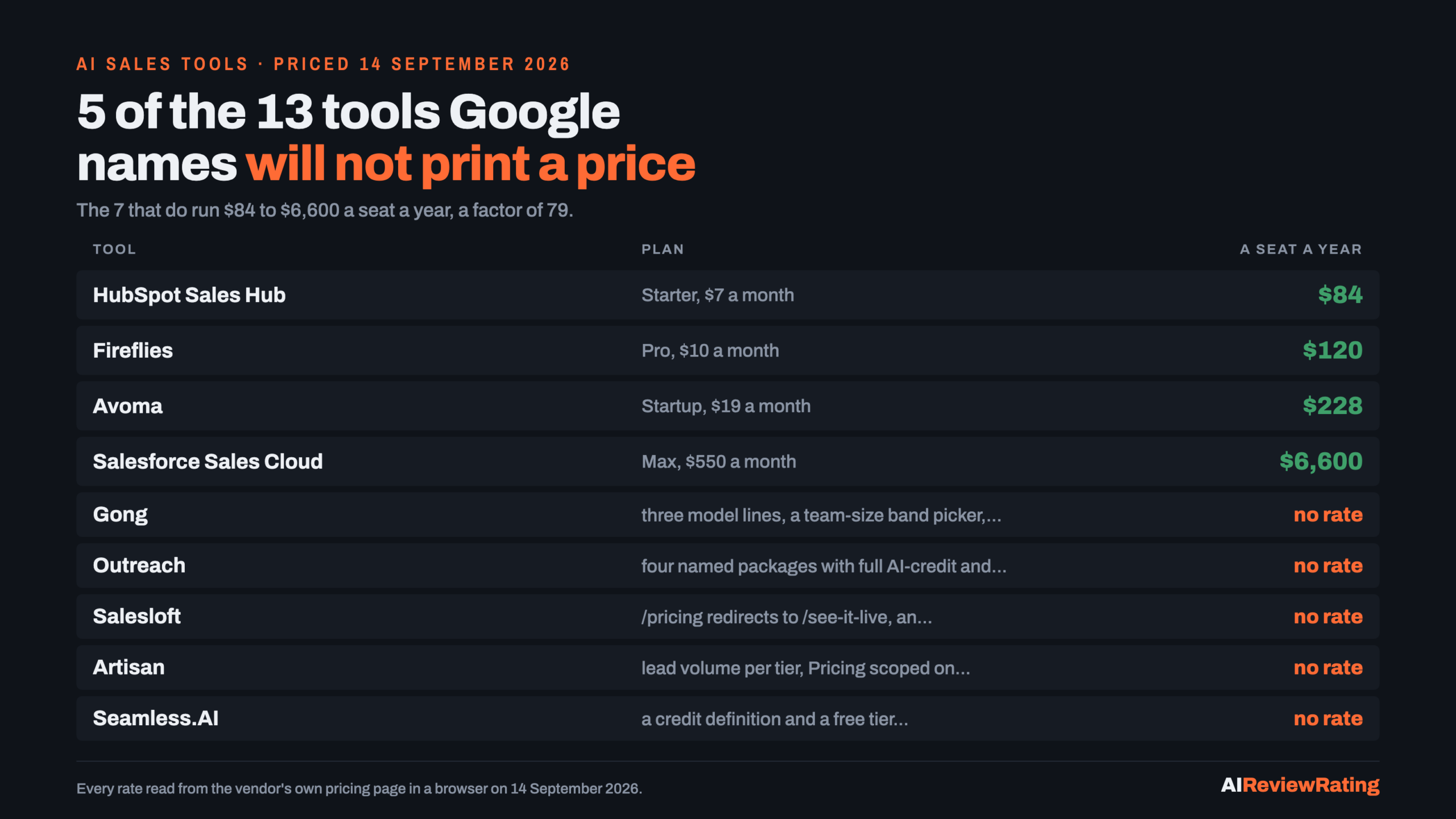
The short answer. Customer acquisition cost is spend divided by customers won, and you cannot fill in the spend for a product that will not tell you its rate. Google’s AI Overview and AI Mode name 13 tools for this query. We opened every one of their pricing pages on 14 September 2026 and recorded a single fact about each: is there a number on it. 7 publish a rate a buyer can act on. 5 publish none. 1 refused our request entirely. Across the 7 that do publish, a paid seat runs from $84 a year on HubSpot Sales Hub Starter to $6,600 a year on Salesforce Sales Cloud Max, a factor of 79.
| Tool | Cheapest paid seat | A year | Billing |
|---|---|---|---|
| HubSpot Sales Hub | Starter, $7 a month | $84 | annual |
| Fireflies | Pro, $10 a month | $120 | annual |
| Avoma | Startup, $19 a month | $228 | annual |
This page is written for a founder or a sales lead at a company under 50 people who has been asked to justify tool spend against pipeline. It does not rank these products on features. It prices them on their own published meters, prints each vendor’s own unit wording beside its number, converts nothing between meters, and says plainly at the end which parts of a real CAC calculation none of these pages lets you complete. None of the tools named here pays us anything.
The census: who prints a number and who does not
Every listicle on this results page writes “Pricing: custom” in a comparison cell and moves on. That cell is the whole decision for a small team, so we made it the table. Each row was opened in a real browser at a 1440 pixel viewport on 14 September 2026, every billing control on the page was operated, and both states were screenshotted. A page that refused our request is recorded as refused, which is a different fact from a page with no price on it.
| Tool | Named by | Prints a rate | What the page gives instead |
|---|---|---|---|
| Gong | AI Overview | No | three model lines, a team-size band picker, then a lead form |
| Outreach | AI Mode | No | four named packages with full AI-credit and API-call allowances, Request pricing on every one |
| Salesloft | AI Mode | No | /pricing redirects to /see-it-live, an email capture and a three step demo flow |
| Artisan | AI Mode | No | lead volume per tier, Pricing scoped on your plan, Talk to sales |
| Seamless.AI | AI Mode | No | a credit definition and a free tier allowance, Contact sales on every paid tier |
| ZoomInfo | AI Overview | Could not read | HTTP 403 to a rendered browser and to a plain request |
| Salesforce Sales Cloud | AI Overview | Yes | six editions, $0 to $550 per user per month |
| Apollo.io | both | Yes | four plans with a credit allowance on each, both billing cycles |
| Clay | both | Yes | four plans on two meters, actions and data credits |
| Fireflies | AI Overview | Yes | four tiers per seat, both billing cycles |
| Avoma | AI Overview | Yes | three tiers per recorder seat plus three priced add-ons |
| HubSpot Sales Hub | AI Overview | Yes | four tiers per seat, a credit allowance and a top-up rate |
| Lindy | AI Mode | Yes | three tiers per user with a credit allowance on each |
The split is not random. Every one of the 5 that prints no rate is an enterprise platform sold by a sales team, and the tool Google’s AI Overview leads its answer with, Gong, publishes nothing but a team-size band and a form. An assistant recommending it cannot know what it costs either, because the number is not on the public web.
What a seat costs a year on the 7 that publish
A monthly headline price is not comparable across these products, because some of them quote the annual-billing rate and some quote the month-to-month rate, and 3 of them open on the annual view without saying so above the fold. So every plan below is reduced to a single figure: the lowest rate that plan publishes, multiplied by 12. Where a plan is sold annual-only, that is noted rather than converted.
| Tool | Plan | Best published rate | A seat a year | What it includes |
|---|---|---|---|---|
| HubSpot Sales Hub | Starter | $7 a month, annual | $84 | 500 HubSpot Credits |
| Fireflies | Pro | $10 a month, annual | $120 | 20 AI credits, 8,000 storage minutes a seat |
| Fireflies | Business | $19 a month, annual | $228 | 30 AI credits, unlimited storage |
| Avoma | Startup | $19 a month, annual | $228 | recorder seats only, up to 25 paid |
| Salesforce Sales Cloud | Starter Suite | $25 a month, either cycle | $300 | billed monthly or annually at the same rate |
| Avoma | Organization | $29 a month, annual | $348 | recorder seats only, up to 100 paid |
| Lindy | Plus | $29.99 a month, monthly | $359.88 | 3,000 credits a user a month |
| Fireflies | Enterprise | $39 a month, annual | $468 | annual only, 50 AI credits |
| Avoma | Enterprise | $39 a month, annual | $468 | annual only, minimum 10 paid seats |
| Apollo.io | Basic | $49 a month, annual | $588 | 2,500 credits a month, or 30,000 a year granted upfront |
| Apollo.io | Professional | $79 a month, annual | $948 | 4,000 credits a month, or 48,000 a year granted upfront |
| HubSpot Sales Hub | Professional | $90 a month, annual | $1,080 | 3,000 credits, plus a required one-time $1,500 onboarding fee |
| Lindy | Pro | $99.99 a month, monthly | $1,199.88 | 15,000 credits a user a month |
| Salesforce Sales Cloud | Pro Suite | $100 a month, annual | $1,200 | billed annually |
| Apollo.io | Organization | $119 a month, annual | $1,428 | minimum 3 seats, 6,000 credits a month or 72,000 a year |
| HubSpot Sales Hub | Enterprise | $150 a month, annual | $1,800 | 5,000 credits, plus a required one-time $3,500 onboarding fee |
| Salesforce Sales Cloud | Core | $195 a month, annual | $2,340 | billed annually |
| Lindy | Max | $199.99 a month, monthly | $2,399.88 | 35,000 credits a user a month |
| Salesforce Sales Cloud | Advanced | $395 a month, annual | $4,740 | billed annually |
| Salesforce Sales Cloud | Max | $550 a month, annual | $6,600 | billed annually |
The floor and the ceiling are both worth stating out loud. HubSpot Sales Hub Starter at $7 a seat a month on annual billing is $84 a year. Salesforce Sales Cloud Max at $550 is $6,600, a factor of 79. Those are not the same product and nobody should pretend they are, which is the point: a category this wide cannot be shopped on a headline price. Note too that Starter Suite at $25 and Max at $550 are the same vendor on the same page, a 22 times spread inside one company before a second tool is considered.
Six of them have a free tier, and one of those free tiers has a number on it that the paid tiers do not
| Tool | What the free tier gives |
|---|---|
| HubSpot Sales Hub | free for up to 2 users, no credit card |
| Fireflies | free forever, 400 storage minutes a team, 20 AI credits |
| Apollo.io | 75 credits a seat a month, or 900 a seat a year |
| Clay | 500 actions and 100 data credits a month, unlimited seats |
| Salesforce Sales Cloud | Free Suite at $0 a user a month |
| Seamless.AI | 1 user, 50 credits |
Three of these pages open on the cheaper view, and one of them changes the unit at the same time
Clay, Fireflies and Avoma all open on the annual view, which prints the lower monthly-equivalent figure. None of the three opens on the price a buyer pays month to month. That is ordinary, and a reader who clicks the toggle sees it. Clay does something else, and it is the single most misleading card on this results page, without a word on it being untrue.
Clay: a price per month beside an allowance per year
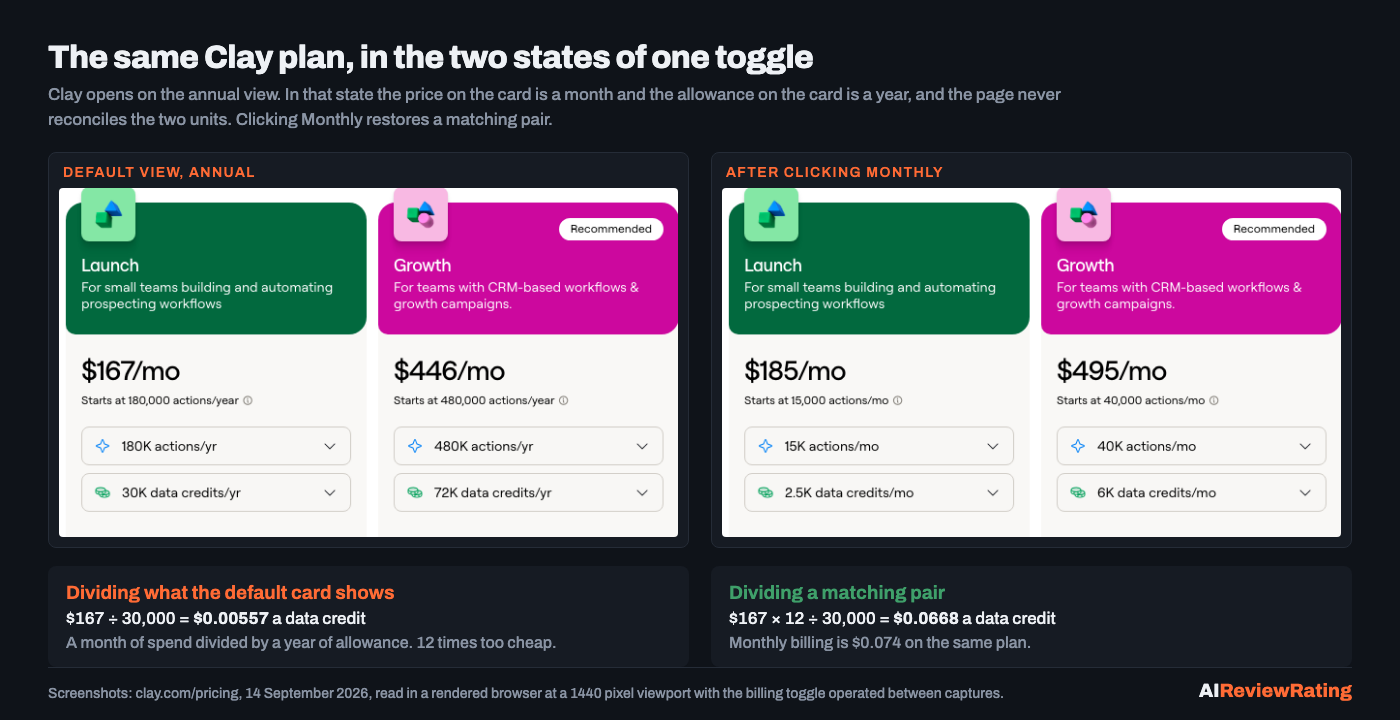
On 14 September 2026 the Clay pricing page opens on “Annual, Save 10%”. In that state the Launch card reads $167/mo and, two lines below it, 30,000 data credits/yr. The price is a month. The allowance is a year. Divide the two numbers a reader can see on one card and the answer is $0.00557 a data credit, which is 12 times too cheap. Click Monthly and the same plan reads $185/mo against 2,500 data credits/mo, which is a real rate.
| Plan | Annual view | Monthly view | Per data credit, annual | Per data credit, monthly |
|---|---|---|---|---|
| Launch | $167/mo, 30,000/yr | $185/mo, 2,500/mo | $0.0668 | $0.074 |
| Growth | $446/mo, 72,000/yr | $495/mo, 6,000/mo | $0.07433 | $0.0825 |
The right hand columns hold a second thing worth knowing before anyone upgrades. Growth costs 11 percent more per data credit than Launch on the same billing cycle, $0.07433 against $0.0668. The bigger plan buys 2.7 times the actions and 2.4 times the data credits for 2.7 times the money, so the actions carry the volume discount and the data credits carry a penalty. That is the same inversion Apollo shows below, at a different vendor on a different meter.
Fireflies and Avoma: the toggle is honest, the default is not the price you pay monthly
Fireflies opens on the annual view with a “Save up to 44%” badge. Pro reads $10 a seat a month there and $18 once the toggle is moved to Monthly, which is the 44 percent the badge promises. Business moves $19 to $29, a 34 percent cut, so the badge figure belongs to one tier only. Enterprise does not move at all: it stays $39 and keeps the words billed annually, because it cannot be bought monthly.
Avoma has the same shape and one extra wrinkle worth a minute of anyone’s time. Three monthly/annual controls render on this page and all three share one state; operating any of them moves every price on the page. Switching to monthly takes Startup from $19 to $29, a 53 percent rise, and Organization from $29 to $39. At that point Organization billed monthly costs exactly what Enterprise costs billed annually, $39 a recorder seat, and the three add-ons rise with it from $29 to $35 apiece.
| Avoma line item | Annual | Monthly | Note |
|---|---|---|---|
| Startup | $19 | $29 | up to 25 paid seats |
| Organization | $29 | $39 | up to 100 paid seats |
| Enterprise | $39 | not sold monthly | minimum 10 paid seats |
| Conversation Intelligence | $29 | $35 | add-on, per seat |
| Revenue Intelligence | $29 | $35 | add-on, per seat |
| Lead Router | $19 | $25 | add-on, per seat |
A credit is not a credit, and 5 of these vendors mean 5 different things by the word
Five of the 7 priced tools sell a credit and none of them sells the same credit. Apollo spends credits on contact data, Lindy on agent work, HubSpot on agent actions, Fireflies on summaries, Clay on marketplace data. The rates below are each vendor’s own meter divided by its own price. Nothing here is converted between meters, because nothing here is convertible between meters.
Apollo: the volume curve runs the wrong way on annual billing
An email is 1 credit, a phone number is 8, an export is 1 to 8, a sequence run is 1, the dialer is 2 a minute, all from Apollo’s own page. Dividing each plan price by the allowance that plan grants gives the table below, printed to five decimals because the finding disappears at four.
| Plan | Billing | Price | Credits | Per credit |
|---|---|---|---|---|
| Basic | monthly | $65 a seat a month | 2,500 a month | $0.026 |
| Basic | annual | $49 a seat a month | 30,000 a year | $0.0196 |
| Professional | monthly | $99 a seat a month | 4,000 a month | $0.02475 |
| Professional | annual | $79 a seat a month | 48,000 a year | $0.01975 |
| Organization (min 3 seats) | monthly | $149 a seat a month | 6,000 a month | $0.02483 |
| Organization (min 3 seats) | annual | $119 a seat a month | 72,000 a year | $0.01983 |
On annual billing the cheapest paid plan is also the cheapest per credit, and every step up is dearer per credit than the step below it: $0.0196 on Basic, $0.01975 on Professional, $0.01983 on Organization. Buying more from Apollo on an annual contract carries a volume penalty of 1.2 percent from bottom to top, not a volume discount. The reason to move up a tier is the feature list and the seat minimum, and it is worth being clear with yourself that it is not the unit price.
Seamless defines a unit and will not price it. Apollo prices the same unit.
Seamless.AI’s pricing page carries the line “1 Credits = Phone + Email” and then says Contact sales on both paid tiers. That unit is buyable elsewhere: on Apollo an email is 1 credit and a phone number is 8, so the thing Seamless calls one credit is 9 Apollo credits. On Professional annual that is $0.17775 for a contact you can both email and call, and $0.22275 on monthly billing. Seamless may well be cheaper. There is no way to find out from its pricing page.
Lindy: the only published volume discount on this roster
| Plan | Price a user a month | Credits a user a month | Per credit |
|---|---|---|---|
| Plus | $29.99 | 3,000 | $0.01 |
| Pro | $99.99 | 15,000 | $0.00667 |
| Max | $199.99 | 35,000 | $0.00571 |
Plus to Max cuts the credit rate by 43 percent, which is the only genuine volume curve among the priced tools here. Lindy also publishes what a credit buys, in three bands: Everyday Asks at 2 to 250 credits, Deep work at 250 to 1,000 credits, Big Builds at 1,000 to 2,500 credits. At $0.01 a credit on Plus, the top of the Big Builds band is $24.99 of credit for one piece of work.
HubSpot: the one vendor that publishes both a bundle and the price of the same unit sold loose
$9.00 per 1,000 credits when you pay annually, printed on the same page. That rate values every bundled allowance on the page, which no other vendor here makes possible.
| Plan | A seat a year | Credits included | Those credits at the top-up rate | Required onboarding | First year, one seat |
|---|---|---|---|---|---|
| Starter | $84 | 500 | $4.50 | none | $84 |
| Professional | $1,080 | 3,000 | $27 | $1,500 | $2,580 |
| Enterprise | $1,800 | 5,000 | $45 | $3,500 | $5,300 |
Two things fall out of that table. The credits bundled into Starter are worth $4.50 against an $84 seat year, so they are a rounding error and not a reason to choose a tier. And the onboarding fee is not optional: HubSpot’s own footnote says the cost shown does not include the required one-time onboarding, $1,500 on Professional and $3,500 on Enterprise. For a three seat team on Professional, that fee is 46 percent on top of the first year and it appears in no comparison table on this results page.
The banner across the top of the same page offers Revenue Hub Professional at $57 a seat a month, was $95, or Enterprise at $98, was $140, billed annually. It applies to new Sales Hub and Revenue Hub customers only and carries no published end date, so it is a conditional promotion rather than a price. Quoting the $57 without the condition, which several pages on this results page do, is wrong.
Fireflies: the paid tier that adds no credits
Fireflies sells AI credits too, 20 on Free, 20 on Pro, 30 on Business and 50 on Enterprise. Pro grants exactly the same 20 credits as the free tier. What $10 a seat a month buys is the storage and the unlimited summaries, 8,000 minutes a seat against 400 minutes a team, not more AI credit. That is a fair deal and it is not the deal the credit line implies.
The 5 that print no rate, and the 5 different ways they do it
Outreach publishes the whole denominator and none of the numerator
Of the five, Outreach is the most interesting, because it is not hiding the shape of the deal at all. outreach.io/pricing resolves to outreach.ai/pricing, which describes the model as “a combination of seat-based pricing and consumption-based pricing powered by AI credits” and then prints a full four tier allowance ladder with request pricing on every package.
| Package | AI credits | API calls | Custom objects | Knowledge |
|---|---|---|---|---|
| Amplify Essentials | 10,000 | 250,000 | 5 | 500 MB |
| Amplify Core | 25,000 | not rendered | not rendered | not rendered |
| Amplify Plus | 50,000 | 500,000 | 10 | 750 MB |
| Amplify Pro | 100,000 | 1,000,000 | 20 | 1,500 MB |
Set that beside Lindy, which prints 3,000 to 35,000 credits a user a month with a price on each. The two vendors are selling the same unit type and only one of them lets you divide.
Gong states the model in three lines and stops
- Licenses are priced per user
- There is a platform fee based on the number of users supported
- You can integrate your existing tech stack for free.
The only input on the page is one team-size band: 1-50, 51-1,000, 1,001-9,999, 10,000+. There is no rate, no allowance and no worked example. The page does carry third-party rating badges, 4.8 from Gartner and 9.2 from TrustRadius, and a third from a review directory this site does not cite. Those are described here because they are on the page, not offered as evidence.
Salesloft does not have a pricing page
salesloft.com/pricing redirects to salesloft.com/see-it-live, whose only interactive element is a business email capture followed by a three step flow: Quick intro call, Tailored walkthrough, Follow up. The page carries 3 performance claims set in large type: 3x FASTER ROI; 12+ hrs SAVED PER REP, WEEKLY; 40% MORE SELLING ACTIVITY. None of the 3 cites a study, a sample or a date. They are reported here as vendor claims and are not used in any calculation on this page.
Artisan publishes a volume and no price, which is the mirror of Seamless
| Tier | Leads contacted a month | Price |
|---|---|---|
| Team | about 2,500 | Pricing scoped on your plan |
| Scale | about 6,000 | Talk to sales |
| Enterprise | custom volume | Flexible plans |
Artisan is the only tool here that publishes a lead volume per tier, which is the denominator a cost per lead needs, and withholds the numerator. Seamless.AI does the opposite on its free tier and withholds both on its paid ones. Neither lets a buyer compute a cost per lead from a primary source.
What you can compute from these pages, and what you cannot
Everything above is arithmetic on published rows. Here is the line where that stops.
| Question | Answerable from a primary? | Why |
|---|---|---|
| Annual cost of a seat | Yes, on 7 of 13 | the published rate times 12, on both cycles |
| Cost per credit or action | Yes, on 5 of 13 | the vendor prints the allowance beside the price |
| First year cost including setup | Yes, on HubSpot only | the only vendor here that publishes a mandatory onboarding fee |
| Cost per lead contacted | No | Artisan publishes the volume and no price; nobody publishes both |
| Cost per meeting booked | No | no vendor publishes a booking rate with a methodology, and we have not measured one |
| Customer acquisition cost | No | CAC needs won customers, which depends on your motion and not on the tool |
We are not going to publish a cost per meeting or a CAC for these tools. We have not run them on a sales motion, no vendor here publishes a booking rate with a sample size and a date, and a number invented for a table is worse than an empty cell. What a buyer can do with this page is fix the spend side exactly, then divide by their own won deals, which is the only half of the equation that was ever going to come from a web page.
How these pages were read, and the mistake we had been making
Every row was read in a rendered browser at a 1440 pixel viewport on 14 September 2026, with each billing control clicked and both states captured as images. Prices are taken from painted pixels rather than from page text, because a walk of the DOM that keeps every element with a non-zero box still returns both billing states at once on Fireflies, because the hidden card is translated rather than removed. Only a screenshot settled it.
Salesforce was recorded as blocked twice, and it was not blocked. Our 7 September 2026 sprint listed Salesforce Sales Cloud as not captured and a re-read on 11 September 2026 listed it as HTTP 403. On 14 September 2026 the same URL returned HTTP 403 to a headless browser and HTTP 200 to a plain request carrying the identical user agent string. The refusal was aimed at the browser fingerprint, not at us, and both earlier reads used only the browser. Recovering it moved the census from 6 published prices to 7 and removed the uncaptured row entirely. ZoomInfo, for contrast, returns HTTP 403 to both methods, so it stays in the blocked column, which is a statement about our access and not about its pricing.
That rule generalises and it is now how this desk works: a single failed fetch is a property of one client, not a property of the page. Two clients disagree far more often than a vendor changes its mind.
Who Google is citing for this question
Across both of Google’s AI surfaces for “best ai sales tools” on 7 September 2026, the most cited vendor domain was lindy.ai with 3 citations, and the most cited domain of any kind was YouTube with 5. That is the same shape we found on the lead generation query: video outweighs every written source, and a vendor being compared is among the sources doing the comparing.
Two further things about this results page. Organic position 1 is a Reddit thread in r/MarketingAutomation. reddit.com returns HTTP 403 to anonymous reads, so it is cited and not quoted. And the Discussions and forums block, which Google returned three of for the lead generation query the day before, returned no Discussions and forums block at all, unlike the lead generation query the day before, which returned three.
The 7 that publish, one at a time
Apollo.io
Contact data and sequencing, priced per seat with a credit meter on top. $49 to $119 a seat a month on annual billing, $65 to $149 monthly, with a 3 seat minimum on the top tier. The credit rate is flat to within 1.2 percent across the whole ladder, so the tier choice is a feature choice. Free tier: 75 credits a seat a month, or 900 a seat a year.
Clay
A spreadsheet that runs enrichment waterfalls, priced on two meters at once and sold with unlimited seats on every tier including Free. $167 to $446 a month on annual billing, $185 to $495 monthly. Read the unit on the card before dividing, for the reason set out above.
Fireflies
Meeting transcription and summaries, $10 to $39 a seat a month annually and $18 to $29 monthly, with Enterprise sold annual-only. The free tier is genuinely usable at 400 minutes a team. On our own site Fireflies is filed under Productivity rather than Sales, which is a catalogue problem on our end and not a judgement about the product.
Avoma
The one pricing idea on this roster worth copying: only recorder seats are billed, viewers and collaborators are always free. $19 to $39 a recorder seat a month annually, with three add-ons at $19 to $29 each. A 14 day free trial of the Organization plan runs with all add-ons enabled. Avoma has no review page on this site yet, so it is named here without a link.
HubSpot Sales Hub
The cheapest published seat in this entire census at $7 a month on annual billing, $84 a year, and free for up to 2 users below that. Budget the onboarding fee on the upper tiers. Our catalogue holds a HubSpot Breeze page, which is a different product, so Sales Hub is named here without a link rather than sent to the wrong review.
Lindy
Agent automation billed per user with a pooled credit balance. $29.99 to $199.99 a user a month, the only published volume discount here at 43 percent bottom to top. Lindy pauses and tells you rather than overbilling when the pool runs low, and admins can set an allocation per seat. On our site Lindy is filed under AI Agents rather than Sales.
Salesforce Sales Cloud
| Edition | A user a month | A user a year | Billing |
|---|---|---|---|
| Free Suite | $0 | $0 | free |
| Starter Suite | $25 | $300 | billed monthly or annually |
| Pro Suite | $100 | $1,200 | billed annually |
| Core | $195 | $2,340 | billed annually |
| Advanced | $395 | $4,740 | billed annually |
| Max | $550 | $6,600 | billed annually |
Starter Suite is the only Salesforce edition sold monthly at the same rate as annually. Everything above it is annual. Salesforce has no review page on this site.
How we test
Every price on this page was read from the vendor’s own pricing page on 14 September 2026, in a browser, with the billing controls operated and both states saved as images. No price here comes from a review directory, an affiliate page or another comparison article. Where a page would not render a figure, the cell says not rendered. Where a server refused us, the cell says so and names the status code. Anything we could not verify was cut rather than hedged, and the cuts are listed on this page rather than left out of it. Our lead generation pricing work uses the same method on a different meter.
What we cut from this page
- Any CAC or cost per meeting figure for a customer other than us. We have not run these tools on a sales motion and will not publish a rate we did not measure.
- Every conversion, reply and meetings-booked claim printed on these vendor pages. All of them are unsourced on the page.
- ZoomInfo, in full. HTTP 403 to both a browser and a plain request is a block, not an absence of a price.
- Amplify Core’s API call, custom object and knowledge allowances, which do not render on the Outreach page.
- Clay’s two slider base rates, which render in both billing states at once and cannot be attributed to one of them from this capture.
- The 275 million and 250M+ contact-count claims from Apollo and Artisan. Neither carries a methodology or a date.
Questions people ask about this
How much does Gong cost?
Gong does not publish a rate. Its pricing page, read on 14 September 2026, gives three lines of model description and a team-size band picker with four options, then a lead form. It states that licenses are priced per user and that there is a platform fee based on the number of users supported, and it names no figure for either. Anyone quoting a Gong per-seat price is quoting a deal they saw, not a published rate.
Which AI sales tool has the cheapest seat?
Of the 7 tools in this roster that publish a rate, HubSpot Sales Hub Starter is the cheapest paid seat at $7 a month on annual billing, which is $84 a year. Budget the required onboarding fee if you move above that tier: $1,500 one time on Professional. The most expensive published seat is Salesforce Sales Cloud Max at $6,600 a year, a factor of 79 apart.
Are there free AI sales tools?
6 of the 13 tools here publish a free tier. HubSpot Sales Hub: free for up to 2 users, no credit card. Fireflies: free forever, 400 storage minutes a team, 20 AI credits. Apollo.io: 75 credits a seat a month, or 900 a seat a year. Clay: 500 actions and 100 data credits a month, unlimited seats. Salesforce Sales Cloud: Free Suite at $0 a user a month. Seamless.AI: 1 user, 50 credits. Read on 14 September 2026. The free tiers are real products rather than trials, with the exception of Avoma, whose free offer is a 14 day trial of a paid plan.
Why do enterprise sales tools hide their pricing?
The census above splits cleanly: all 5 tools that publish no rate are platforms sold through a sales team, and all 7 that do publish sell at least one tier a buyer can put on a card. The published reason, on Outreach’s page, is that the model combines seats with consumption, which is true and does not prevent printing a seat rate. The practical effect is that a small team cannot compare the two halves of the category on cost at all.
How do I work out CAC for a sales tool?
Fix the spend side from the tables above, then divide by the customers your own motion won in the same period. The spend side is seats times the annual rate, plus any mandatory onboarding fee, plus any credit or action overage above the bundled allowance. No page on this results page, ours included, can supply the denominator, because won customers depend on your list, your offer and your reps rather than on the tool. Treat any published cost per meeting for a tool you have not run as marketing.
Apollo or Clay for a two person team?
They are not the same purchase. Apollo sells seats with contact credits: $79 a seat a month annually on Professional, so two seats is $1,896 a year. Clay sells unlimited seats and charges for the work: $167 a month annually on Launch, $2,004 a year regardless of headcount. Below roughly three people Apollo is cheaper; the crossover moves with how much enrichment you actually run.
What does one contact with an email and a phone number cost?
On Apollo, which publishes the meter, an email is 1 credit and a phone number is 8, so a contact you can both email and call is 9 credits. At the Professional annual rate of $0.01975 a credit that is $0.17775, and $0.22275 on monthly billing. Seamless.AI defines the identical unit on its own page, one credit for a phone plus an email, and prices it nowhere.
Do these pricing pages show the monthly price by default?
Three of them do not. Clay, Fireflies and Avoma all open on the annual view, which prints the lower monthly-equivalent figure. Clay goes further and changes the allowance period at the same time: in its default state the Launch card shows $167 a month beside 30,000 data credits a year, and dividing the two numbers on the card gives a rate 12 times too cheap. Click Monthly before you compare anything.
Related reading on this site
- Best AI lead generation tools, priced per enriched contact: the same division on Apollo, Clay and Instantly, from $0.0248 a credit.
- Best AI SEO tools, priced per tracked AI prompt: 30 plans from 8 vendors and a spread of 827 to 1.
- Open source web scrapers for lead lists: cost per 1,000 pages, and the 4 licences that decide whether you can sell the output.
- Best AI note takers, priced per year: the meeting recorder half of this roster, in more depth.
- HyNote review: 1,200 transcription minutes a month at $79.99 a year, for comparison with the seat-priced meeting recorders in this roster. HyNote is our pick and we earn a commission if you subscribe through our link.
- MCP servers for web scraping, priced per 1,000 pages: the web-data step before outreach, priced per 1,000 pages.
Sources
- Gong pricing: gong.io/pricing, read on 14 September 2026.
- Outreach pricing: outreach.io/pricing, read on 14 September 2026.
- Salesloft pricing: salesloft.com/pricing, read on 14 September 2026.
- Artisan pricing: artisan.co/pricing, read on 14 September 2026.
- Seamless.AI pricing: seamless.ai/pricing, read on 14 September 2026.
- ZoomInfo pricing: zoominfo.com/pricing, read on 14 September 2026.
- Salesforce Sales Cloud pricing: salesforce.com/sales/pricing, read on 14 September 2026.
- Apollo.io pricing: apollo.io/pricing, read on 14 September 2026.
- Clay pricing: clay.com/pricing, read on 14 September 2026.
- Fireflies pricing: fireflies.ai/pricing, read on 14 September 2026.
- Avoma pricing: avoma.com/pricing, read on 14 September 2026.
- HubSpot Sales Hub pricing: hubspot.com/pricing/sales, read on 14 September 2026.
- Lindy pricing: lindy.ai/pricing, read on 14 September 2026.
- Google AI Overview, AI Mode, People Also Ask and the organic results for “best ai sales tools”, captured 7 September 2026.
1 comment
Sign in to join the discussion.
Login to comment