The short answer
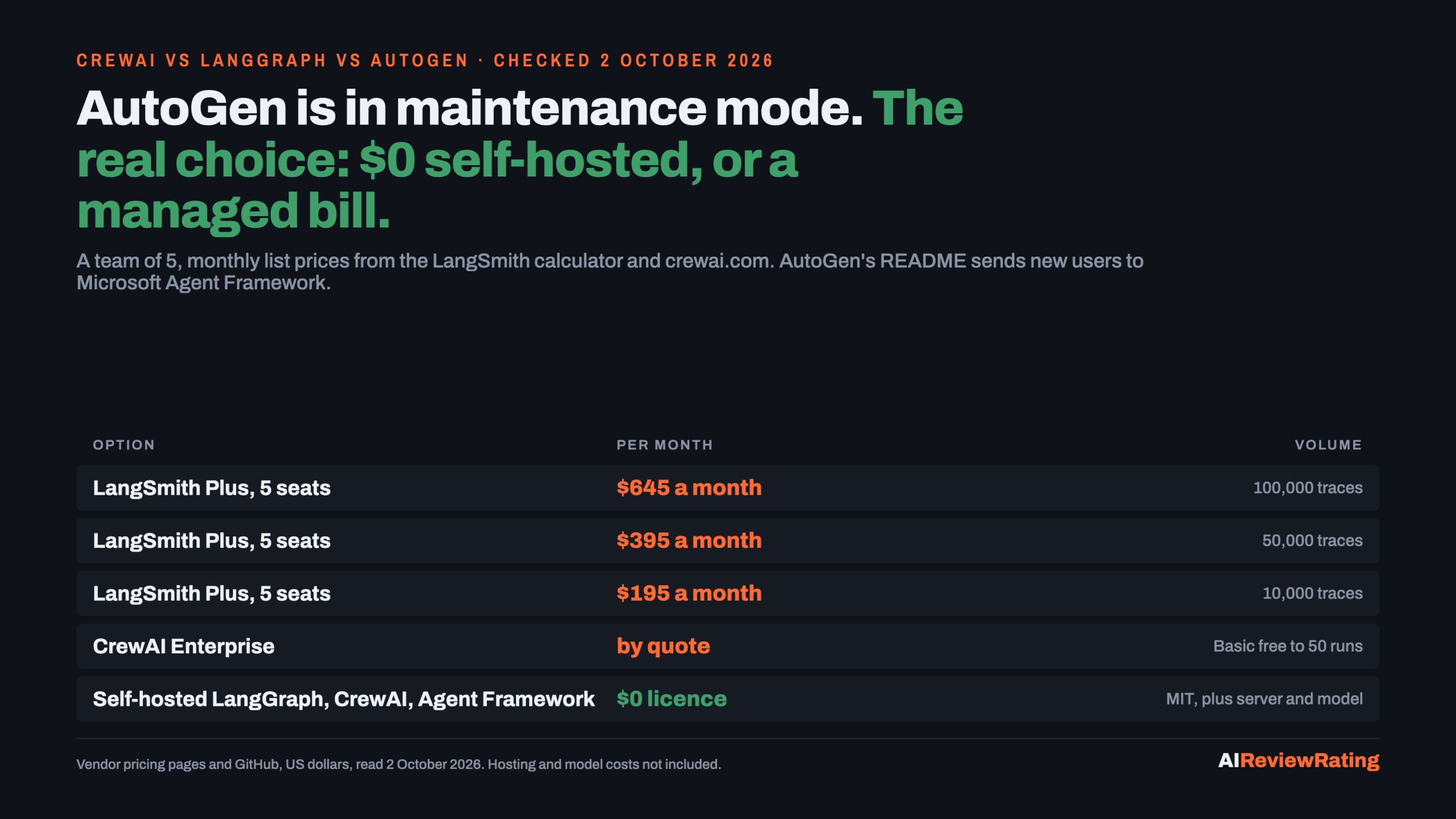
Short answer, checked on 2 October 2026: for a development team starting an agent project, the choice is no longer three-way. AutoGen‘s own README says it is in maintenance mode and sends new users to Microsoft Agent Framework. So pick LangGraph for tight, stateful control, CrewAI for role-based agent teams, or Microsoft Agent Framework if you work in .NET or are moving off AutoGen. All of them are MIT licensed and cost $0 to self-host. The money question is the managed platform each one leads to: LangSmith, the LangChain team’s hosted platform for LangGraph, costs a team of 5 $195 a month at 10,000 traces and $645 at 100,000 traces by its own calculator, while CrewAI publishes no paid self-serve price beyond a free plan of 50 executions a month.
| Framework | Status on 2 October 2026 | Licence | Managed platform price |
|---|---|---|---|
| AutoGen | Maintenance mode | MIT (code) | None listed in its README |
| LangGraph | Active | MIT | LangSmith: $195 to $645 a month for 5 seats |
| CrewAI | Active | MIT | $0 for 50 executions a month, then Enterprise by quote |
| Microsoft Agent Framework | Active, AutoGen’s successor | MIT | No Microsoft price read for this page |
What Google’s answer leaves out
When we captured Google’s AI Overview for this exact search on 28 September 2026, it called the three “the three main frameworks used to build multi-agent AI systems” and advised: “Choose AutoGen if your task relies heavily on writing and executing code iteratively.” It said nothing about AutoGen’s status. AutoGen’s README, read on 2 October 2026, opens with a caution box: “AutoGen is now in maintenance mode.” It goes on to say AutoGen “will not receive new features or enhancements and is community managed going forward”, and that new users should start with Microsoft Agent Framework.
The GitHub record agrees. AutoGen’s last release, python-v0.7.5, came out on 30 September 2025, 367 days before our check, and its last push was on 15 April 2026, 170 days before. The README now limits contributions to bug fixes, security patches, and documentation improvements. For a team deciding where to spend months of build time, that is the fact that matters most, and it is the one Google’s summary skipped.
The four repositories, side by side
Ordered by GitHub stars on 2 October 2026. Stars measure attention, not quality: AutoGen still has the 61,252 it collected before maintenance mode. Look at the release and push dates for the real signal.
| Framework | What it is | GitHub stars | Licence | Latest release | Last push | Status |
|---|---|---|---|---|---|---|
| AutoGen | multi-agent conversations: two-agent chat and group chats | 61,252 | MIT (code) | python-v0.7.5, 30 September 2025 | 15 April 2026 | Maintenance mode: fixes only, no new features |
| CrewAI | role-based agent teams (Crews) plus event-driven Flows | 59,282 | MIT | 1.15.23, 28 September 2026 | 1 October 2026 | Active |
| LangGraph | low-level graph orchestration for stateful agents | 42,600 | MIT | 1.2.12, 21 September 2026 | 2 October 2026 | Active |
| Microsoft Agent Framework | graph workflows for agents in Python and .NET | 13,905 | MIT | Python 1.19.0, 18 September 2026; .NET 1.23.0, 1 October 2026 | 2 October 2026 | Active, AutoGen’s named successor |
AutoGen: keep it running, do not start on it
AutoGen came out of Microsoft Research and is built in layers: Core API (message passing, event-driven agents), AgentChat API (two-agent chat, group chats), Extensions API (model clients, code execution). The README says existing users can continue to use it. What changes is the future: no new features, community management, and a README that calls Microsoft Agent Framework “enterprise-ready successor to AutoGen”. It also describes Agent Framework 1.0 as a production-ready release with stable APIs and a commitment to long-term support.
If you have AutoGen in production, Microsoft publishes a migration guide from AutoGen to Agent Framework. If you were going to use AutoGen Studio as a front end, note the README’s own warning that it is “not meant to be a production-ready app”.
Microsoft Agent Framework, the successor (13,905 stars)
Microsoft Agent Framework supports .NET and Python, Go SDK in a separate repository. Its README lists graph-based workflows: sequential, concurrent, handoff and group collaboration, with checkpointing, streaming, human-in-the-loop and time-travel. It shipped Python 1.19.0 on 18 September 2026 and .NET 1.23.0 on 1 October 2026. We have no review page for it yet, so the link goes to its GitHub repository. It covers .NET as well as Python, which matters if your team works in C#.
LangGraph: control and state (42,600 stars)
LangGraph describes itself as a “Low-level orchestration framework for building stateful agents”. You draw the agent as a graph, and the README lists durable execution, human-in-the-loop, comprehensive memory, debugging with LangSmith, deployment as what you get. That suits a team that has to explain every step an agent took, pause for a human sign-off, or resume a long run after a crash. It is built by the LangChain team: we do not have a LangGraph review page yet, so its parent project, LangChain (147,375 stars), carries the score box below. LangGraph can be used standalone, without the rest of LangChain.
CrewAI: agent teams by role (59,282 stars)
CrewAI gives you two building blocks. Crews are role-based AI agents working together with autonomy; Flows are event-driven automations with precise workflow control, with native support for Crews. If your problem reads like a job description, for example a researcher, a writer and an editor handing work along, Crews map onto it directly. CrewAI shipped 1.15.23 on 28 September 2026, so it is moving quickly.
The managed bill each choice leads to
The frameworks are free. The bill arrives when you want hosted tracing, evaluation and deployment, and here the vendors differ sharply in how much they publish.
LangSmith (for LangGraph): priced in public, per seat plus usage
LangSmith Developer is $0 for 1 seat with up to 5,000 base traces a month. Plus is $39 per seat a month and includes 10,000 base traces a month, then each extra trace costs 0.005 LangChain Standard Units (LSU), at $1 per LSU. Plus also includes 1 free Serverless (Small) deployment. Rather than multiply those rates ourselves, we set the calculator on LangChain’s pricing page to 5 seats and read its totals:
| Traces a month | 5 seats | Usage on top | Monthly total | Per year |
|---|---|---|---|---|
| 10,000 | $195 | $0 | $195 | $2,340 |
| 50,000 | $195 | $200 | $395 | $4,740 |
| 100,000 | $195 | $450 | $645 | $7,740 |
Enterprise is custom pricing and is where LangSmith lists self-hosted and hybrid deployment options. Deployment beyond the free one is metered, for example runtime compute at 0.0675 LSU per vCPU-hour.
CrewAI’s platform: free to start, then a sales call
CrewAI’s Basic plan is $0 a month with 50 workflow executions and 2 automations. Enterprise is “Custom” and can be deployed on CrewAI cloud, your own VPC, or your own infrastructure. There is no published tier in between, so the spend a self-hosted CrewAI avoids cannot be computed from public prices. Budget for a quote if your team will outgrow 50 runs a month on the hosted platform.
AutoGen and Agent Framework
AutoGen’s README lists no hosted AutoGen plan. Agent Framework’s README names Microsoft Foundry and Azure OpenAI among the services it works with, but we did not read a Microsoft price for this page, so we quote none.
Which one should your team pick?
- You need auditability, human approval steps or long runs that survive failures: LangGraph. Plan for LangSmith if you want hosted traces, from $195 a month for 5 people.
- Your workflow is a team of specialists passing work along: CrewAI. Self-host the MIT framework; the hosted plan is free up to 50 executions a month.
- You are a .NET shop, or you have AutoGen code to move: Microsoft Agent Framework, with Microsoft’s migration guide.
- You are about to start on AutoGen: do not. Its README says it will not receive new features.
What self-hosting does not remove
- The model. Every framework here calls a model through an API key or a local runner. Our break-even for self-hosting a model shows when running it yourself beats paying per token.
- The server and the tracing. We did not price hosting for this page. Without a hosted platform you also run your own logging and evaluation.
- Retrieval. Most business agents read documents. Our RAG framework comparison covers that layer.
How we checked
Stars, release dates, push dates and archive status come from the GitHub REST API on 2 October 2026, and the status and licence wording from each repository’s README and licence files the same day. LangSmith and CrewAI prices were read on the vendors’ own pricing pages in a rendered browser, and the LangSmith team totals are the figures its own calculator returned for 5 seats. The Google AI Overview quote is from our capture on 28 September 2026. We did not benchmark speed or token use, and we quote no third-party comparison tables. Scores in the boxes come from our desk review rubric, which this article does not change. For more self-hostable tools, see our open source AI tools list.
Related reading on this site
- RAG frameworks compared: the retrieval layer most agents sit on.
- Self-hosting an LLM against paying per token: the model half of a self-hosted agent’s bill.
- Open source alternatives to paid AI tools: the same cost test applied to other paid AI tools.
- Open source AI tools you can self-host: what self-hostable repositories replace, tool by tool.
Questions people ask about CrewAI, LangGraph and AutoGen
Is AutoGen better than CrewAI?
For a new project in October 2026, no. AutoGen’s README says it is in maintenance mode and will not receive new features; its last release was python-v0.7.5 on 30 September 2025. CrewAI released 1.15.23 on 28 September 2026. If you liked AutoGen’s approach, Microsoft points you to Microsoft Agent Framework instead. Checked 2 October 2026.
Is AutoGen better than LangChain?
For new work, AutoGen’s own README answers it: maintenance mode, no new features. LangChain’s agent orchestration library, LangGraph, had a push on 2 October 2026 and released 1.2.12 on 21 September 2026. Both are MIT licensed. Checked 2 October 2026.
Which AI agent is considered the best?
There is no single winner. By GitHub stars on 2 October 2026: AutoGen 61,252 (but in maintenance mode), CrewAI 59,282, LangGraph 42,600 and Microsoft Agent Framework 13,905. Choose LangGraph for control, CrewAI for role-based teams, Agent Framework for .NET.
Is AutoGen still maintained?
Only for fixes. As of 2 October 2026 its README says AutoGen is in maintenance mode, community managed, and accepts bug fixes, security patches, and documentation improvements. Its last push was on 15 April 2026.
Is LangGraph free?
Yes. LangGraph is MIT licensed and free to self-host. The paid part is LangSmith, its hosted platform: Developer is $0 for one seat, Plus is $39 per seat a month plus usage, read on 2 October 2026.
Is CrewAI free?
The framework is MIT licensed and free. CrewAI’s hosted platform has a Basic plan at $0 a month with 50 workflow executions; Enterprise is priced by quote. Read on 2 October 2026.
How much does LangSmith cost for a team?
By LangChain’s own calculator on 2 October 2026, 5 seats of LangSmith Plus cost $195 a month with 10,000 traces, $395 with 50,000 and $645 with 100,000. Each extra trace beyond the included 10,000 is 0.005 LSU at $1 per LSU.
Sources
- GitHub REST API, langchain-ai/langgraph, read 2 October 2026.
- GitHub REST API, crewAIInc/crewAI, read 2 October 2026.
- GitHub REST API, microsoft/autogen, read 2 October 2026.
- GitHub REST API, microsoft/agent-framework, read 2 October 2026.
- GitHub REST API, langchain-ai/langchain, read 2 October 2026.
- LangGraph releases on GitHub, read 2 October 2026.
- CrewAI releases on GitHub, read 2 October 2026.
- AutoGen releases on GitHub, read 2 October 2026.
- Microsoft Agent Framework releases on GitHub, read 2 October 2026.
- AutoGen README (microsoft/autogen), read 2 October 2026.
- AutoGen LICENSE-CODE, read 2 October 2026.
- Microsoft Learn: migrating from AutoGen to Microsoft Agent Framework, read 2 October 2026.
- Microsoft Agent Framework README, read 2 October 2026.
- LangGraph README, read 2 October 2026.
- CrewAI README, read 2 October 2026.
- LangSmith pricing (langchain.com), read 2 October 2026.
- CrewAI pricing, read 2 October 2026.
- Google results for “crewai vs langgraph vs autogen” (our SerpAPI capture), read 28 September 2026.
Comments
Sign in to join the discussion.
Login to comment