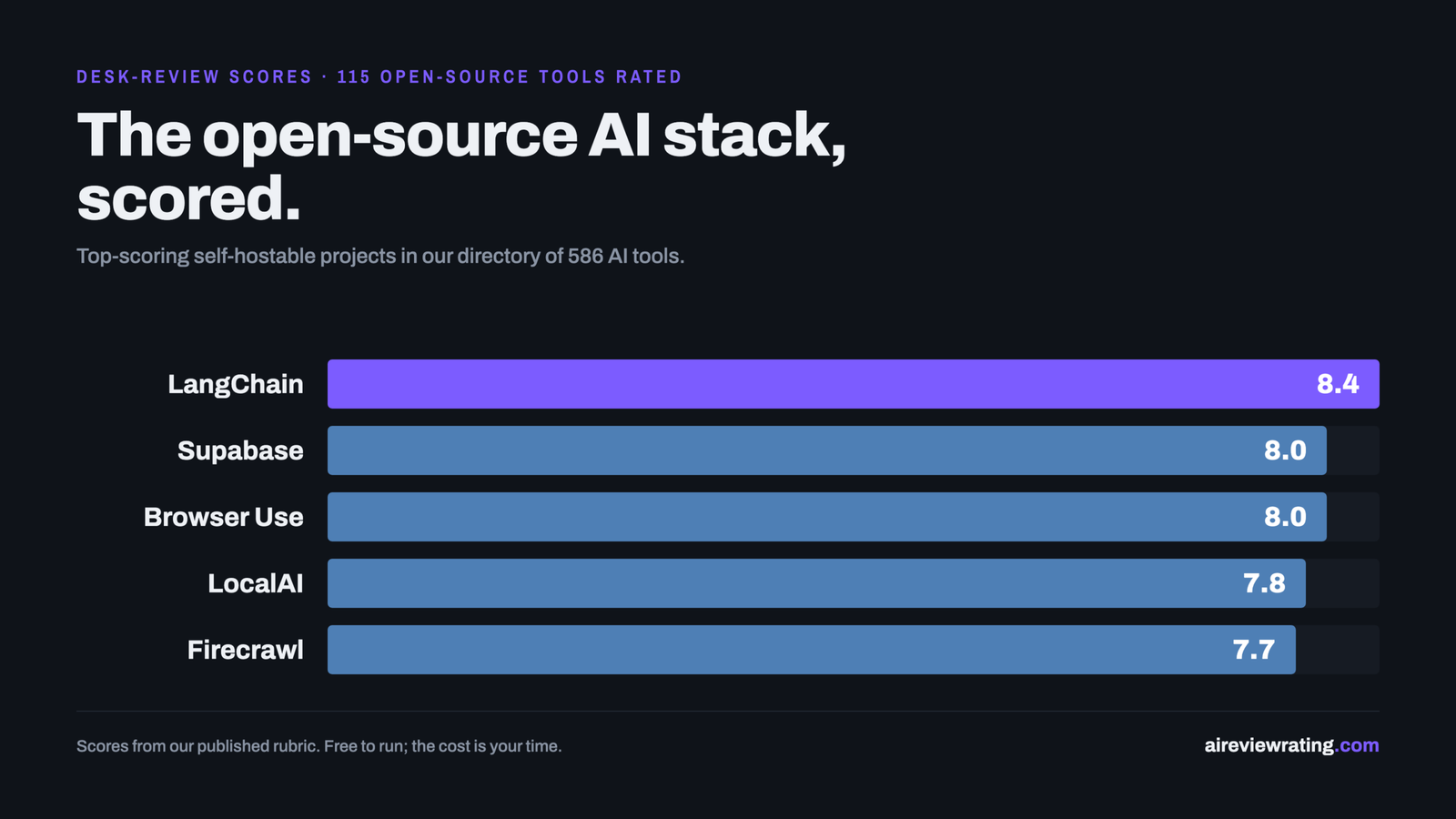
Short answer: the open-source AI stack is now good enough that self-hosting is a cost decision rather than a compromise. The tools below are the highest-scoring open-source projects in our directory of 586 AI tools, and each one is listed with the paid product it displaces and roughly what that displacement is worth per month.
The only question that matters: what does it replace?
“Open source” is not a benefit by itself. Nobody self-hosts for ideology when they are running a business. The benefit is arithmetic: a subscription you stop paying, minus the time you spend running the thing yourself.
That second term is the one every listicle omits. Self-hosting is not free, it is differently expensive. You are trading a predictable monthly invoice for setup time, a server, and being your own support desk at the least convenient moment. The projects worth choosing are the ones where that trade is clearly favourable, and that depends far more on your volume than on the software.
The rule of thumb we use: below a few hundred dollars a month of equivalent SaaS spend, hosting it yourself usually loses on time alone. Above that, it starts to win, and it keeps winning as you scale because your costs stop tracking your usage.
Web scraping and data collection
This is the category with the most direct revenue story on this list, because scraped data becomes lead lists, and lead lists become pipeline.
Firecrawl
Firecrawl turns websites into clean markdown built for language models, handling the JavaScript rendering that breaks naive scrapers. It has a hosted tier if you would rather not run it, which makes it a reasonable place to start before committing to infrastructure. What the hosted tier costs per 1,000 pages, against Bright Data, Apify and Browserbase, is in our web scraping MCP comparison.
Crawl4AI and ScrapeGraphAI
Crawl4AI is a crawler designed for feeding models rather than for indexing. ScrapeGraphAI takes a different approach, using a model to work out the structure of a page rather than requiring you to write selectors that break the next time somebody ships a redesign. That second property is the one that matters operationally: selector maintenance is the hidden cost of every scraping project.
A necessary caution: what you may collect and what you may do with it are governed by each site’s terms and by law in your jurisdiction, and neither is decided by whether the scraping is technically possible. Treat legal review as part of the build, not as an afterthought.
Running models yourself
LocalAI
LocalAI runs language, vision, voice and image models on your own hardware behind an API that mirrors the one you are probably already coding against. That compatibility is the whole point: it means switching is a configuration change rather than a rewrite.
The break-even is genuinely computable, so compute it, as we did for a small team’s LLM traffic in our self-hosting break-even. Take your monthly API spend, then price the hardware or instance that would serve the same volume. If you are paying per token for high, steady traffic, self-hosting wins on a horizon of months. If your traffic is spiky or small, it does not, and the API is doing you a favour by charging you only for what you use.
Transformers and the training stack
For teams going further than inference, the fine-tuning stack in our directory scores consistently high, and our fine-tuning cost comparison prices a training run on rented GPUs against a managed service. That path only makes sense when you have proprietary data that a general model handles badly, which is a real situation but a rarer one than the discourse suggests.
Agents and automation
LangChain and Langflow
LangChain scores 8.4 out of 10 in our directory. Langflow puts a visual builder over the same territory, which matters if the people designing the workflow are not the people who would otherwise write it.
Browser Use
Browser Use lets an agent drive a real browser, which covers the large category of business processes that live inside a web interface with no API behind it. This is where the automation savings usually hide, because the work is repetitive, high volume, and nobody has been able to automate it before now.
OpenHands
OpenHands is the open-source coding agent, and the one to evaluate against a paid assistant subscription if you have a team of any size, since per-seat pricing is where those costs compound.
Back office
paperless-ngx
paperless-ngx scans, indexes and makes searchable every document a business accumulates. Unglamorous, and one of the most useful things on this page for a small company, because the alternative is either a document management subscription or a filing cabinet nobody opens.
Supabase
Supabase gives you Postgres with authentication, storage and APIs, self-hostable or managed. It is the backing store for a large share of small AI products, and the fact that you can move between hosted and self-hosted without rewriting is the reason to pick it early.
What we would actually deploy first
- Start with the thing you pay the most for. Not the most interesting project, the biggest invoice. That is where the arithmetic is most likely to favour you.
- Run both in parallel for a month. Keep the subscription. If the self-hosted version has not fully replaced it after four weeks, it was not ready.
- Count your own hours honestly. At any realistic hourly rate, six hours of setup and an hour a month of maintenance beats a $20 subscription only in the second year.
- Cancel deliberately. The saving is not real until the invoice stops, and this is the step teams forget.
Frequently asked questions
Is open source AI good enough for production?
For a lot of jobs, yes. The projects on this page are used in production by real companies, and several score higher in our directory than paid alternatives in the same category. The gap that remains is largely in polish and support rather than in capability.
What does self-hosting actually cost?
A server plus your time. The server is usually the smaller number. Budget setup hours honestly and a recurring maintenance slice, and compare that total against the subscription you are replacing rather than against zero.
Which open-source AI tool should a small business start with?
Whichever replaces your biggest AI invoice. If you have no AI invoices yet, paperless-ngx for documents and Supabase for anything you build are the two with the broadest payoff and the least novelty risk.
Can I use these commercially?
Licences differ per project and some carry conditions on commercial or hosted use. Check the licence file in the repository before building a business on top of it, because this is a decision that is expensive to reverse later.
Related reading on this site
- Open source alternatives to paid AI tools, what each self-hostable swap saves a small team a month, and the three licences that decide if you can.
Comments
Sign in to join the discussion.
Login to comment