The short answer
The cheapest image we priced is OpenAI at low quality, $0.00588 for a square one, and the cheapest from Google is $0.0336. If the image has to land inside a post, deck or ad, Canva is the better fit, because it prices no single image. For a marketing team choosing on a budget, the plan price tells you less than you think. Every price in this article is read from the vendor’s own page: OpenAI, Google, Ideogram, Midjourney and Canva on 7 November 2026, Black Forest Labs on 25 September 2026, the rest on 21 September 2026.
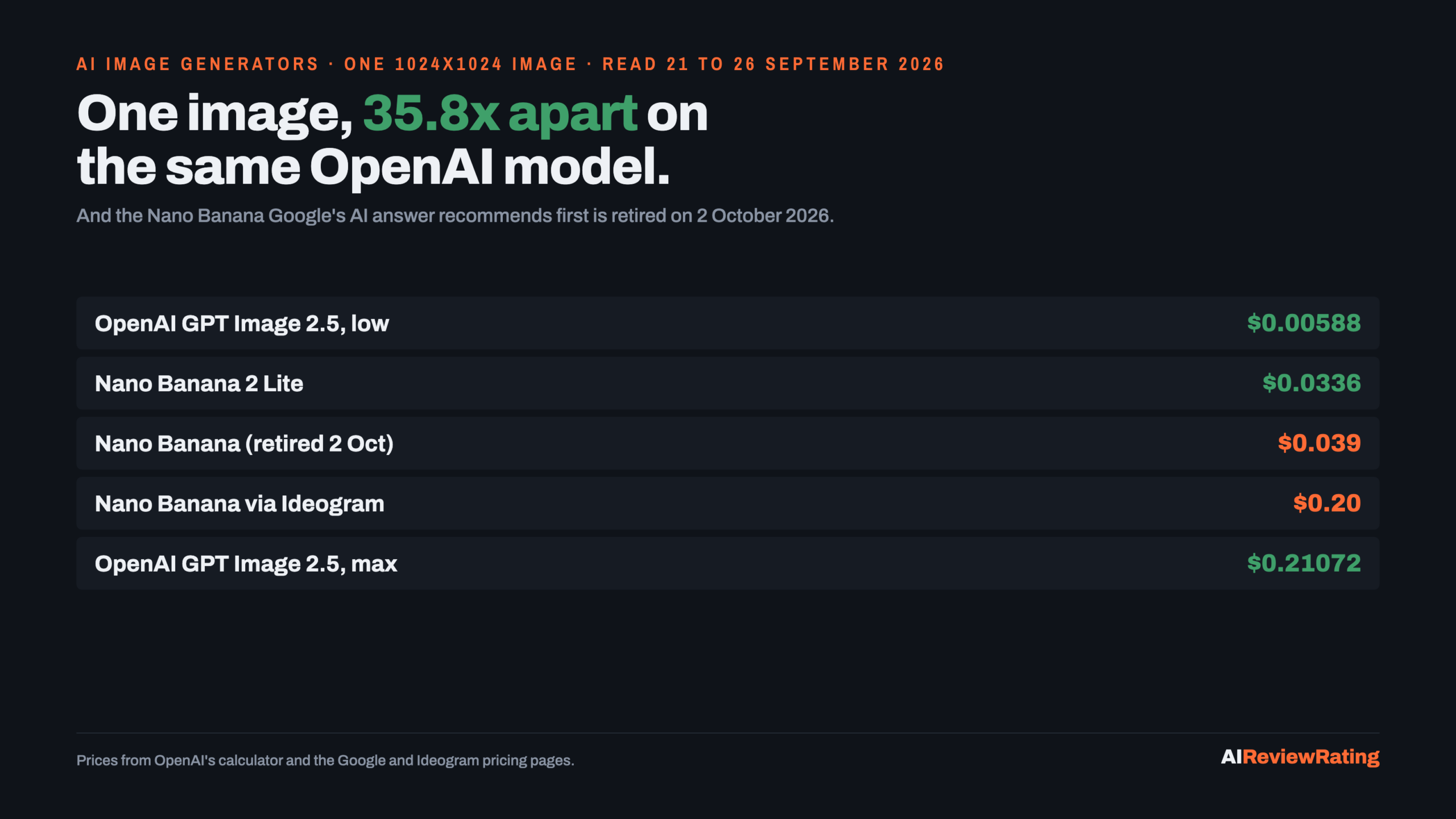
- One square image costs from $0.00588 to $0.21072 at OpenAI, a 35.8x spread inside one model at one size, set only by the quality dial.
- Google’s cheapest image is now $0.0336, half of what Nano Banana 2 charges. Nano Banana 2.1 makes a 1024×1024 image for $0.0336 against $0.067. The original Nano Banana now shuts down on 15 March 2027.
- Ideogram’s app charges 5.13x what Google charges for the original Nano Banana, $0.20 against $0.039. Its API passes Nano Banana 2 through at $0.0672, level with Google’s $0.067.
- Midjourney’s $10 plan is not for companies over $1,000,000 of revenue. Its own rules require Pro at $60 a month or Mega at $120.
Every vendor’s price for one image, side by side
Six vendors bill six different units: GPU hours, output tokens, megapixels, generations and credits. The table keeps each in the unit the vendor sells and says so where no per-image price is published, rather than normalising them into one column the vendors never printed.
| Vendor | Billing unit | Per image | Entry plan |
|---|---|---|---|
| OpenAI GPT Image 2.5 | output tokens | $0.00588 to $0.21072 (calculator) | pay as you go |
| Google Gemini image models | output tokens | $0.0336 to $0.134 at 1024×1024 | pay as you go |
| Black Forest Labs FLUX | megapixels (FLUX.2) | $0.014 to $0.07 for the first MP | pay as you go |
| Ideogram | generations (API), credits (plans) | $0.003 to $0.42 (API) | from $20 a month |
| Midjourney | Fast GPU hours | not published | from $10 a month |
| Adobe Firefly | generative credits | not published | from $9.99 a month |
Google’s cheapest image fell to $0.0336, and the original Nano Banana now shuts down on 15 March 2027
Google’s AI Mode, captured 21 September 2026 for the query “best ai image generators”, opens with The best AI image generator overall is Google’s Nano Banana (Gemini)
. Nano Banana is the consumer name of gemini-2.5-flash-image. Google’s pricing page, read on 26 September 2026, said that model is deprecated and will be shut down on October 2, 2026
. Google’s deprecations page, read on 7 November 2026, lists the shutdown as 15 March 2027 and names gemini-3.1-flash-lite-image as the replacement. The same page lists gemini-nano-banana-2.1, released 6 October 2026, as the recommended replacement for Nano Banana 2, with no shutdown date announced for either.
| Model | Also sold as | Rate per 1M image output tokens | 1024×1024 image | 4K image |
|---|---|---|---|---|
| Gemini 3 Pro Image | Nano Banana Pro | $120.00 | 1,120 tokens, $0.134 | $0.24 |
| Gemini 3.1 Flash Image | Nano Banana 2 | $60.00 | 1,120 tokens, $0.067 | $0.151 |
| Gemini Nano Banana 2.1 | Nano Banana 2.1 | $30.00 | 1,120 tokens, $0.0336 | $0.113 |
| Gemini 3.1 Flash Lite Image | Nano Banana 2 Lite | $30.00 | 1,120 tokens, $0.0336 | not published |
| Gemini 2.5 Flash Image | Nano Banana | $30.00 | 1,290 tokens, $0.039 | not published |
Two things in this table matter for a budget. The newer models are cheaper, not dearer: Nano Banana 2.1 and Gemini 3.1 Flash Lite Image make the same size image in 1,120 tokens against 1,290 on the original, $0.0336 against $0.039, which is 13.8% less. And the same 1,120 tokens cost 4x as much on Gemini 3 Pro Image as on those two, because only the rate differs. At 4K, Nano Banana 2.1 is $0.113 against $0.151 on Nano Banana 2, 25.2% less. On Gemini 3.1 Flash Image, a 512px image is $0.045 and a 1024px image $0.067: four times the pixels for 1.5 times the price.
OpenAI publishes no per-image price, so we operated its calculator
OpenAI’s pricing page lists image output at $30.00 per million tokens and then says For image generation cost estimates, use the calculator in the image generation guide.
We ran that calculator on 21 September 2026 on GPT Image 2.5 at each quality setting rather than multiplying a guessed token count.
| Quality | 1024×1024 | 1536×1024 | Wider image costs |
|---|---|---|---|
| low | 196 tokens, $0.00588 | 158 tokens, $0.00474 | 19.4% less |
| medium | 439 tokens, $0.01317 | not captured | |
| high | 1,756 tokens, $0.05268 | 1,372 tokens, $0.04116 | 21.9% less |
| xhigh | 3,122 tokens, $0.09366 | not captured | |
| max | 7,024 tokens, $0.21072 | 5,488 tokens, $0.16464 | 21.9% less |
The quality dial moves the price 35.8x on one model at one size. And a 1536×1024 image, 1.5 times the pixels of a square one, costs fewer tokens at every quality we tested: 19.4% fewer at low and 21.9% fewer at high and max. For a team making landscape social or blog images, asking for the wide format is a saving, not a surcharge.
Adobe Firefly’s commercial-safety promise covers Adobe’s models, not the partner models it sells
Google’s AI Overview, captured 21 September 2026, describes Firefly as guaranteeing that generated content is commercially safe from copyright issues
. Adobe’s own FAQ, read the same day, is narrower: Outputs from Adobe Firefly AI models are safe for commercial use
, followed by You’re responsible for determining whether content generated by partner models is appropriate
. The same plans page sells access to partner models from Google, OpenAI and Flux as a headline feature. Indemnity is narrower again, offered to eligible enterprise customers for IP indemnification for select Adobe Firefly outputs
.
| Plan | Monthly | Generative credits | Per 1,000 credits |
|---|---|---|---|
| Firefly Standard | $9.99 | 2,000 | $5.00 |
| Firefly Pro | $19.99 | 4,000 | $5.00 |
| Firefly Pro Plus | $49.99 | 10,000 | $5.00 |
| Firefly Premium | $199.99 | 50,000 | $4.00 |
For a marketing team the practical rule is simple: if the image goes into paid work and legal cover matters, pick an Adobe model inside Firefly, not a partner model, and check whether your contract includes the indemnity. Volume buys nothing until the top plan, where the credit price falls 20%.
Ideogram: a 140x spread on one price list, and a Google model at 5.13x in its app
| Ideogram API endpoint | Per generation |
|---|---|
| P-Image Ideogram, Very Low 1K | $0.003 |
| 4.0 Turbo | $0.03 |
| 4.0 Default | $0.06 |
| 4.0 Quality | $0.10 |
| 3.0 Quality | $0.09 |
| 3.0 Quality with Character Reference | $0.20 |
| Transparent 4.0 Quality 8K | $0.42 |
| Nano Banana 2, 1K, via the API | $0.0672 |
| Nano Banana (Gemini 2.5 Flash), app only | $0.20 |
Ideogram charges $0.20 a generation for Nano Banana, Google’s gemini-2.5-flash-image, and its page marks that line as an app-only product. Google charges $0.039 for a 1024×1024 image from the same model, so the app costs 5.13x as much. The API is different: it bills Nano Banana 2 at $0.0672 for a 1K image, against $0.067 direct from Google, and Nano Banana Pro at $0.1344 against $0.134. Character Reference on the 3.0 model more than doubles the price, $0.09 to $0.20. Plans run Plus $20, Pro $60 and Team $30 per user a month on monthly billing. On annual billing the same page shows Plus at $15 a month ($180 a year), Pro at $42 ($504) and Team at $20 per user ($240). Its credits-per-generation table did not load for us, so plan credits cannot be converted to images.
Black Forest Labs FLUX: the extra megapixel is 14x cheaper than the first
| FLUX.2 model | First megapixel | Each extra megapixel |
|---|---|---|
| FLUX.2 [max] | $0.07 | $0.03 |
| FLUX.2 [pro] | $0.03 | $0.015 |
| FLUX.2 [klein] 9B | $0.015 | $0.002 |
| FLUX.2 [klein] 4B | $0.014 | $0.001 |
| FLUX.2 [flex] | $0.05 | $0.05 |
On FLUX.2 [klein] 4B, a 4 megapixel image costs $0.017, 1.21 times the one megapixel price for four times the pixels. The same page bills the older FLUX.1 family per image instead, from $0.025 for FLUX.1 [dev] to $0.08 for Kontext [max], so a reader comparing the two tabs is comparing two units. FLUX.2 [klein] 4B is also the one FLUX.2 model released under Apache-2.0; our self-hosting guide covers when running it on your own GPU beats this API.
Midjourney: the $1,000,000 clause that moves the floor from $10 to $60
| Plan | Monthly | Fast GPU hours | Included cost per GPU hour |
|---|---|---|---|
| Basic | $10.00 | 3.3 | $3.03 |
| Standard | $30.00 | 15 | $2.00 |
| Pro | $60.00 | 30 | $2.00 |
| Mega | $120.00 | 60 | $2.00 |
Midjourney sells GPU time, not images, and publishes no per-image price. Extra Fast time is $4.00 an hour on every plan, 1.32x the Basic plan’s included rate and 2.00x the others’. Annual billing takes 20% off: $96 for Basic, $288 for Standard, $576 for Pro and $1,152 for Mega. The line that decides the bill for a company, in Midjourney’s words: You must purchase the Pro or Mega plan
above $1,000,000 USD of gross revenue a year. For that company the cheapest legal plan is $60 a month.
Three more plan ladders, read from the vendors
None of these three publishes credits per image on its pricing page, so we give the plan prices only.
- Leonardo AI: Essential $12, Premium $30, Ultimate $60 a month, read 21 September 2026.
- Krea: Basic $9, Pro $35, Max $105, Business $200 a month, read 21 September 2026.
- Recraft: $10, $20, and $22 per seat a month, read 21 September 2026.
Canva: image generation inside a design tool, on a shared AI allowance
Canva Our pick is the option for teams that need the image placed in a post, deck or ad, not just generated. Canva prices no single image. Its pricing page says the Standard, Premium and Ultra AI tools share one monthly AI allowance that resets each month, and harder tasks use more of it.
- Free: US$0, limited access to Standard and Premium AI tools, no Ultra AI tools.
- Pro: US$144 a year for one person, 10x the AI allowance of Free.
- Business: US$250 a year per person, 20x the AI allowance of Free.
One catch before you test it: Canva says the AI allowance during a free trial is the same as Canva Free, and the 10x arrives only once the paid plan starts. Prices re-read on canva.com/pricing on 7 November 2026, tax excluded. Try Canva free.
Which one fits a marketing team’s budget
- High volume, lowest unit cost: OpenAI at low quality, $0.00588 a square image, or Nano Banana 2.1 at $0.0336. Both are API products; someone has to wire them in.
- Large images on a budget: FLUX.2 [klein] 4B, $0.017 for 4 megapixels.
- The image has to end up in a design: Canva, on a shared monthly AI allowance, Pro at US$144 a year.
- Legal cover for paid campaigns: Adobe Firefly, using Adobe’s own models only.
- Heavy daily use on a flat fee: Midjourney Standard and up include unlimited Relax-mode images; a company over $1M revenue starts at Pro, $60.
We rank on published price and terms, not on image quality, which we did not measure for this article.
How we built this
Every price was read on the vendor’s own page. Google, OpenAI, Ideogram, Midjourney and Canva were re-read on 7 November 2026 as page text, with Ideogram’s yearly and monthly figures taken from the same page. OpenAI per-image figures come from operating its calculator on 21 September 2026. Black Forest Labs was read on 25 September 2026; Adobe Firefly, Leonardo AI, Krea and Recraft on 21 September 2026 and not re-read for this update. Anything a vendor does not publish is marked “not published”. Figures quoted by Google’s AI answers that trace to no vendor page were cut.
Related reading on this site
- Self-hosting AI image models: which weights you can sell from, and the GPU break-even
- AI video generators, priced per finished second
- Open source AI tools you can self-host, and what they replace
Questions people ask about AI image generators
What is the cheapest AI image generator?
Per image through an API, OpenAI at low quality, $0.00588 for a 1024×1024 image, and Ideogram’s P-Image Very Low at $0.003 per 1K generation, listed on its API tab. Google’s cheapest is $0.0336 for Nano Banana 2.1 or Nano Banana 2 Lite. Quality was not measured, so cheapest here means lowest published price. Read 7 November 2026.
Which AI image generator is best for a marketing team?
It depends on where the image ends up. For a team that needs it placed in a post, deck or ad, Canva, with Pro at US$144 a year. For cost per image at volume, OpenAI or Google through the API. For paid campaigns where legal cover matters, Adobe Firefly using Adobe’s own models. We rank on published price and terms, not image quality.
Is there a 100% free AI image generator?
Ideogram lists a $0 plan and Adobe advertises a free Firefly tier, both with usage limits. The only route with no per-image charge is running an Apache-2.0 model such as FLUX.2 [klein] 4B on your own hardware, which moves the cost to the GPU. Every paid option in this article publishes a price above zero.
Is ChatGPT the best image generator?
On price it is the widest range we measured: $0.00588 to $0.21072 for one 1024×1024 image through the API, 35.8x, set by the quality setting. We did not measure image quality, so we do not rank it on output.
What AI is better than ChatGPT for image creation?
For cost per image through an API, Nano Banana 2.1 at $0.0336 and FLUX.2 [klein] 4B at $0.014 both cost less than OpenAI’s high setting of $0.05268, though more than its medium $0.01317 and low $0.00588. For commercial legal cover, Adobe Firefly’s own models. Google prices read 7 November 2026, FLUX 25 September 2026.
Is Nano Banana being discontinued?
The original one, yes, but later than we first read. Google’s pricing page said 2 October 2026 when we read it on 26 September; its deprecations page, read 7 November 2026, lists gemini-2.5-flash-image shutting down on 15 March 2027, with gemini-3.1-flash-lite-image as the replacement. Nano Banana 2 and Nano Banana Pro have no shutdown date announced, and Nano Banana 2.1 makes the same size image as the original for $0.0336.
How much does Midjourney cost per image?
Midjourney does not publish a per-image price. It sells Fast GPU time, from 3.3 hours on the $10 Basic plan to 60 hours on the $120 Mega plan, with extra time at $4.00 an hour.
Sources
Every figure above traces to one of these, each opened on the date shown.
- Google, Gemini API pricing (image models; the 2 October 2026 shutdown notice was read here on 26 September), ai.google.dev, re-read 7 November 2026 at aistudio.google.com/docs/pricing.
- Google, Gemini API deprecations (Nano Banana models table), ai.google.dev, read 7 November 2026.
- OpenAI, API pricing (image token rates), developers.openai.com, re-read 7 November 2026.
- OpenAI, image generation guide cost calculator, operated at each quality and size, developers.openai.com, read 21 September 2026.
- Midjourney, Comparing Midjourney Plans, docs.midjourney.com, re-read 7 November 2026.
- Ideogram, pricing page, plan and API tabs, ideogram.ai, re-read 7 November 2026.
- Black Forest Labs, API pricing (FLUX.2 and FLUX.1 tabs), bfl.ai, read 25 September 2026.
- Adobe, Firefly plans and FAQ, www.adobe.com, read 21 September 2026.
- Leonardo AI, Krea and Recraft pricing pages, monthly toggle, leonardo.ai, read 21 September 2026.
- Google AI Overview and AI Mode for this query, captured via SerpAPI, www.google.com, read 21 September 2026.
- Canva, pricing page, canva.com, read 7 November 2026.
Comments
Sign in to join the discussion.
Login to comment