The short answer
If you are a founder or lead engineer standardising on one retrieval framework before you write any code, the decision on this page is not about features. Every page ranking these frameworks ranks features. The two questions that actually cost money are whether the licence lets you charge for what you build, and what the company behind the framework bills you once you stop running it yourself. We read all 8 repositories through GitHub’s own API and opened every vendor pricing page in a rendered browser on 15 September 2026.
5 of the 8 projects Google names carry a plain permissive licence and were pushed within 1 days of 15 September 2026. Those are the safe defaults. The exceptions are the article.
| Framework | Licence badge | What the LICENSE file says | Stars | Last push |
|---|---|---|---|---|
| Dify | Other | modified Apache-2.0, commercial licence required for multi-tenant | 155,802 | 15 September 2026 |
| LangChain | MIT | plain MIT | 146,370 | 15 September 2026 |
| RAGFlow | Apache-2.0 | plain Apache-2.0 | 90,731 | 15 September 2026 |
| LlamaIndex | MIT | plain MIT | 52,168 | 15 September 2026 |
| LangGraph | MIT | plain MIT | 41,690 | 14 September 2026 |
| Haystack | Apache-2.0 | plain Apache-2.0 | 26,513 | 15 September 2026 |
| Ragas | Apache-2.0 | plain Apache-2.0 | 15,737 | 24 February 2026, 203 days before 15 September 2026 |
| Cognita | Apache-2.0 | plain Apache-2.0 | 4,418 | 13 March 2026, 186 days before 15 September 2026 |
Three things on that table that no page on this results page carries
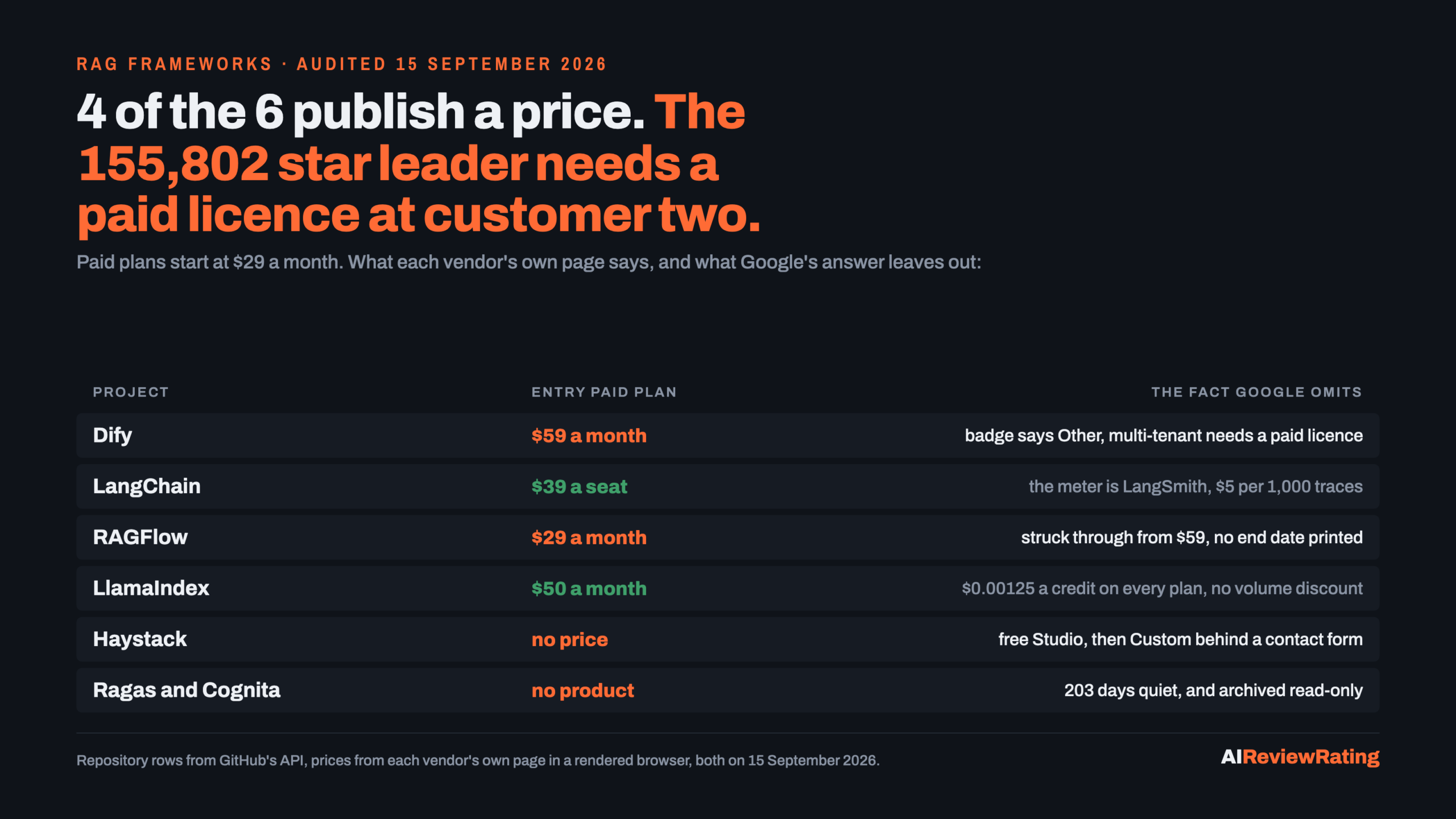
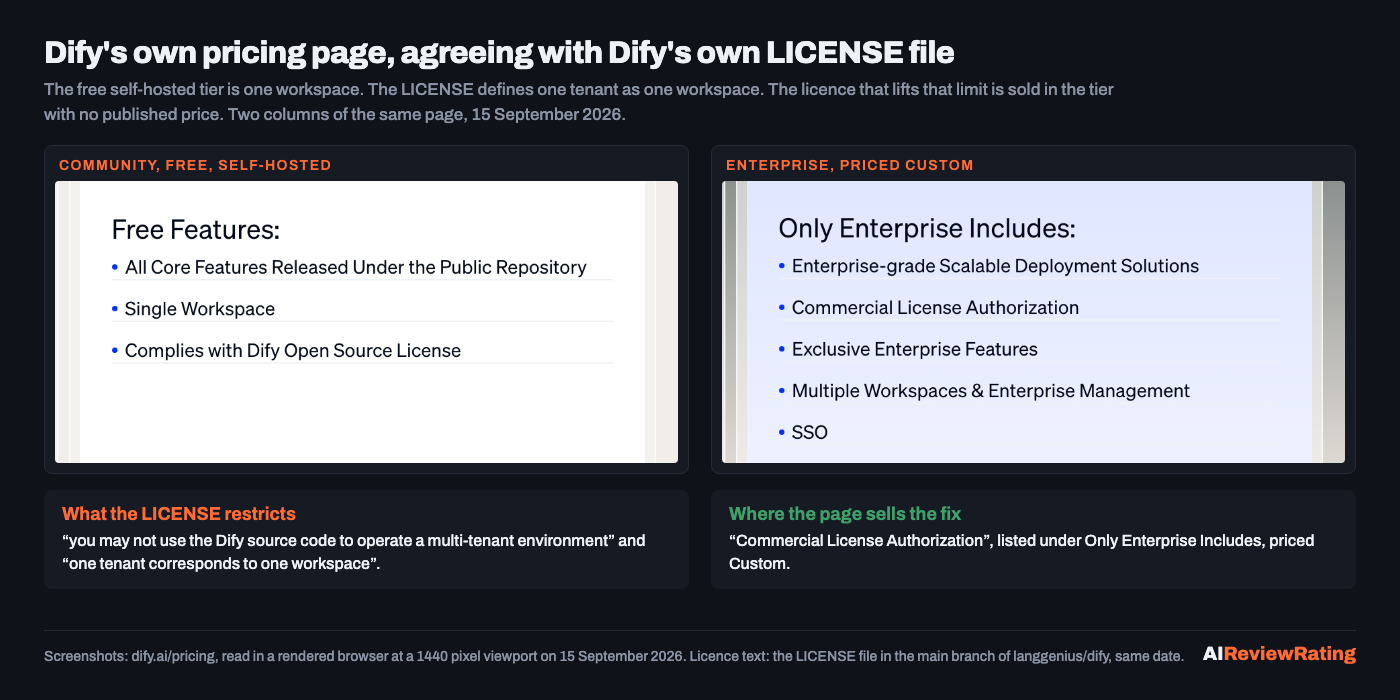
- Dify is the most starred project here at 155,802 stars, and its badge says Other. The LICENSE file is a modified Apache-2.0. Running it as a multi-tenant environment needs a commercial licence, and Dify’s own pricing page sells that licence only inside the Enterprise tier, priced Custom.
- Cognita is an archived repository. Google’s AI Overview names it as a RAG framework to consider. GitHub reports it read-only, last pushed 13 March 2026, 186 days before 15 September 2026.
- Ragas moved owner and has gone quiet. The repository Google points at,
explodinggradients/ragas, now redirects tovibrantlabsai/ragas, last pushed 24 February 2026, 203 days before 15 September 2026, with 590 open issues.
On the money side: 4 of the 6 publish a price you can act on, 2 publish none, paid plans start at $29 a month, and exactly one publishes a rate card complete enough to compute a bill for a stated workload before you sign up.
Who publishes the page Google shows you
Before the roster, the provenance. Google’s AI Overview for this query cited 6 sources on 14 September 2026 and AI Mode cited 3. Firecrawl, Olostep appear in both, and both sell a crawling API that feeds a retrieval pipeline, so both are selling into the decision they are cited to inform. Tredence and Sphere Inc. are consultancies that build these systems for a fee.
Below the fold it repeats. Of the 9 organic results, organic 7 is published by Meilisearch, which sells a search engine, and organic 9 by Braintrust, which sells RAG evaluation, the slot Ragas occupies in Google’s own answer. The two results on that page with no product to sell are a Reddit thread at position 1 and an Awesome list committed to a GitHub repository at position 5. The discussions module returned none returned and the video pack returned none returned.
None of that makes those pages wrong. It does mean nobody on the results page has an incentive to open a LICENSE file, so nobody does.
The licence audit, and the one row that fails it
GitHub prints a licence badge on every repository. It is generated by a detector that matches the LICENSE file against known texts, and when the file has been edited the detector gives up and returns NOASSERTION, which renders as the word Other. That word is the whole signal. Of the 8 repositories here, 7 return a real SPDX identifier and 1 returns NOASSERTION, and it is the one whose terms restrict a business.
This is the third distinct meaning of Other this desk has read in three weeks, after n8n’s Sustainable Use License on 3 September 2026 and Browserless’s dual SSPL on 9 September 2026. The word is not a licence. It is an instruction to go and read one.
What Dify’s LICENSE actually says
The file opens by stating that Dify is a modified version of the Apache License 2.0
, with additional conditions. Two of them decide whether you can build a product on it.
| Condition | The text | What it rules out |
|---|---|---|
| Multi-tenant service | you may not use the Dify source code to operate a multi-tenant environment |
Serving more than one customer from one deployment. The file defines a tenant precisely: one tenant corresponds to one workspace. |
| Logo and copyright | you may not remove or modify the LOGO or copyright information in the Dify console |
White labelling. The file defines the frontend as all components located in the web/ directory, or the web image when running with Docker, so the restriction does not apply if you use Dify only as a backend. |
Dify’s pricing page agrees with its licence, which is the part worth checking yourself. The free self-hosted Community tier is described as For open-source enthusiasts, individual developers, and non-commercial projects
and its feature list says Single Workspace
. One workspace is one tenant. And the Enterprise column, priced Custom, lists Commercial License Authorization
as one of the things only Enterprise includes.
So the sequence for anyone building a customer-facing assistant on Dify is: self-host free for one workspace, and the moment a second customer needs their own workspace, the licence you need is a line item in a tier with no published price. That is not a reason to avoid Dify. It is a reason to know it on day one rather than at the second customer.
One more clause worth reading before you contribute code: The producer can adjust the open-source agreement to be more strict or relaxed as deemed necessary
Contributors agree the terms can be tightened later.
The maintenance audit, which takes ten seconds and nobody runs it
A framework you standardise on is a dependency for years. The cheapest check available is the last push date on its repository, and on this roster it separates the field cleanly. 6 of the 8 projects were pushed within 1 day of 15 September 2026. The other 2 are the two evaluation tools Google names.
| Project | Named by Google as | Last push | Days before 15 September 2026 | Repository state |
|---|---|---|---|---|
| Ragas | RAG evaluation toolkit | 24 February 2026 | 203 | Active |
| Cognita | Modular RAG framework from TrueFoundry | 13 March 2026 | 186 | Archived, read-only |
| Dify | Visual low-code RAG and agent platform | 15 September 2026 | 0 | Active |
| LangChain | General orchestration and agent workflows | 15 September 2026 | 0 | Active |
| RAGFlow | Deep document understanding, complex PDFs, GraphRAG | 15 September 2026 | 0 | Active |
| LlamaIndex | Data-heavy RAG, ingestion connectors, indexing | 15 September 2026 | 0 | Active |
| LangGraph | Stateful agent graphs on top of LangChain | 14 September 2026 | 1 | Active |
| Haystack | Production search and RAG pipelines | 15 September 2026 | 0 | Active |
archived and pushed_at fields are both returned by the same call.Cognita is the sharper of the two. An archived repository is not a project that happens to be quiet, it is one whose owner has explicitly set it read-only: no issues, no pull requests, no fixes. Google’s AI Overview names it without that fact, and it carries 4,418 stars and 22 open issues that can no longer be answered.
Ragas is the subtler one. It is not archived and its licence is clean plain Apache-2.0. But it moved from explodinggradients/ragas to vibrantlabsai/ragas, and 590 issues are open against a codebase last touched 203 days before 15 September 2026. Google’s own answer recommends it as the evaluation toolkit while organic 9 on the same page is a competitor selling the replacement.
What the managed tier costs, when there is one
All six frameworks are free to run yourself. What separates them is the company standing behind each one and what that company charges when you decide not to. On 15 September 2026 we opened each vendor’s pricing page in a rendered browser and recorded the entry paid plan and whether any usage rate is published at all.
| Framework | Company and product | Free tier | Entry paid plan | Published usage rate |
|---|---|---|---|---|
| LangChain | LangChain, LangSmith | Developer, $0 a seat, 1 seat, up to 5,000 base traces a month | Plus, $39 a seat a month | 0.005 LSU per additional trace at $1.00 a LSU |
| LlamaIndex | LlamaIndex, LlamaCloud and LlamaParse | Free, $0 a month, 10,000 credits | Starter, $50 a month | $1.25 per 1,000 credits |
| Dify | LangGenius, Dify Cloud | Sandbox, $0, 200 message credits, 1 workspace, 1 member | Professional, $59 a workspace a month | message credits bundled into the plan, no published overage rate |
| RAGFlow | InfiniFlow, RAGFlow hosted | Free, $0 a month, 500 credits, 0.1 GB, no API key | Starter, $29 a month | credits bundled into the plan, no published overage rate |
| Haystack | deepset, deepset AI Platform | Studio, $0, 1 workspace, 1 user, 100 pipeline hours, 50 files at 10 MB each | none published | no published rate of any kind |
| Ragas | Vibrant Labs | the library itself, Apache-2.0 | none published | no commercial product priced on the project site |
4 publish a price. 2 do not, and they are the two projects with no commercial product priced on their own site: Haystack and Ragas. The deepset case is the interesting one, because deepset does have a product and does have a pricing page. That page carries 2 tiers: a free Studio and an Enterprise tier labelled Custom behind a contact form. Every limit on the free tier is printed to the file size (50 files at 10 MB each, 100 pipeline hours, 2 development pipelines). The production tier has no number of any kind.
That is the same shape this desk recorded on 14 September 2026 for Outreach in the sales lane: publish the denominator, withhold the numerator. Haystack remains a genuinely good, plain plain Apache-2.0 framework with 26,513 stars. You simply cannot budget for its managed tier without a sales call.
Three credit meters, and not one volume discount
Three of these platforms bill in credits: Dify Cloud, RAGFlow hosted and LlamaCloud. The usual assumption is that a bigger plan buys a better unit rate. Divide the plan price by the bundled allowance on each and none of the three does. Two charge more.
| Platform | Plan | Price a month | Bundled credits | Cost of one credit |
|---|---|---|---|---|
| Dify Cloud | Professional | $59 | 5,000 | $0.0118 |
| Dify Cloud | Team | $159 | 10,000 | $0.0159 |
| RAGFlow hosted | Starter | $29 | 5,000 | $0.0058 |
| RAGFlow hosted | Pro | $129 | 20,000 | $0.00645 |
| LlamaCloud | Starter | $50 | 40,000 | $0.00125 |
| LlamaCloud | Pro | $500 | 400,000 | $0.00125 |
- Dify charges 34.75 percent more per message credit on Team than on Professional. Team is $159 against $59, which is 2.69 times the price for exactly 2 times the credits. The same 34.75 percent gap holds on annual billing, $0.00983 against $0.01325.
- RAGFlow charges 11.21 percent more per credit on Pro than on Starter. Pro does buy more of everything else: 50 GB of dataset storage against 5, and 20 team members against 5. The credit line specifically gets dearer.
- LlamaCloud is flat at exactly $0.00125, and that is not a coincidence: it is precisely the $1.25 per 1,000 credits the documentation publishes as the pay-as-you-go rate. The $500 plan is a prepayment, not a bulk rate. What it actually buys is support and a higher overage ceiling.
Both Dify and RAGFlow bundle credits and neither publishes what happens when a month runs out. There is no overage rate on either page, which means the only published way past the allowance is the next tier up, and on Dify the tier above Team is Custom.
The RAGFlow prices are struck through, with no date on the offer
Both RAGFlow paid cards show a crossed-out list price beside the live one: $29 struck from $59 on Starter and $129 struck from $259 on Pro. Both paid cards show a struck-through list price with no end date and no label on the offer. At list price the same volume penalty is still there, $0.0118 a credit on Starter against $0.01295 on Pro. Budget against the list price, not the struck one, because nothing on that page commits the vendor to keeping it.
The one rate card you can actually budget against
Four vendors publish a plan price. Exactly one publishes enough of a rate card to answer the question a buyer is really asking, which is what my workload will cost. LlamaIndex prints credits per page for each parsing tier, credits per indexing action, credits per retrieval query, credits per chat turn and credits per GB of storage per day, alongside a flat $1.25 per 1,000 credits that is identical in North America and Europe.
Multiply those two published numbers together and you get the figure this whole category is missing: a cost per 1,000 pages. Across the four parsing tiers on one dropdown it moves by a factor of 45.
| Parsing tier | Credits a page | Cost a page | Cost per 1,000 pages | Note |
|---|---|---|---|---|
| Fast | 1 | $0.00125 | $1.25 | spatial text only, no markdown |
| Cost-effective | 3 | $0.00375 | $3.75 | the tier the vendor recommends starting on |
| Agentic | 10 | $0.0125 | $12.50 | |
| Agentic Plus | 45 | $0.05625 | $56.25 |
The other published actions convert the same way, and one of them is worth pinning to the wall before you design a chat interface.
| Action | Credits | Charged | Cost each | Cost per 1,000 |
|---|---|---|---|---|
| Indexing, exported page | 2 | a page | $0.0025 | $2.50 |
| Retrieval query | 1 | a query | $0.00125 | $1.25 |
| Chat turn | 100 | a turn | $0.125 | $125 |
| Retained file storage | 100 | a GB a day | $0.125 | $125 |
A chat turn costs $0.125, which is 100 retrieval queries or 100 pages of Fast-tier parsing. Retrieval is close to free on this platform. Answering is not. Any design that treats a turn as cheap has the cost model backwards.
A worked bill for a 10,000 page internal knowledge base and 20,000 assistant turns a month
Here is the arithmetic in full, on the only roster member whose page supports it. 10,000 pages ingested once, 5 GB retained, 20,000 assistant turns a month.
| Line | Working | Credits | Cost |
|---|---|---|---|
| Parse, Cost-effective tier | 10,000 pages × 3 credits | 30,000 | $37.50 |
| Index, exported pages | 10,000 pages × 2 credits | 20,000 | $25 |
| One-time ingestion | sum of the two rows above | 50,000 | $62.50 |
| Chat turns, a month | 20,000 turns × 100 credits | 2,000,000 | $2,500 |
| Retained storage, a month | 5 GB × 100 credits × 30 days | 15,000 | $18.75 |
| Every month after | sum of the two rows above | 2,015,000 | $2,518.75 |
Two things fall out of that table. The ingestion everyone worries about is $62.50, a rounding error. The serving nobody models is $2,518.75 every month, 40 times the one-time cost, and 16 times what Dify’s largest self-serve plan costs. Choosing the Agentic Plus parsing tier instead would take ingestion from $62.50 to $587.50, and it would still be smaller than one month of answering.
Note also that the same workload does not fit Dify Cloud at a published price at all. Its largest self-serve plan, Team at $159 a month, includes 10,000 message credits, which is half the stated volume, and no overage rate is printed. The published route past it is Enterprise, at Custom.
The bill nobody budgets for: watching the thing run
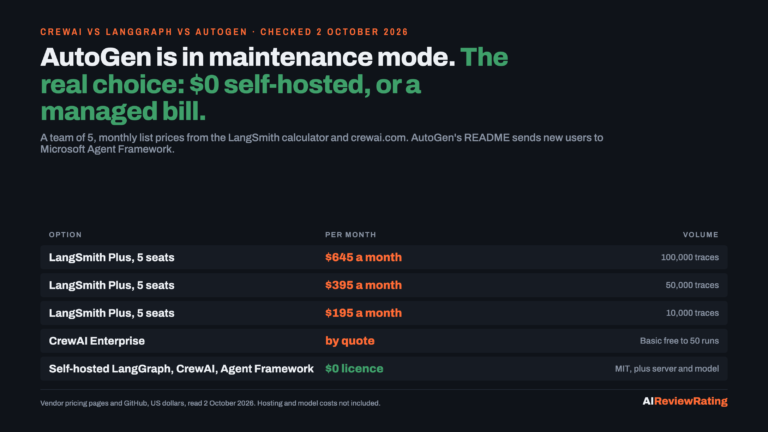
LangChain is plain plain MIT with 146,370 stars and it is free forever. langchain.com/pricing does not price it. That page prices LangSmith, the tracing and evaluation product, which is what the company sells. The same is true at LlamaIndex, whose pricing page prices LlamaParse rather than the framework. For half this roster, the vendor’s pricing page is not about the thing Google recommended.
| LangSmith plan | Seat a month | Traces included | Seats | What it adds |
|---|---|---|---|---|
| Developer | $0 | 5,000 | 1 seat | Community support |
| Plus | $39 | 10,000 | Unlimited seats | Access to Deployment, Engine, and more |
| Enterprise | Custom | Custom | Custom seats and workspaces | Support SLA, self-hosted and hybrid |
Past the included traces the page publishes a unit: 0.005 LSU per additional trace at $1 a LSU, which is $5 per 1,000 traces. Compute is billed separately at $1.50 a LCU. The vendor ships a calculator on the same page, and it reproduces exactly: set it to 260,000 traces on 1 seat and it returns $1,289, which is 250,000 chargeable traces at 0.005 LSU, so 1,250 LSU at $1, plus one $39 seat.
For the assistant in the worked example, 20,000 turns a month traced one to one is $89 a month on one seat: $39 of seat and $50 of usage. That is a small number, and it is the only number on this page a reader can check against the vendor’s own calculator in under a minute. It is also a line most teams discover in month two.
The ceiling usually decides before the price does
Plan prices get compared. Plan limits do not, and on a knowledge assistant the limit is what bites first. A corpus does not care what a seat costs if the plan caps the knowledge base below the size of the corpus.
| Platform | Plan | Price | Knowledge base cap | Storage | Members |
|---|---|---|---|---|---|
| Dify Cloud | Sandbox | Free | 50 documents | 0.05 GB | 1 |
| Dify Cloud | Professional | $59 a month | 500 documents | 5 GB | 3 |
| Dify Cloud | Team | $159 a month | 1,000 documents | 20 GB | 50 |
| RAGFlow hosted | Free | Free | not published | 0.1 GB | 1 |
| RAGFlow hosted | Starter | $29 a month | not published | 5 GB | 5 |
| RAGFlow hosted | Pro | $129 a month | not published | 50 GB | 20 |
| deepset | Studio | Free | 50 files at 10 MB each | not published | 1 |
Dify is the one to check against your corpus before you pick a tier: Professional caps the knowledge base at 500 documents and Team at 1,000. RAGFlow publishes storage rather than a document count, up to 50 GB on Pro. deepset’s free Studio is capped at 50 files of 10 MB, which is a prototyping tier and says so.
How this shakes out, framework by framework
Dify
Other badge, modified Apache-2.0, 155,802 stars, last push 15 September 2026. Google’s low-code pick and the most starred project on the page at 155,802. Self-host it free for one workspace. The moment a second customer needs their own workspace you need the commercial licence, and that is an Enterprise line item priced Custom. Cloud runs $59 to $159 a workspace a month with a 500 to 1,000 document knowledge base cap.
Managed option: Dify Cloud, free tier Sandbox, $0, 200 message credits, 1 workspace, 1 member, entry paid plan Professional at $59 a workspace a month for 5,000 message credits a month, 3 members, 500 knowledge documents, 5 GB.
LangChain
MIT badge, plain MIT, 146,370 stars, last push 15 September 2026. The default answer for orchestration, and the licence is as clean as it gets. The cost is not the framework, it is LangSmith at $39 a seat a month plus $5 per 1,000 traces beyond 10,000.
Managed option: LangSmith, free tier Developer, $0 a seat, 1 seat, up to 5,000 base traces a month, entry paid plan Plus at $39 a seat a month for 10,000 traces a month, unlimited seats.
RAGFlow
Apache-2.0 badge, plain Apache-2.0, 90,731 stars, last push 15 September 2026. The document-understanding pick, and the only roster member whose hosted entry plan is under $50: $29 a month for 5,000 credits and 5 GB. Both paid prices are struck through from a higher list with no expiry date printed, and the page does not say what a credit buys.
Managed option: RAGFlow hosted, free tier Free, $0 a month, 500 credits, 0.1 GB, no API key, entry paid plan Starter at $29 a month for 5,000 credits a month, 5 team members, 5 GB dataset storage.
LlamaIndex
MIT badge, plain MIT, 52,168 stars, last push 15 September 2026. The one to pick if you need to know the bill in advance. It is the only vendor here publishing credits per page, per query, per chat turn and per GB per day against a flat $1.25 per 1,000 credits, so you can compute a workload before you sign up. The paid plans carry no volume discount.
Managed option: LlamaCloud and LlamaParse, free tier Free, $0 a month, 10,000 credits, entry paid plan Starter at $50 a month for 40,000 credits, pay as you go to $500 a month.
LangGraph
MIT badge, plain MIT, 41,690 stars, last push 14 September 2026. Stateful agent graphs, same MIT licence and same company as LangChain, so the same LangSmith meter applies once you want to see what the graph did. No review page on this site yet.
Managed option: LangSmith, free tier Developer, $0 a seat, 1 seat, up to 5,000 base traces a month, entry paid plan Plus at $39 a seat a month for 10,000 traces a month, unlimited seats.
Haystack
Apache-2.0 badge, plain Apache-2.0, 26,513 stars, last push 15 September 2026. The strongest licence-and-maintenance profile of the three Google names for production pipelines: plain plain Apache-2.0, pushed 15 September 2026. The catch is commercial: deepset publishes a free Studio and an Enterprise tier labelled Custom, so there is no way to budget the managed option without talking to sales.
Ragas
Apache-2.0 badge, plain Apache-2.0, 15,737 stars, last push 24 February 2026. Named by Google as the open-source evaluation toolkit. The repository moved from explodinggradients/ragas and was last pushed 24 February 2026, 203 days before 15 September 2026, with 590 open issues. Still usable, no longer obviously maintained. Check the commit history yourself before you build an evaluation gate on it.
Cognita
Apache-2.0 badge, plain Apache-2.0, 4,418 stars, last push 13 March 2026. Archived. GitHub reports the repository read-only, last pushed 13 March 2026. It is named in Google’s AI Overview for this query on 14 September 2026. Do not start here.
What we cut, and why
The rule on this site is that anything we could not verify gets removed rather than hedged. Removed from this article:
- Any retrieval quality, recall, precision or latency comparison between these frameworks. We have not benchmarked them on identical hardware against an identical corpus, and four of the six domains Google cites for this query sell into the decision.
- Any “X is faster than Y” claim from a vendor blog on this results page.
- Token costs for the model behind any of these frameworks. Every one of them is bring your own model, so the LLM bill is a separate decision priced in the 14 September 2026 self-hosting article.
- Dify message credit and RAGFlow credit overage rates, because neither vendor publishes one. Both bundle credits into the plan and neither page states what happens when you run out.
- deepset Enterprise pricing, because deepset publishes none.
- The r/LocalLLaMA thread at organic position 1 is cited but not quoted: reddit.com returns HTTP 403 to anonymous reads.
One method note worth passing on, because it cost us a wrong number before a settled screenshot caught it. The price digits animate on toggle. A screenshot taken straight after the click reads $90 and $590, numbers that are neither the monthly nor the annual price. Only a settled frame is a price. This is the fourth variant of the same class this desk has recorded in ten days, after Thunderbit’s annual credits, Mangools’ 404 and Fireflies’ translated-not-removed billing cards. Read a price from a settled frame, never from page text, element geometry, or the first frame after a click.
How we tested
Repository rows come from the GitHub REST repository endpoint, one call per project on 15 September 2026, reading the license.spdx_id, stargazers_count, pushed_at and archived fields. Where the badge returned NOASSERTION the raw LICENSE file was fetched from the main branch and read in full. Pricing was read in a rendered browser at a 1440 pixel viewport, cookie banners declined, every billing control operated, and every card screenshotted after the price animation settled. No number on this page comes from a competitor listicle, a directory, or a vendor blog. The roster is what Google’s AI Overview and AI Mode returned on 14 September 2026, not what scores well on our own desk. Our open source methodology and the licence-badge check it introduced are set out in the pillar for that lane, and the token side of the decision is priced in the self-hosting break-even article.
Questions people actually ask about RAG frameworks
Which AI is best at RAG?
All 8 projects on this page are bring your own model, so 2 decisions are hiding in that question: which framework orchestrates retrieval, and which model writes the answer. They are separate purchases. On the framework half, Google’s AI Overview leads with LlamaIndex for data-heavy retrieval and LangChain for agent workflows, and both carry plain MIT licences and were pushed within 1 day of 15 September 2026. On the model half, see our break-even analysis of self-hosted against API models, which prices that side separately.
Which RAG architecture is considered the best?
Of the 8 projects Google names for this query we rank 0 on architecture, because no ranking is worth trusting from anyone who has not measured it on your corpus, and we have not. What we can tell you is which building blocks are safe to commit to. Of those 8 projects, 7 carry a real SPDX licence identifier and 6 were pushed within 1 day of 15 September 2026. The 2 exceptions are both evaluation tools, and one of them, Cognita, is an archived repository.
Which local model is best for RAG?
All 8 projects here are bring your own model, so this is a model choice rather than a framework choice, and we have not benchmarked open-weight models against each other on retrieval tasks, so we will not name one. What the framework decision changes is the bill around the model. On LlamaCloud, one chat turn costs $0.125 in platform credits before a single model token, which is 100 times what a retrieval query costs. Running the retrieval layer yourself removes that line entirely, which is the whole case for self-hosting a framework whose licence permits it.
What is the LLM RAG framework?
A RAG framework is the layer between your documents and your model: it ingests and chunks files, builds an index, retrieves the relevant passages for a question and assembles the prompt that goes to the model. It does not include the model, and on every option here it does not include the vector store either. LangChain, LlamaIndex, Haystack, RAGFlow and Dify all do this job; they differ in whether you assemble it in code or in a visual builder, and in what the vendor charges once you stop self-hosting.
Is LangChain or LlamaIndex better for RAG?
Both are plain MIT, both were pushed within 1 day of 15 September 2026, and neither licence constrains a commercial product, so the licence does not decide it. Google’s AI Mode leads with LlamaIndex for data-heavy ingestion and groups LangChain under general orchestration. The commercial difference is the meter: LangChain’s company sells LangSmith at $39 a seat a month plus $5 per 1,000 traces beyond 10,000, while LlamaIndex’s sells document parsing at $1.25 per 1,000 credits. You are choosing which adjacent product you will eventually pay for.
Can I use Dify commercially?
Yes, with two conditions its GitHub badge does not show. Dify’s LICENSE is a modified Apache-2.0. You may use it commercially, including as a backend service, but a commercial licence must be obtained to operate a multi-tenant environment, and the file defines a tenant as one workspace. You also may not remove or modify the logo or copyright information in the Dify console, unless you use Dify only as a backend with none of its frontend. Dify’s pricing page lists commercial licence authorisation as an Enterprise-only inclusion priced Custom, and describes the free self-hosted tier as a single workspace for non-commercial projects. Read on 15 September 2026 from the LICENSE file in the main branch.
What is the best open-source RAG evaluation tool in 2026?
Google names two, and both fail a maintenance check. Ragas moved from explodinggradients/ragas to vibrantlabsai/ragas and was last pushed 24 February 2026, 203 days before 15 September 2026, with 590 open issues. Cognita is archived, read-only since 13 March 2026. Both are still Apache-2.0 and still run. Neither is a safe thing to build a release gate on without checking the commit history yourself first, which takes about ten seconds on the repository page.
Do I need a vector database to build RAG?
Not necessarily, and it is a separate bill either way. Several frameworks here ship with an embedded store that is adequate for a single-node deployment, and Meilisearch and Qdrant are the two stores that appear in our own RAG and search category. Where it matters commercially is that the store is metered independently of the framework: on LlamaCloud, retained file storage is billed at 100 credits a GB a day, which is $3.75 a GB over 30 days, while Dify and RAGFlow bundle storage into the plan at 5 GB and 5 GB on their entry paid tiers.
Related reading on this site
- Self-hosted vs managed vector search, what a RAG team’s vector store costs on each route.
- MCP servers for web scraping, priced per 1,000 pages: the crawl that feeds a retrieval pipeline, priced per 1,000 pages.
- Open source LLM serving stacks: the model endpoint behind the retrieval layer, and what the same open model bills depending on who runs it.
Sources
- Dify pricing, read 15 September 2026.
- Dify LICENSE on GitHub, read 15 September 2026.
- RAGFlow plans, read 15 September 2026.
- LlamaIndex plans, read 15 September 2026.
- LlamaCloud credit rates, read 15 September 2026.
- LangSmith plans and usage calculator, read 15 September 2026.
- deepset pricing, read 15 September 2026.
- GitHub REST API, repository endpoint, read 15 September 2026.
- Ragas repository, read 15 September 2026.
- Cognita repository, read 15 September 2026.
- r/LocalLLaMA thread at organic position 1, read 14 September 2026.
Comments
Sign in to join the discussion.
Login to comment