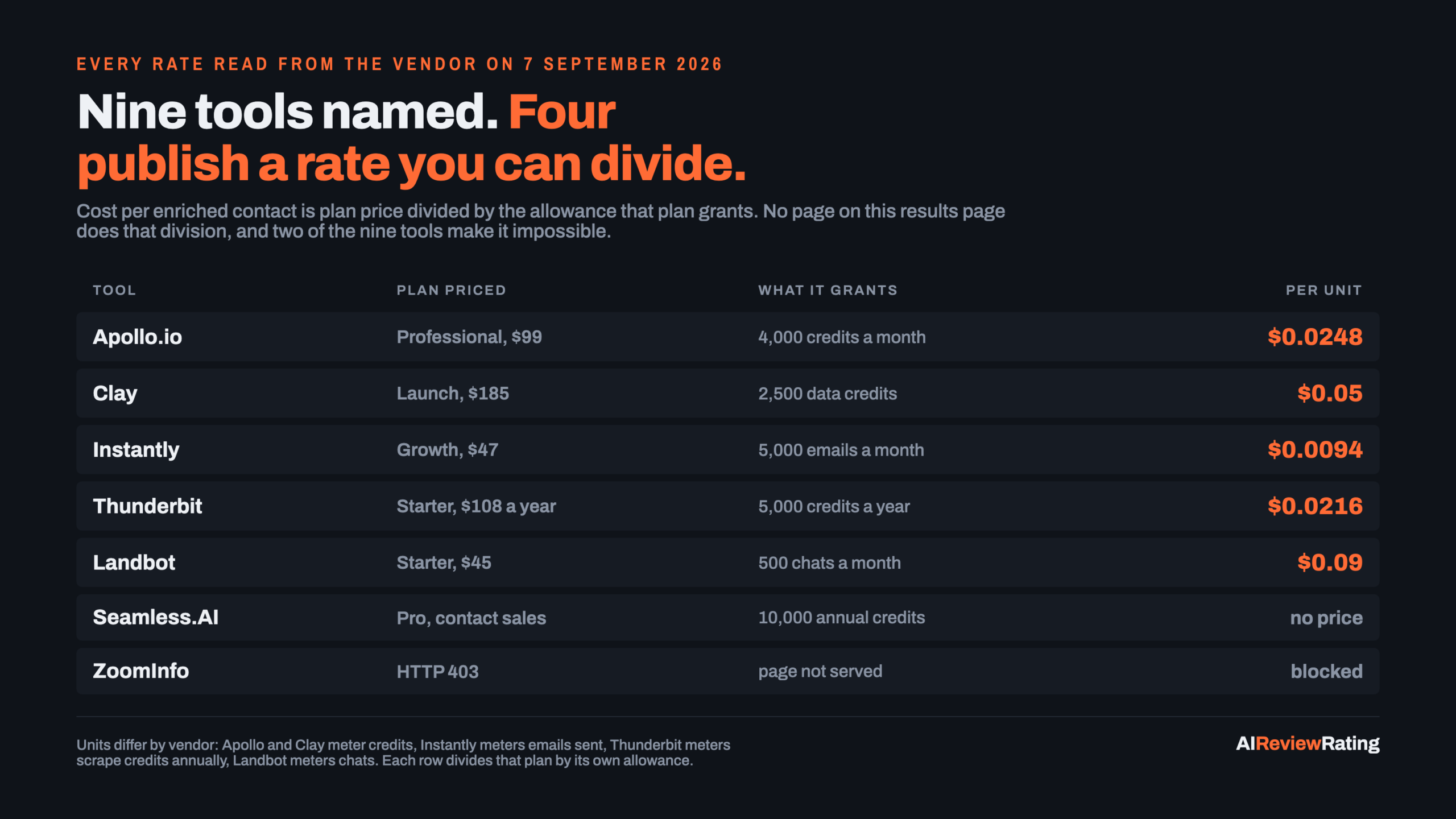
The short answer. Of the 9 tools Google’s two AI answers named for this query on 7 September 2026, four publish a rate we could divide into a unit cost, one publishes an allowance with no price, and one blocked our request. Where the arithmetic is possible it runs from $0.0248 for an Apollo credit to $0.09 for a Landbot chat on Starter, a spread of 3.6 times. Those units are not the same thing, which is the point of the table below: nobody sells “a lead”, so cost per qualified lead starts with knowing what your tool actually meters.
| Tool | Best for | Price from | What that buys, per unit |
|---|---|---|---|
| Apollo.io | One database that also sends the email | $65 per seat a month | $0.0248 per credit on Professional, and one email address is one credit |
| Clay | Enrichment across many providers at once | $185 a month | $0.05 per data credit on Launch, plus a separate actions meter |
| Instantly | Sending at volume once you have the list | $47 a month | $0.0094 per email sent on Growth |
This page is for a founder or a two-person sales team choosing a first paid prospecting stack, and it is organised around one question: what does one enriched contact cost. It does not rank these tools on features. It prices them on their own published meters, names the four cases where the vendor’s own page makes that harder than it should be, and says plainly which tools cannot be priced at all.
Why cost per enriched contact is the number, and why nobody prints it
Cost per qualified lead is the figure a founder is actually managing. You cannot get to it from a pricing page, because no vendor sells qualified leads. What they sell is one step earlier: a credit that reveals an email address, a credit that runs an enrichment, an email you are allowed to send, a chat your bot is allowed to hold. Divide the plan price by that allowance and you have the input cost. Multiply by your own conversion rate and you have the lead cost. The first half is arithmetic anyone can check. The second half is your data, not ours, and this article does not invent it.
Google’s AI Overview and AI Mode both answered this query on 7 September 2026 by grouping tools into funnel stages. Between them they named 9 products and carried zero prices. Of the 14 distinct sources the two surfaces cited, none was a pricing page.
| Tool | Plan priced | What the plan grants | Cost per that unit |
|---|---|---|---|
| Apollo.io | Professional, $99 per seat | 4,000 credits a month | $0.0248 per credit |
| Clay | Launch, $185 | 2,500 data credits a month | $0.05 per data credit |
| Instantly | Growth, $47 | 5,000 emails a month | $0.0094 per email sent |
| Thunderbit | Starter, $9 a month billed yearly | 5,000 credits a year | $0.0216 per credit |
| Landbot | Starter, $45 | 500 chats a month | $0.09 per included chat |
| Seamless.AI | Pro, price not published | Pro plans start off at 10,000 annual credits | not computable |
| ZoomInfo | not read | HTTP 403 to our request | not computable |
Clay does not have a price. It has two meters, and the headline is their sum
This is the finding worth thirty seconds of your time on Clay’s own page. Every listicle on this results page quotes Clay at $185 a month for Launch. That figure is not a plan price. It is what two sliders add up to when you leave both where the page puts them.
| Tier | Actions meter | Data credits meter | Headline shown |
|---|---|---|---|
| Launch | 15,000 for $60 | 2,500 for $125 | $185 |
| Growth | 40,000 for $205 | 6,000 for $290 | $495 |
The distinction matters because the two meters do different work and only one of them finds you a person. Actions are steps a table runs. Data credits are what a lookup costs when it returns an email address or a phone number. On Launch the actions half of that $185 is $60 and the half that actually enriches is $125, so 68 percent of the bill is the meter people mean when they say Clay is expensive.
| Data credits a month | Price | Per data credit |
|---|---|---|
| 2,500 | $125 | $0.05 |
| 6,000 | $290 | $0.0483 |
| 10,000 | $460 | $0.046 |
| 20,000 | $880 | $0.044 |
| 50,000 | $2,125 | $0.0425 |
That ladder is the volume discount, and it is shallower than it looks. Going from 2,500 data credits a month to 50,000, a 20 times jump in volume, moves the unit rate from $0.05 to $0.0425. That is 15 percent off for 17 times the spend. Compare it with Apollo below, where a credit costs $0.0248 at 4,000 a month, and the reason Clay is bought as an orchestration layer rather than as a database becomes a number instead of an opinion: it is 2.0 times the price per lookup.
One more thing the sliders hide. The same 15,000 actions cost $60 on Launch and are not offered on Growth at all, whose actions meter starts at 40,000 for $205. Moving up a tier is not a discount on what you were buying. It is a higher floor. Clay’s free tier is genuinely usable for evaluating this: 500 actions and 100 data credits a month, unlimited seats, up to 200 rows per table, and a 14 day trial on the paid tiers.
Apollo: the per-credit rate stops improving after the $99 tier
Apollo is the cheapest per unit of anything on this page that returns contact data, at $0.0248 a credit. It is also the clearest case on the page of a ladder that quietly flattens.
| Plan | Price a seat a month | Credits a seat a month | Per credit |
|---|---|---|---|
| Free | $0 | 75 | included |
| Basic | $65 | 2,500 | $0.02600 |
| Professional | $99 | 4,000 | $0.02475 |
| Organization | $149 | 6,000 | $0.02483 |
Read the last column downward. Basic to Professional is a real cut, $0.02600 to $0.02475, worth 5 percent. Professional to Organization is not a cut at all. $149 for 6,000 credits works out at $0.02483 against $0.02475 on the $99 tier, so the larger plan is fractionally dearer per credit. That is why this table is printed to five decimal places: at four they are both $0.0248 and the flattening disappears. The extra $50 a seat buys features and headroom. It does not buy cheaper data.
The second thing to know is that an Apollo credit is not a contact. Its own pricing page FAQ, read 8 September 2026, prices the actions:
| What you do | Credits it costs | Cost on Professional |
|---|---|---|
| Reveal one contact’s email | 1 | $0.0248 |
| Reveal one contact’s phone number | 8 | $0.20 |
| Both, for the same contact | 9 | $0.22 |
| Enrich one record | up to 9 | up to $0.22 |
| One minute on the dialer | 2 | $0.05 |
So “cost per enriched contact” on Apollo has three answers depending on what enriched means to you: $0.0248 for an email, $0.20 for a phone number, $0.22 for both. A team that dials will burn its allowance 9 times faster than a team that only emails, on the same plan. The Free tier grants 75 credits a seat a month, which is 8 contacts with both details or 75 email addresses.
Instantly is the cheapest per email here, and its own page disagrees with itself
Instantly meters sending rather than finding, so its unit is an email, not a contact. On that unit it is the cheapest thing on this page by a wide margin: $0.0094 an email on Growth, falling to $0.0007 on Light Speed.
| Plan | Price a month | Uploaded contacts | Emails a month | Per email | Per uploaded contact |
|---|---|---|---|---|---|
| Growth | $47 | 1,000 | 5,000 | $0.0094 | $0.05 |
| Hypergrowth | $97 | 25,000 | 125,000 (disputed) | $0.0008 | $0 |
| Light Speed | $358 | 100,000 | 500,000 | $0.0007 | $0 |
Now the defect. On one URL, on 8 September 2026, Instantly states two different email allowances for the same $97 plan. The plan card says 125,000 emails monthly. The Compare Features table further down the same page says 100,000 for the same plan. The gap is 25 percent, and it moves the unit cost from $0.0008 to $0.001 an email.
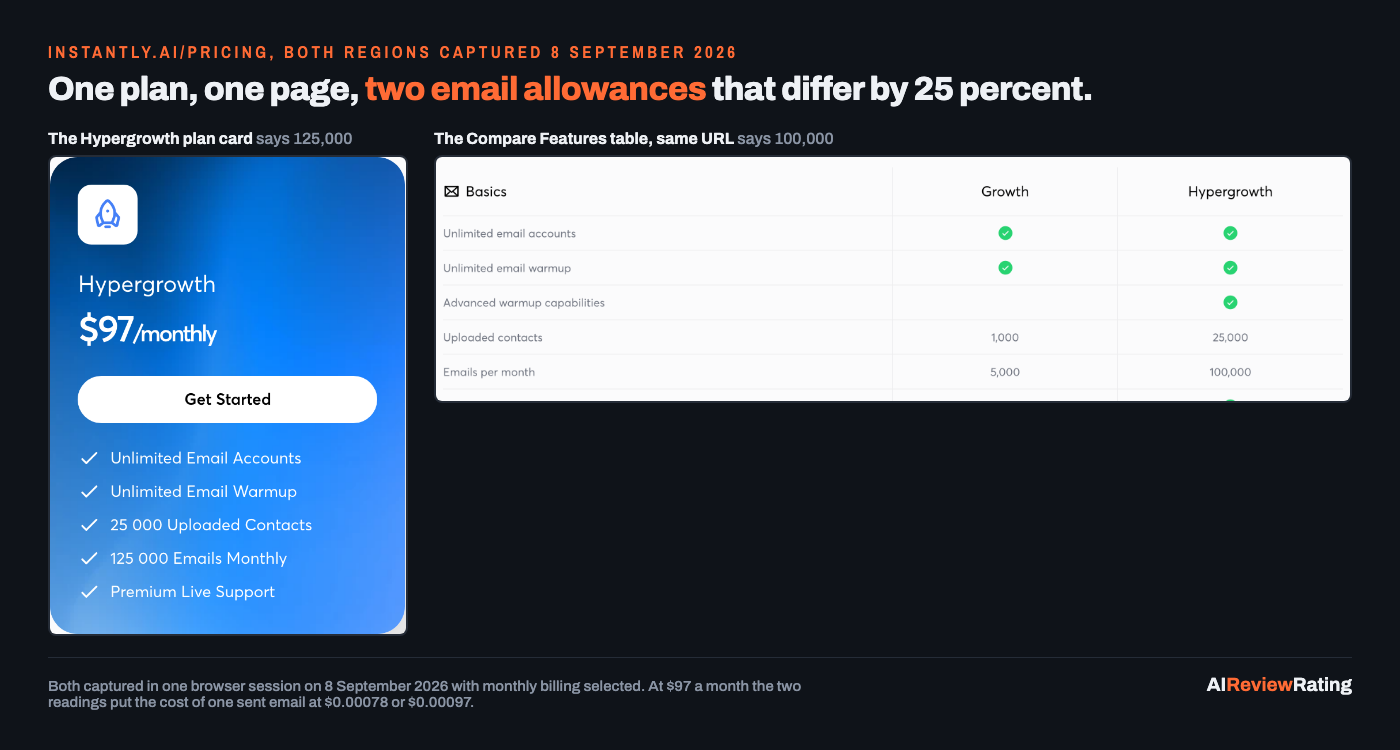
We are not calling that a trick. It reads like a plan that was uprated on the cards and not in the comparison table, or the reverse. But it is the plan most buyers land on, it is a quarter of the allowance, and it has survived at least from 7 September 2026 to 8 September 2026. If you are budgeting against Hypergrowth, get the number in writing before you commit. This is the same class of defect we documented on ElevenLabs’ pricing page, and it is common enough that reading a vendor’s comparison table against its own plan cards is worth doing every time.
Thunderbit prices in months and meters in years
Thunderbit is the scraper on Google’s roster, and the $9 on its Starter card is a real price with two conditions attached that the card states quietly. It is billed for a year up front, and the credit allowance beside it is annual, not monthly.
| Plan | Shown as | Actually billed | Credits | Credits a month | Per credit |
|---|---|---|---|---|---|
| Free | $0 | $0 | 6 pages a month | n/a | free |
| Starter | $9 a month | $108 a year | 5,000 a year | 417 | $0.0216 |
| Pro | $16.50 a month | $198 a year | 30,000 a year | 2,500 | $0.0066 |
Starter’s 5,000 credits are 417 a month, not 5,000. At $0.0216 a credit that is still cheaper per unit than a Clay data credit, and Pro is cheaper again at $0.0066, but a scraper credit and an enrichment credit are not the same good. A scraped page gives you what a website published. A data credit gives you a verified email address for a named person. Compare them on what you get, not on the word credit.
Pro is shown struck through from $24 to $16.50 under a 31% off LIMITED TIME label. No end date is published for it, so we are not describing it as expiring, and you should not assume the strike-through price is what a renewal costs.
Landbot: the chats you buy cost more than the chats you overrun into
Landbot converts inbound traffic rather than building lists, so its unit is a chat. It is the only tool on this page that publishes both an included allowance and an overage rate on the same card, which lets you price the allowance against itself.
| Plan | Price a month | Chats included | AI chats | Seats | Per included chat |
|---|---|---|---|---|---|
| Free | $0 | 100 | none | 1 | n/a |
| Starter | $45 | 500 | 100 | 2 | $0.09 |
| Professional (most popular) | $110 | 2,500 | 300 | 3 | $0.04 |
| Business | custom | custom | custom | from 5 | n/a |
Now price each bundle at Landbot’s own overage rate and see what the plan is really charging for the chats. Starter’s 500 included chats would cost $25 at $0.05 each, and the plan costs $45. So $20 of that $45 is not chat volume at all. It is the 2 seats, the integrations and the support. Professional runs the other way: its 2,500 chats would cost $125 as overage and the plan is $110, so the bundle saves $15 against buying the same volume a chat at a time.
The practical reading for a small team: Starter is a seats-and-features purchase, not a volume purchase, and the volume discount only starts at $110. If chat volume is the thing you are buying, Professional at $0.04 a chat is where the meter turns in your favour.
Landbot’s free tier is 100 chats a month with no AI chats included, which is enough to see whether the builder suits you and not enough to run anything. One caveat we could not resolve: the same page prices WhatsApp service messages in euros while every plan displays in dollars, so a WhatsApp deployment is quoted in two currencies.
The two we could not price, and why those are different failures
Both of these get named on Google’s roster for this query, and neither can be given a cost per contact from its own primary. The reasons are not the same, and collapsing them into “pricing on request” would lose the useful half.
Seamless.AI publishes an allowance and withholds the price. Its free tier is 50 credits for 1 user. Pro and Enterprise both say “Contact sales”. Its own FAQ states that Pro plans start at 10,000 annual credits, and defines a credit as one contact researched for emails, phone numbers and insights, which is a more generous unit than Apollo’s. So you know what you get and not what it costs. Cost per contact is not computable from the vendor’s own page, and we will not source a price from anywhere else.
ZoomInfo blocked us. zoominfo.com/pricing returned HTTP 403 to our rendered request on 7 September 2026. That is a refusal to serve the page, not a statement that there is no price on it. We are recording which of those two happened rather than folding a block into an absence, and no ZoomInfo figure appears anywhere in this article.
The free tiers, compared on what they actually let you finish
Free tier is the query in this category with the strongest buying intent, and it is usually answered with a yes or a no. The useful version of the answer is what one month of each free tier actually completes.
| Tool | Free allowance | What that finishes in a month |
|---|---|---|
| Apollo.io | 75 credits a seat | 75 email addresses, or 8 contacts with an email and a phone number |
| Clay | 500 actions and 100 data credits | 100 enrichment lookups across up to 200 rows a table, on unlimited seats |
| Thunderbit | 6 pages a month, max 30 credits a page | 6 scraped pages, which is an evaluation rather than a workflow |
| Landbot | 100 chats a month, 1 seat | no AI chats included, so the bot answers from your flow rather than from a model |
| Seamless.AI | 50 credits, 1 user | 50 contacts researched, on its own definition of a credit |
| Instantly | none published | the entry point is $47 a month |
Only two of these finish a real piece of work. Clay’s 100 data credits and Apollo’s 75 are both enough to test a list of a hundred names against your own conversion data, which is the only test that settles this decision. Run the same fifty companies through both before paying either.
What Google cited for this query, and why it is worth knowing
One observation for the marketing reader, because it changes where you would spend to be found for this query. Across both of Google’s AI answers on 7 September 2026, 7 of the 14 distinct sources cited were YouTube videos. Not blog posts. Videos.
| Surface | Distinct sources cited | Of which YouTube |
|---|---|---|
| AI Overview | 7 | 4 |
| AI Mode | 11 | 6 |
| Both, deduplicated | 14 | 7 |
Two further details worth having. The only vendor cited by both surfaces was Clay, for its own blog. And the top two results in the video pack for this query are published by two of the vendors being compared, Landbot and Instantly, on their own channels. A buying query in this category is being answered largely by video, and a good deal of that video is made by the companies in the answer. That is not a scandal, it is a media gap, and it is the least contested surface a small vendor could still compete on for this query.
Position one in the organic results was a Reddit thread in r/SaaS asking which of these tools are worth it. We cite it rather than quote it: reddit.com returns HTTP 403 to anonymous reads, so we could not read the thread on our own account and will not paraphrase a page we did not open.
How we checked this
- Every price was read from the vendor’s own pricing page in a rendered browser, with the monthly toggle clicked rather than left at its default. An annual-equivalent quoted as a monthly price is the most common way these comparisons go wrong.
- The capture was made on 7 September 2026. Three rows that did not render that day, Apollo’s Organization credit allowance and Landbot’s chat and seat allowances, were read again on 8 September 2026 and are dated to that day in the tables above. Instantly’s two contradicting regions were re-read the same day to confirm the defect had not been fixed.
- No review aggregator, directory or competitor listicle is a source for anything on this page. Where a figure could not be read from a vendor primary it was cut, and the cuts are listed below rather than hedged.
- Unit costs are our arithmetic on the vendor’s own two numbers, price and allowance. They are not vendor claims and no vendor publishes them.
- We hold no affiliate relationship with any tool on this page, and the ordering is by published unit cost, not by anything we earn.
Our catalogue holds 120 tools under Sales, 50 under Marketing and 33 under Web Scraping. Lead generation is not a category on our site, and stapling those three together would have produced a list padded with chatbots, landing page builders and document parsers. The roster on this page is instead the intersection of what Google named for the query and what we could price from a primary, which is why it is six tools and not fifteen. Four of them have a review page on this site and two do not, and we say which rather than linking a near-miss.
What we could not verify, and therefore did not print
- ZoomInfo, everything
- Apollo’s ‘275 million verified contacts’ claim, not on the pricing page
- Landbot per-conversation rates
- Any cost per qualified lead we did not measure ourselves
The second of those is worth naming. Google’s AI Mode answer for this query on 7 September 2026 credited Apollo with over 275 million verified contacts and Instantly with a database of 450 million. Neither figure is on the pricing page we read, so neither appears above. Database size is also the claim in this category with the least agreed definition, and it is not a cost.
Questions people ask about this
How can I use AI for lead generation?
In three metered steps, and each vendor sells one of them. Building and enriching a list, which Clay and Apollo.io meter in credits at $0.05 and $0.0248 each. Sending the outreach, which Instantly meters in emails at $0.0094 on its $47 plan. Converting the inbound traffic you already have, which Landbot meters in chats at $0.09 each on Starter. Rates read 7 September 2026, Apollo and Landbot re-read 8 September 2026. Buying all three from one vendor is rarely cheaper; buying the wrong one first is the expensive mistake.
Which tool is best for lead generation?
On cost per unit of contact data, Apollo.io at $0.0248 a credit is the cheapest we could price, and one credit is one email address. On cost per email sent, Instantly at $0.0094 is the cheapest. Clay is 2.0 times Apollo per lookup and is bought for orchestrating many providers rather than for cheap data. There is no single answer because the three meter different things, which is why this page prices each on its own unit rather than ranking them against each other.
What are the top 5 AI lead generation tools in 2026?
Google’s AI Overview named Clay, Apollo.io, Instantly, Landbot, ZoomInfo Copilot on 7 September 2026, and its AI Mode added Thunderbit, Seamless.AI, Hey Reach, Pipedrive LeadBooster. That is the roster this page prices, minus the two it could not: Seamless.AI publishes an allowance with no price, and ZoomInfo returned HTTP 403 to our request. Of the nine names, four have a published rate we could divide into a unit cost.
Is there a free AI lead generation tool?
Several, and two of them finish real work in a month. Apollo.io grants 75 credits a seat a month, which is 75 email addresses or 8 contacts with an email and a phone number. Clay grants 100 data credits and 500 actions a month on unlimited seats. Thunderbit grants 6 pages a month and Landbot 100 chats. Instantly publishes no free tier. All read 7 September 2026, Apollo and Landbot 8 September 2026.
How much does Clay actually cost per month?
The card says $185 for Launch, and that figure is the sum of two sliders you can move independently: 15,000 actions at $60 plus 2,500 data credits at $125. Growth is the same arithmetic, $205 plus $290 equals $495. Your real monthly cost is whatever the two meters read at your volume, and the data credit ladder runs from $0.05 each at 2,500 a month to $0.0425 at 50,000. Read 7 September 2026.
What does an Apollo credit buy?
One credit reveals one contact’s email address. A phone number costs 8 credits, so the same contact with both details costs 9. On the $99 Professional plan, at $0.0248 a credit, that is $0.0248 for an email and $0.22 for a contact you can also call. An enrichment costs up to 9 credits a record and the dialer costs 2 a minute. Apollo’s own pricing page FAQ, read 8 September 2026.
Why will ZoomInfo and Seamless.AI not show a price?
They are two different situations and it is worth keeping them apart. Seamless.AI publishes a page: the free tier is 50 credits, and Pro and Enterprise both say “Contact sales” while the FAQ states that Pro starts at 10,000 annual credits. So there is an allowance and no price, and a cost per contact cannot be derived. ZoomInfo is different: its pricing URL returned HTTP 403 to our request on 7 September 2026, which is a refusal to serve us the page rather than evidence about what is on it.
What is cost per enriched contact, and how do I turn it into cost per lead?
It is the plan price divided by the allowance that plan grants, in whatever unit the vendor meters. On this page it runs from $0.0248 for an Apollo credit up to $0.09 for a Landbot chat, with Thunderbit at $0.0216 a scrape credit in between. To get cost per qualified lead, multiply by the number of contacts your process consumes to produce one qualified conversation. That multiplier is your data and no vendor can give it to you, which is why every page that quotes a cost per lead without asking about your funnel is quoting a number it made up.
Related reading on this site
- Best open source AI tools you can self-host, our 2026 audit of what each one replaces and the monthly spend it avoids.
- ElevenLabs pricing per finished minute, the same cost-per-unit method applied to voice.
- Self-hosting an LLM against paying per token, for the enrichment steps you might run yourself.
Sources
- Clay pricing: clay.com/pricing, read in a rendered browser on 7 September 2026.
- Apollo.io pricing: apollo.io/pricing, read in a rendered browser on 7 September 2026.
- Instantly pricing: instantly.ai/pricing, read in a rendered browser on 7 September 2026.
- Thunderbit pricing: thunderbit.com/pricing, read in a rendered browser on 7 September 2026.
- Landbot pricing: landbot.io/pricing, read in a rendered browser on 7 September 2026.
- Seamless.AI pricing: seamless.ai/pricing, read in a rendered browser on 7 September 2026.
- ZoomInfo pricing: zoominfo.com/pricing returned HTTP 403 to our request on 7 September 2026. Not a source, recorded as a block.
- Google AI Overview and AI Mode for this query, captured 7 September 2026. 14 distinct sources cited between them.
- Reddit r/SaaS thread, cited not quoted (reddit.com returns HTTP 403 to anonymous reads)
- Landbot, 5 NEW AI That Just Changed Lead Generation Forever, 14:07, position 1 in the video pack for this query on 7 September 2026.
- Instantly, I Tried 100 Lead Generation Tools. These Are The Best, 11:51, position 2 in the video pack for this query on 7 September 2026.
- James Bonadies, Top AI Lead List Scraping Tools in 2026 (These Got Me …, 9:49, position 3 in the video pack for this query on 7 September 2026.

Comments
Sign in to join the discussion.
Login to comment