Audited 27 September 2026. Install counts from the open Claude Code Templates registry (aitmpl.com), 2026-09-26. Every agent file read on the main branch, and every price read from Anthropic’s own pages, on 27 September 2026.
The short answer
If you lead an engineering team on Claude Code and you are deciding which subagents go into the shared .claude/agents/ folder, install the agents that check work before the ones that write it. Anthropic’s own documentation says a subagent earns its keep when the work is self-contained, throws off output you do not need in the main conversation, and can come back as a summary. Reviewing a change, chasing a bug through logs and running a test suite all fit. Building a feature usually does not, because planning, implementation and testing share context, and the same documentation says that kind of work belongs in the main conversation.
The money side decides the rest. Anthropic puts Claude Code at about $13 per developer per active day and $150 to $250 per developer per month across enterprise deployments, and every subagent sends its own requests on top of the developer’s session. The model line in each file sets the rate, and 9 of the 12 most installed subagents have none, so they run on whatever model the developer happens to be using.
Our picks from the 12 most installed: code-reviewer, debugger and test-engineer first, security-auditor for a team facing a compliance audit, and the three builder roles, frontend-developer, fullstack-developer and python-pro, only after you edit them to your stack. Each one is free to install and is billed as ordinary Claude usage when it runs.
| Subagent | Installs | Where it pays off | Runs on, API price per million tokens |
|---|---|---|---|
code-reviewer |
30,065 | A severity-ranked review of every change, ending in a merge call | Your session’s model: $2 in, $10 out on Claude Sonnet 5, $4 in, $20 out on Claude Opus 5.5 |
debugger |
13,013 | Root-causing a failure without flooding the session with logs | Claude Sonnet 4.5 as shipped, $3 in, $15 out |
test-engineer |
9,374 | Running the suite and reporting only what failed | Your session’s model, same rates as the first row |
The 12 most installed, and what their files actually grant
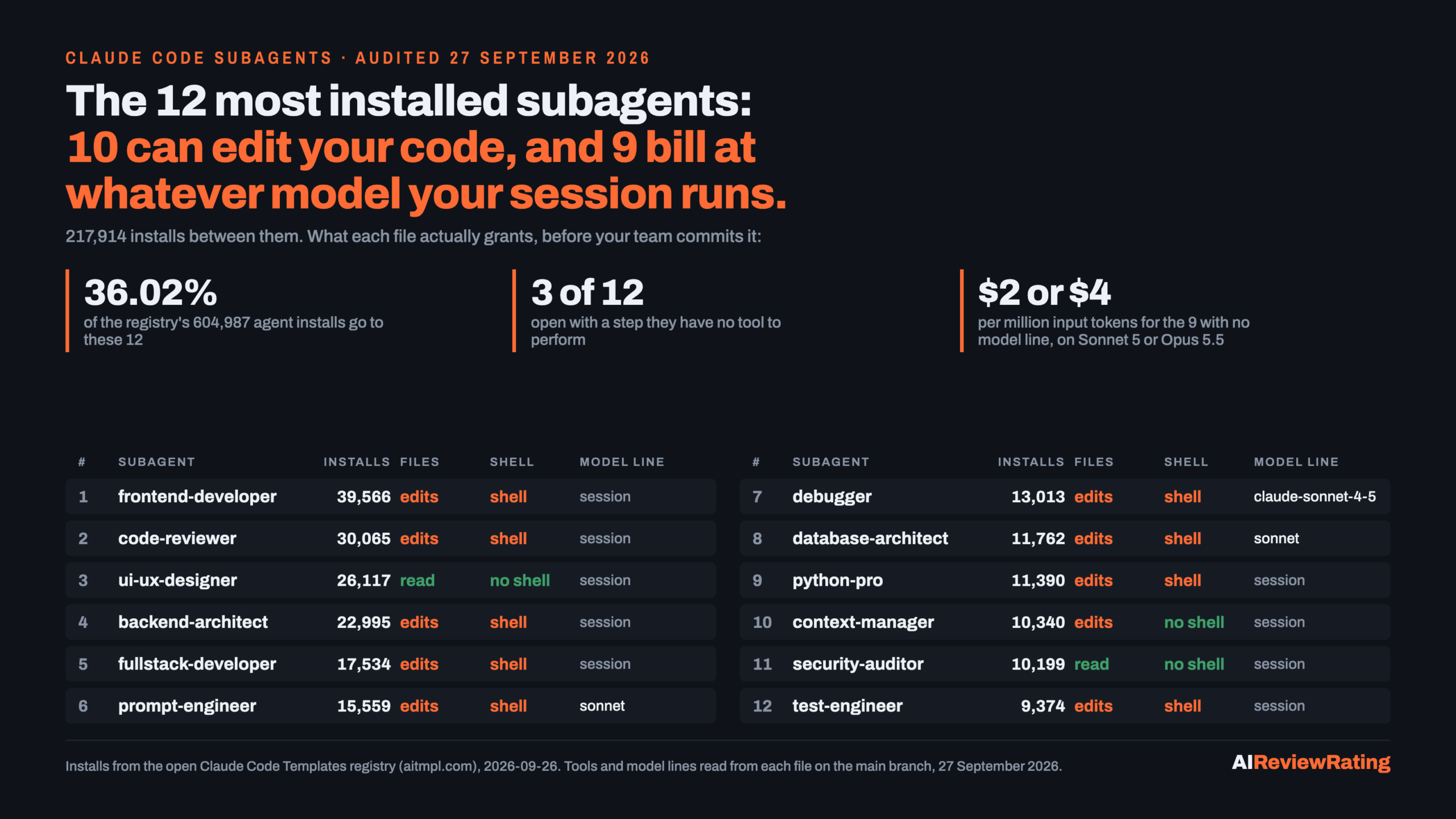
The roster is not our ranking. It is the install count from the open Claude Code Templates registry (aitmpl.com), 2026-09-26, which lists 422 agents in 28 categories. These 12 account for 217,914 of the 604,987 agent installs the registry records, or 36.02 percent. Half of the 422 agents have 475 installs or fewer.
Installs measure popularity, not quality. The installer sends one anonymous event per successful install, carrying the component’s type, name, path, category and CLI version and no user identifier, and it sends nothing when CI=true is set or a developer opts out. A number below is a count of install events, not of teams, and says nothing about whether the agent did its job afterwards. That is what the rest of this page checks.
| # | Subagent | Installs | Edits files | Runs shell | Model line | File last changed | Our verdict |
|---|---|---|---|---|---|---|---|
| 1 | frontend-developer | 39,566 | yes | yes | none | 8 April 2026 | Edit first |
| 2 | code-reviewer | 30,065 | yes | yes | none | 2 April 2026 | Install first |
| 3 | ui-ux-designer | 26,117 | no | no | none | 26 March 2026 | UI without a designer |
| 4 | backend-architect | 22,995 | yes | yes | none | 26 March 2026 | New services only |
| 5 | fullstack-developer | 17,534 | yes | yes | none | 27 March 2026 | Only on its stack |
| 6 | prompt-engineer | 15,559 | yes | yes | sonnet |
17 August 2026 | Only if you ship prompts |
| 7 | debugger | 13,013 | yes | yes | claude-sonnet-4-5 |
19 April 2026 | Install first |
| 8 | database-architect | 11,762 | yes | yes | sonnet |
9 May 2026 | Schema-heavy teams |
| 9 | python-pro | 11,390 | yes | yes | none | 31 March 2026 | Edit first |
| 10 | context-manager | 10,340 | yes | no | none | 26 March 2026 | Skip as shipped |
| 11 | security-auditor | 10,199 | no | no | none | 26 March 2026 | Before an audit |
| 12 | test-engineer | 9,374 | yes | yes | none | 26 March 2026 | Install first |
Four things in that table that change what you install
- 10 of the 12 can edit files and 9 can run shell commands, including the reviewer. Anthropic’s documented sample code reviewer gets Read, Glob and Grep, with Bash added in one variant, and never Write or Edit. The registry’s
code-reviewerships with Read, Write, Edit, Bash, Glob, Grep. A reviewer that can edit can change the code it is reviewing. Onlyui-ux-designerandsecurity-auditorare read-only. - 3 open with a step they cannot perform.
frontend-developer,python-proandsecurity-auditoreach begin by consulting a context manager, but none of the 12 lists theAgenttool, and Anthropic’s documentation says an agent without it cannot start a subagent. Claude Code already loads your CLAUDE.md files into a custom subagent when it starts, so put project context there and delete the step. - No subagent can ask you a question. Claude Code withholds its question tool,
AskUserQuestion, from every subagent. Theprompt-engineerhas a required five-question interview as its first step, anddatabase-architectwants read and write ratios, data volumes and latency targets. Put the answers in your request, or run the agent as the whole session withclaude --agent prompt-engineer, where the conversation is yours. - 5 of the 12 ask to be used proactively.
ui-ux-designer,backend-architect,database-architect,context-managerandtest-engineercarry that phrase in their descriptions, and Claude Code’s documentation says it encourages Claude to delegate without being asked. Unrequested delegation is unrequested spend; delete the phrase from any agent you want only on request.
What each subagent costs to run: the model line is a budget line
Every subagent sends its own requests. On a Pro, Max, Team or Enterprise plan they draw on the same usage limits as the developer’s session; on the Claude Console or a cloud provider they are billed per token. Anthropic’s costs page gives the scale: about $13 per developer per active day on average across enterprise deployments, under $30 per active day for 90 percent of users. Claude Code picks a subagent’s model in this order: a model Claude passes for that one call, then the file’s model line, then the CLAUDE_CODE_SUBAGENT_MODEL environment variable, then the main conversation’s model.
| Model line | Subagents in the top 12 | Runs on, Anthropic API | Input, per million tokens | Output, per million tokens |
|---|---|---|---|---|
| none | 9: frontend-developer, code-reviewer, ui-ux-designer, backend-architect, fullstack-developer, python-pro, context-manager, security-auditor, test-engineer | The developer’s session model, for example Claude Opus 5.5 or Claude Sonnet 5 | $4 or $2 | $20 or $10 |
sonnet |
2: prompt-engineer, database-architect | Claude Sonnet 5; Claude Sonnet 4.5 on Amazon Bedrock and Google Cloud | $2 | $10 |
claude-sonnet-4-5 |
1: debugger | Claude Sonnet 4.5 on every provider | $3 | $15 |
haiku |
0, but Anthropic suggests it for simple subagent tasks | Claude Haiku 4.5 | $1 | $5 |
Two consequences follow. A developer who switches the session to Opus moves 9 of these 12 onto Opus as well, at twice the Sonnet 5 rate per token, and Anthropic’s costs page names Opus left as the default model as a usual cause of unexpectedly high spend. And the debugger‘s pinned Sonnet 4.5 lists at $3 per million input tokens against $2 for Sonnet 5. Anthropic also notes that Claude 4.7 and later models count about 30 percent more tokens for the same text, so the gap per task is narrower than the rate card suggests, but the pin still stops the agent following the sonnet alias.
The levers are small edits. Change one agent’s model line, or put every subagent on one model by setting CLAUDE_CODE_SUBAGENT_MODEL to haiku and CLAUDE_CODE_SUBAGENT_MODEL_FORCE to 1 in the env block of your settings, which needs Claude Code v2.1.257 or later. Then measure: on subscription plans the /usage screen attributes recent usage to subagents as a percentage of the total, which is the number to watch the week after you add one.
{
  "env": {
    "CLAUDE_CODE_SUBAGENT_MODEL": "haiku",
    "CLAUDE_CODE_SUBAGENT_MODEL_FORCE": "1"
  }
}
The description tax you pay in every session
Claude reads each custom subagent’s description to decide when to delegate, and Anthropic’s documentation says those descriptions take up context; the prompt body loads only when the subagent runs. The 12 descriptions total 26,364 characters, about 6,600 tokens by the rule of about 4 characters a token on Anthropic’s pricing page, because 9 of them embed worked example conversations. The prompt-engineer description alone runs to 3,769 characters. Claude Code prints a warning at startup once custom descriptions pass 15,000 tokens.
By the same rule of thumb, the running total of the registry’s descriptions passes that line at the 29th most installed agent, and all 422 together come to about 131,000 tokens. Install the handful you will use, and trim the example conversations out of their descriptions into the body, which is Anthropic’s own advice.
The 12, one by one
Each entry says what the file actually instructs, in our words, when it pays back the review or build time it costs, when to leave it out, and what to change before you commit it for the team.
1. frontend-developer: 39,566 installs
What it does. Acts as a senior UI engineer across React 19, Vue 3.5 and Angular 20, with firm tooling defaults for new projects (Vite, pnpm, Tailwind v4, Biome or ESLint 9) and TanStack Query plus Zustand for state on React. It scaffolds components, wires state and writes tests alongside the code, and on an existing project it is told to match the current toolchain before proposing upgrades.
Pays off when a UI task is specified well enough to hand off whole, such as a new component with a known API, and you want it built alongside other work. Add isolation: worktree to its frontmatter so it builds in a temporary git worktree rather than in your checkout.
Skip it when the work is iterative styling with a person reacting to each pass. Anthropic’s documentation puts back-and-forth refinement in the main conversation, where you can steer every step.
Before you commit it: delete the mandatory opening step that asks the context manager for project context, which it has no tool to reach, and put that context in CLAUDE.md instead. At 39,566 installs it is the most installed agent in the registry, so it is the file most likely to reach your repository unedited.
File facts, 27 September 2026: tools Read, Write, Edit, Bash, Glob, Grep; model line none, follows your session; prompt 1,475 words; description 381 words; last changed 8 April 2026. Verdict: Edit first.
2. code-reviewer: 30,065 installs
What it does. Scopes the change from git, runs whichever dependency audit fits the project (npm audit, pip-audit or cargo audit), searches the changed files for hard-coded secrets, and reads the code with a depth that scales with the diff: every file under 20 changed files, the diff plus the risky files up to 100, and a request to narrow the scope beyond that. Findings come back ranked critical, high, medium or low with a file and line, and the review ends with a merge call: block, approve with suggestions, or approve. It reads team conventions from CLAUDE.md and .editorconfig.
Pays off when you want every change reviewed before a person spends time on it. The work is self-contained, the output is a list, and the noisy part, audit output and file reads, stays out of the developer’s session.
Skip it when a hosted reviewer is already your gate. CodeRabbit and GitHub Copilot code review both review pull requests and both offer reviews inside the editor, per their own pages on 27 September 2026. Two automated reviewers on one diff means two lists to triage; pick one to be the gate.
Before you commit it: add disallowedTools: Write, Edit to the frontmatter, which keeps Bash for the audits and stops edits. Its default scope, git diff HEAD~1, compares against the commit before the last one, so on a branch with several commits, name the base branch in your request.
File facts, 27 September 2026: tools Read, Write, Edit, Bash, Glob, Grep; model line none, follows your session; prompt 1,003 words; description 343 words; last changed 2 April 2026. Verdict: Install first.
3. ui-ux-designer: 26,117 installs
What it does. Critiques design rather than building it. It reads CSS, HTML, screenshots and design tokens and returns opinionated, source-cited feedback, with a stated mission against generic AI-looking interfaces, a list of fonts it will not accept that includes Inter and Roboto, and a section on interface patterns for AI products such as streamed output and loading states.
Pays off when a team ships UI without a dedicated designer and wants a second opinion before release. It cannot edit files or run commands, so a wrong call costs you a bad suggestion, not a bad commit.
Skip it when your design system deliberately uses a font on its banned list. It will argue with your brand on every review.
Before you commit it: note the licence. The file carries its own notice, Creative Commons Attribution 4.0 with attribution required, crediting Madina Gbotoe, rather than the repository’s MIT licence. Keep the credit if you modify and share it. Its description asks to be used proactively, so expect it on any UI conversation.
File facts, 27 September 2026: tools Read, Grep, Glob, WebFetch; model line none, follows your session; prompt 2,716 words; description 66 words; last changed 26 March 2026. Verdict: UI without a designer.
4. backend-architect: 22,995 installs
What it does. Turns a service idea into a design package: the API style with its trade-off, contract-first endpoint definitions and an OpenAPI 3.1 spec, service boundaries, schema and indexes, event schemas, caching and security per layer, with observability designed in (structured logs, OpenTelemetry traces, rate, error and duration metrics, health endpoints).
Pays off when you are starting a new service and want a written first draft to argue with. A design document is exactly the kind of summary a subagent hands back well.
Skip it when the change lives inside an existing service. A full design package for a small change is overhead, and the description asks for proactive use, so remove that phrase unless you want design documents offered unprompted.
Before you commit it: give it your load, consistency needs and constraints in the request, since it cannot ask. At 403 words it has one of the two shortest prompts of the 12, and it carries Write, Edit and Bash although its output is a document.
File facts, 27 September 2026: tools Read, Write, Edit, Bash, Grep, Glob; model line none, follows your session; prompt 403 words; description 260 words; last changed 26 March 2026. Verdict: New services only.
5. fullstack-developer: 17,534 installs
What it does. Builds a feature end to end on one specific stack: Next.js 15 or later with React Server Components, Node.js 22 with Hono or tRPC, PostgreSQL through Drizzle, shared TypeScript types and Zod schemas, deployed on Vercel, Railway or Fly.io. It fixes the data model and API contract first, then builds both sides against them.
Pays off when your stack is that stack. The conventions are specific enough to settle the arguments a generic prompt would start.
Skip it when you run anything else. On a Django, Rails, Go or Java backend you would be fighting its defaults on every task.
Before you commit it: its closing section tells it to coordinate with 8 other agents. All 8 exist in the registry, only one of them, security-auditor, is in the top 12, installing this agent installs none of them, and without the Agent tool it could not call them anyway. Delete the section, or install and wire those agents on purpose.
File facts, 27 September 2026: tools Read, Write, Edit, Bash, Glob, Grep; model line none, follows your session; prompt 937 words; description 449 words; last changed 27 March 2026. Verdict: Only on its stack.
6. prompt-engineer: 15,559 installs
What it does. Rewrites and tests prompts for features built on Claude: tagged structure, worked examples, long documents placed before the instructions, calm instructions in place of capital-letter warnings, prompt caching, and a fixed test set with measured accuracy, latency and cost before a prompt ships. It can search the web.
Pays off when your product ships prompts, such as a support bot, an extraction pipeline or an agent, and prompt changes need evidence rather than taste.
Skip it when you use Claude Code only to write ordinary application code. Nothing in it speeds that up.
Before you commit it: run it as the session with claude --agent prompt-engineer so its five opening questions reach you, or answer them in the request. The registry also holds a second agent with the same name in its data-ai category, so install this one by its full path, ai-specialists/prompt-engineer. This file was the last of the 12 to change, on 17 August 2026.
File facts, 27 September 2026: tools Read, Write, Edit, Bash, Glob, Grep, WebSearch; model line sonnet; prompt 2,231 words; description 507 words; last changed 17 August 2026. Verdict: Only if you ship prompts.
7. debugger: 13,013 installs
What it does. Works a failure in a fixed order: reproduce it, state observed against expected behaviour, rank 2 or 3 hypotheses, run the cheapest experiment that could disprove the leading one, then fix it with a regression test and record the root cause. For production incidents it starts from traces, the logs around the first error and whatever changed in the 30 minutes before it.
Pays off when the investigation is log-heavy. Stack traces and log slices are exactly the verbose output Anthropic’s documentation says to keep inside a subagent, so the developer’s session gets the root cause, not the noise.
Skip it when the bug is a one-line fix you can already see. A fresh subagent has to rebuild context first, which the documentation flags as a latency cost.
Before you commit it: change the model line. It pins claude-sonnet-4-5, listed at $3 and $15 per million input and output tokens, while the sonnet alias selects Claude Sonnet 5 at $2 and $10 on the Anthropic API. Use sonnet, or inherit to follow the session, unless you have tested it on Sonnet 4.5 on purpose.
File facts, 27 September 2026: tools Read, Write, Edit, Bash, Glob, Grep; model line claude-sonnet-4-5; prompt 795 words; description 279 words; last changed 19 April 2026. Verdict: Install first.
8. database-architect: 11,762 installs
What it does. Finds your existing migrations and ORM schemas first, classifies the request as new design, schema change, technology choice or performance restructuring, then delivers artefacts rather than advice: DDL with constraints and indexes, migrations with a rollback, and a written technology rationale. It covers multi-tenant isolation, including PostgreSQL row-level security.
Pays off when schema changes are where your incidents come from. A migration with a written rollback is the artefact a lead wants to review.
Skip it when your database is a managed default you rarely touch.
Before you commit it: supply the read and write ratio, data volumes and latency targets it asks for, or it will infer them. 78.7 percent of its 2,444-word prompt is sample SQL and Python, and its description asks for proactive use.
File facts, 27 September 2026: tools Read, Write, Edit, Bash, Glob, Grep; model line sonnet; prompt 2,444 words; description 401 words; last changed 9 May 2026. Verdict: Schema-heavy teams.
9. python-pro: 11,390 installs
What it does. Writes Python to a modern house standard: type hints throughout under strict mypy or pyright, ruff for linting and formatting, uv and pyproject.toml for dependencies, pytest with coverage above 90 percent, and bandit for security scanning.
Pays off when your Python repositories already follow that standard, or you want them to.
Skip it when your standard differs, for example Poetry or Black. It will push its own tooling in every change.
Before you commit it: like frontend-developer, it opens by querying a context manager it cannot reach. Put your conventions in CLAUDE.md and delete the step.
File facts, 27 September 2026: tools Read, Write, Edit, Bash, Glob, Grep; model line none, follows your session; prompt 1,137 words; description 318 words; last changed 31 March 2026. Verdict: Edit first.
10. context-manager: 10,340 installs
What it does. Is meant to keep project state coherent across agents and sessions: capture decisions, brief the next agent, keep an index and suggest when to compact. At 246 words it has the shortest prompt of the 12.
Pays off when you give it a memory scope, because as shipped it sets none: between conversations it keeps only what it writes to files, and the three agents that ask for it cannot call it.
Skip it when what you want is memory. Claude Code has a documented memory field that gives any subagent a persistent directory at user, project or local scope, with the first 200 lines of its MEMORY.md loaded at start. For memory across the whole session rather than one agent, Claude Mem is an Apache 2.0 plugin for Claude Code that captures tool-use observations and feeds summaries to later sessions.
Before you commit it: if you keep it, add memory: project and install it by its full path, development-tools/context-manager; a second agent with the same name sits in another category of the registry.
File facts, 27 September 2026: tools Read, Write, Edit, TodoWrite; model line none, follows your session; prompt 246 words; description 25 words; last changed 26 March 2026. Verdict: Skip as shipped.
11. security-auditor: 10,199 installs
What it does. Reviews code and configuration against compliance frameworks (SOC 2 Type II, ISO 27001, HIPAA, PCI DSS, GDPR, NIST and CIS benchmarks), across access control, data handling, infrastructure, application security and incident response, and returns findings with remediation. It is strictly read-only.
Pays off when an audit is coming and you want a gap list before the auditor writes one. It cannot change anything, so it is safe to point at production configuration.
Skip it when you need vulnerability scanning. Without shell access it cannot run a scanner, so keep SAST and dependency scanning in CI and use this agent for the reading.
Before you commit it: delete its opening step that consults a context manager, which it cannot reach.
File facts, 27 September 2026: tools Read, Grep, Glob; model line none, follows your session; prompt 854 words; description 351 words; last changed 26 March 2026. Verdict: Before an audit.
12. test-engineer: 9,374 installs
What it does. Plans and writes tests across a pyramid split 70, 20 and 10 between unit, integration and end-to-end, with sample harnesses for Jest, Playwright and a CI pipeline, and an 80 percent coverage threshold in its sample configuration. 90.5 percent of its 2,479-word prompt is sample JavaScript and YAML.
Pays off when you hand it the job Anthropic’s documentation uses as its example of work to push into a subagent: run the suite and report only the failing tests with their errors.
Skip it when your stack is not JavaScript and you expect its samples to apply. They are Jest-first.
Before you commit it: its description is 21 words, the shortest of the 12, and asks for proactive use. Add your test runner and test paths to it so Claude delegates the right work.
File facts, 27 September 2026: tools Read, Write, Edit, Bash; model line none, follows your session; prompt 2,479 words; description 21 words; last changed 26 March 2026. Verdict: Install first.
How to install one, checked against the README and the installer’s source
From the root of the project, the README’s own command installs one agent, and the CLI’s help text says --agent also takes a comma-separated list. Running it with no flags opens an interactive menu.
npx claude-code-templates@latest --agent development-tools/code-reviewer --yes

npx claude-code-templates@latest --agent development-tools/code-reviewer,development-tools/debugger,development-tools/test-engineer --yes
What that does, read from the installer source: it downloads the agent file from the repository’s main branch at that moment and writes it to .claude/agents/<name>.md under the current directory, or under the folder --directory names. It drops the category from the path, and that is all it installs for an agent, so copying the file there by hand gives the same result. It then posts the anonymous install event described above; set CCT_NO_TRACKING=true to opt out.
Three things to do next. First, commit .claude/agents/. The installer pulls whatever is on the main branch, so two developers installing weeks apart can get different files, and Anthropic’s documentation recommends checking project subagents into version control so the team uses one reviewed copy. A project agent also outranks a personal one in ~/.claude/agents/ with the same name. Second, watch for name collisions: the registry’s 422 agents share 409 names, 13 names belong to two entries each, and because the category is dropped on install, the second of a pair overwrites the first. Third, use it. Claude Code picks up a new file within a few seconds, no restart; name the agent in a request, @-mention it to force it, or start a session as it with claude --agent code-reviewer.
The one edit we would make before the first commit, for the reviewer:
---
name: code-reviewer
description: ...
tools: Read, Write, Edit, Bash, Glob, Grep
disallowedTools: Write, Edit
---
What we cut, and why
The rule on this site is that anything we could not verify gets removed rather than hedged. Removed from this article:
- Minutes saved per subagent. No vendor publishes it and we did not run a controlled test, so there is no time-saved figure on this page. The verdicts rest on Anthropic’s own criteria for when a subagent helps and on what each file actually grants.
- Statistics quoted inside the agent files. Several files cite figures such as usage shares and quality gains. Those are the files’ claims, not ours, and we did not verify them, so none is repeated.
- Where each file came from. The README credits several community collections, including 48 agents from wshobson/agents, but does not map files to sources. Only the ui-ux-designer names its author inside the file, so that is the only credit stated.
- Teams per agent. Install events carry no user identifier, so the counts cannot be turned into a number of teams or developers.
- Google’s roster for this query. This audit did not capture the results page, so the roster is the registry’s install ranking, not what a search engine or an AI answer names.
- Star counts for other subagent collections that appeared in search results. We did not read them from GitHub, so they are not here.
How we tested
The roster comes from the open Claude Code Templates registry (aitmpl.com), snapshot of 26 September 2026, released under the MIT licence: 422 agents ranked by the install count its CLI records. Each of the 12 files was read from the main branch of davila7/claude-code-templates on 27 September 2026; tools, model line and description come from the file’s frontmatter, word counts are whitespace-separated words, the sample-code shares count words inside fenced code blocks, and the last change is the newest commit touching each file on GitHub’s commits endpoint. The registry’s description strings match the files exactly for all 12. Installer behaviour was read from its source. Claude Code behaviour comes from Anthropic’s documentation on subagents, costs, model configuration, agent teams and skills, and every rate from Anthropic’s API pricing page, all read on 27 September 2026. We did not benchmark the agents. The licence reading follows the method in our open source tools audit.
Questions engineering leads ask about Claude Code subagents
What are the best Claude Code subagents?
By installs, frontend-developer leads with 39,566, then code-reviewer with 30,065 and ui-ux-designer with 26,117, from the open Claude Code Templates registry snapshot of 26 September 2026. By fit, the ones that pay back review and build time are the ones that do self-contained work and return a short report: code-reviewer, debugger and test-engineer, with security-auditor for teams heading into an audit. The builder roles need editing to your stack before they help.
Where do Claude Code subagents live, and how does a team share them?
Project subagents live in .claude/agents/ inside the repository and personal ones in ~/.claude/agents/. When two share a name, the project one wins. Anthropic recommends checking project subagents into version control so the whole team uses and improves the same files, which also pins the version you reviewed, since the Claude Code Templates installer pulls whatever is on its main branch at install time.
Which model does a Claude Code subagent use?
Claude Code checks, in order, a model Claude passes for that call, the file’s model line, the CLAUDE_CODE_SUBAGENT_MODEL environment variable, and finally the main conversation’s model. 9 of the 12 most installed subagents have no model line, so they follow the developer’s session: $4 per million input tokens on Claude Opus 5.5 or $2 on Claude Sonnet 5 on the Anthropic API, read 27 September 2026.
Can a Claude Code subagent start other subagents?
Yes, up to 3 layers below the main conversation by default, but not when its tools list leaves out Agent. All 12 of the most installed subagents set a tools list without it, so the three that open by consulting a context manager cannot do so. The depth limit is set with CLAUDE_CODE_MAX_SUBAGENT_SPAWN_DEPTH; a value of 1 turns nesting off.
What is the difference between a subagent and a skill in Claude Code?
A skill is a SKILL.md file of instructions that Claude adds to its toolkit; its description sits in the main conversation and its full content loads there when used. A subagent runs in its own context window with its own prompt, tools and permissions, and returns a summary. A skill marked context: fork runs inside a subagent, so the two meet in the middle. The subagent page’s own rule: use a subagent when output is verbose, tools must be restricted, or the work can come back as a summary, and keep iterative work in the main conversation.
Should I use subagents or agent teams?
Subagents report back to the session that started them; agent teams are separate Claude Code instances that message each other and share a task list. Teams are experimental and off by default, switched on with CLAUDE_CODE_EXPERIMENTAL_AGENT_TEAMS=1, and Anthropic’s costs page says they use about 7 times more tokens than a standard session when teammates run in plan mode. Any subagent file, including the 12 here, can also be used as a teammate’s role.
Do Claude Code subagents cost extra?
There is no separate fee, but every subagent sends its own requests, which count against the same plan limits or are billed per token on the API. Two things set the size: the model it runs on, and the descriptions of every installed subagent, which take up context in each session. The 12 most installed descriptions total 26,364 characters, about 6,600 tokens by Anthropic’s rule of thumb, and Claude Code warns at 15,000. For scale, Anthropic puts the enterprise average at about $13 per developer per active day.
How many subagents can run at once?
Claude Code refuses a new spawn once 20 subagents are running in a session, and tells Claude not to retry. CLAUDE_CODE_MAX_CONCURRENT_SUBAGENTS changes the limit. Parallel runs suit independent work, such as researching 3 modules at once, and each one draws its own usage.
Are install counts a sign of quality?
No. The count tracks installs, not results. The Claude Code Templates CLI sends one anonymous event per successful install with no user identifier, skips the event under CI=true or an opt-out, and records nothing about whether the agent worked. Half of the 422 agents in the registry have 475 installs or fewer, and our audit of the top 12 found 3 whose first instruction cannot run as written.
Is Claude Code Templates free?
The repository, davila7/claude-code-templates, is MIT licensed, with 31,945 GitHub stars on 27 September 2026, and installing from it costs nothing. Running a subagent is ordinary Claude usage on your own plan or API key. One of the 12 files here, the ui-ux-designer, carries its own Creative Commons Attribution 4.0 notice. The 422 registry entries share 409 names, so install by the full category path.
Related reading on this site
- MCP servers for Claude Code and Cursor teams, the maintained picks and what each costs.
- MCP servers for web scraping, priced per 1,000 pages: when a subagent needs web access, this prices four scraping MCP servers per 1,000 pages.
Sources
- Claude Code Templates registry (aitmpl.com), component snapshot, snapshot of 26 September 2026.
- davila7/claude-code-templates on GitHub: README and repository metadata, read 27 September 2026.
- The agent files on the main branch, read 27 September 2026.
- Installer source, cli-tool/src/index.js, read 27 September 2026.
- Install telemetry source, cli-tool/src/tracking-service.js, read 27 September 2026.
- Claude Code docs: Create custom subagents, read 27 September 2026.
- Claude Code docs: Manage costs effectively, read 27 September 2026.
- Claude Code docs: Model configuration, read 27 September 2026.
- Claude Code docs: Agent teams, read 27 September 2026.
- Claude Code docs: Skills, read 27 September 2026.
- Anthropic API pricing, read 27 September 2026.
- GitHub Docs: About Copilot code review, read 27 September 2026.
- CodeRabbit home page, read 27 September 2026.
- claude-mem on GitHub, read 27 September 2026.


1 comment
Sign in to join the discussion.
Login to comment