The short answer
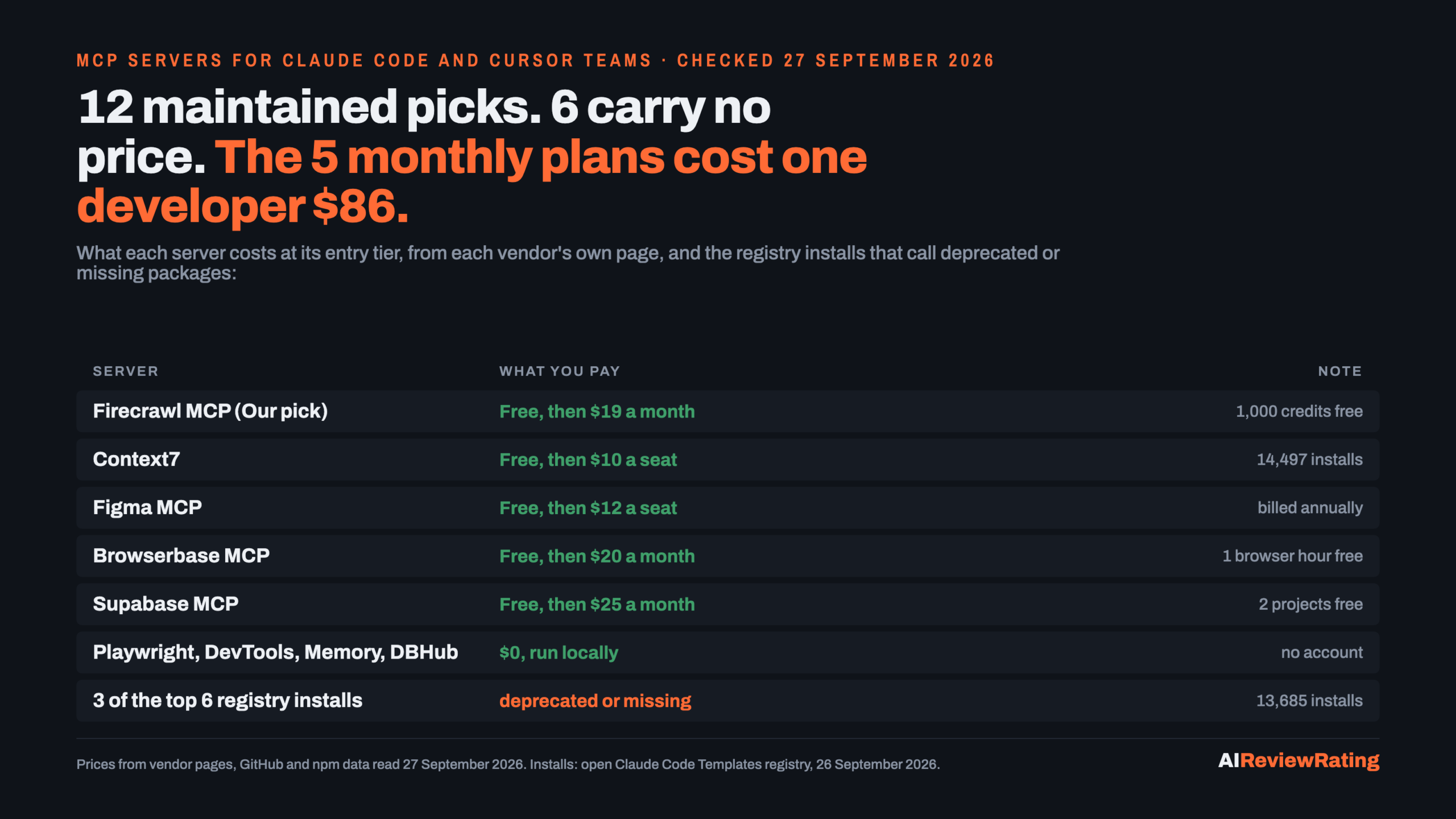
Short answer, checked on 27 September 2026: if you are a developer or a small team shipping with Claude Code, Cursor or another coding agent, 12 maintained MCP servers cover 8 jobs: library docs, repositories, databases, browsers, web data, design files, team docs and memory. 6 of the 12 carry no price of their own. The other 6 bill through the vendor account behind them, and all 6 start on a free tier. At entry paid tiers, the 5 with a monthly price cost one developer $86 a month, and Bright Data bills $1.50 per 1,000 requests past its free 5,000.
| Start with | The job it takes off your desk | Price from, verified 27 September 2026 |
|---|---|---|
| Firecrawl MCP Our pick | Search and scrape the live web into clean markdown for the agent | Free: 1,000 credits a month, no card. Hobby: $19 a month |
| Context7 | Current, version-specific library docs placed in the prompt | Free: 1,000 API calls a month. Pro: $10 a seat a month |
| GitHub MCP server | Issues, pull requests and Actions without leaving the agent | No price on GitHub’s README; runs on your GitHub login or token |
Check the package before you trust the install count. 3 of the 6 most-installed MCP entries in the open Claude Code Templates registry, 13,685 installs between them, write a config that calls an npm package that is deprecated or does not exist. One names a package the npm registry returns 404 for, so it cannot start. The other two run code whose own maintainers archived it with no further security updates. We did not time any of these servers, so this page carries no hours-saved figure; the hours we can point to are the ones a team loses to a config like that.
Disclosure: Firecrawl is our pick, and we earn a commission if you subscribe through our link. That is the only reason it is listed first. On installs alone it would sit 27th of the 104 MCP entries in the registry and 9th of the 12 on this page. Its score on our review page stays 7.7 out of 10, and no number on this page moved.
The 12, side by side
We picked one maintained server for each job, then ordered the other 11 by install count, because it is the one number every row has from the same source. Installs measure popularity, not quality. GitHub stars and the last push date show whether anyone is still maintaining the code, and the last column is what your team pays, read from each vendor’s own page.
| Server | Job | Registry installs (rank of 104) | GitHub stars | Last push | What you pay |
|---|---|---|---|---|---|
| Firecrawl MCP Our pick | Web search and scraping | 592 (27th) | 7,518 | 26 September 2026 | Free: 1,000 credits a month. Hobby: $19 a month |
| Context7 | Current library docs | 14,497 (1st) | 62,461 | 26 September 2026 | Free: 1,000 calls a month. Pro: $10 a seat a month |
| Memory (reference server) | Memory across sessions | 7,814 (2nd) | 90,614 (shared monorepo) | 27 September 2026 | $0, runs locally |
| Supabase MCP | Supabase databases | 4,095 (7th) | 2,924 | 26 September 2026 | Free plan: 2 active projects. Pro: from $25 a month |
| Chrome DevTools MCP | Browser debugging and performance | 4,053 (8th) | 52,649 | 27 September 2026 | $0, runs locally |
| Playwright MCP | Browser automation and tests | 1,925 (11th) | 37,605 | 25 September 2026 | $0, runs locally |
| Figma MCP server | Design files to code | 1,483 (14th) | hosted by Figma | hosted | Starter: 20 tool calls a month. Dev seat: $12 a month, billed annually |
| Notion MCP | Team docs and wikis | 750 (23rd) | hosted by Notion | hosted | No MCP price listed |
| Bright Data MCP | Web data from sites that block bots | 616 (25th) | 2,659 | 17 September 2026 | Free: 5,000 requests a month. Then $1.50 per 1,000 |
| Browserbase MCP | Cloud browsers | 415 (35th) | 3,413, repo archived | archived; use the hosted server | Free: 1 browser hour. Developer: $20 a month |
| GitHub MCP server | Repos, issues, pull requests | 200 (55th) | 33,228 | 25 September 2026 | No price on GitHub’s README |
| DBHub | PostgreSQL and 5 other databases | 66 (79th) | 3,570 | 21 September 2026 | $0, runs locally |
What the install counts do not tell you
The registry holds 104 MCP entries with 86,844 installs between them. Each entry is a small config file, and on 27 September 2026 we opened every one on this page to see which package or URL it actually runs, then asked the npm registry and GitHub what state that package is in. 7 entries install something other than the path we recommend below, and 4 of them, 14,100 installs or 16.2 percent of all MCP installs in the registry, call a package that is deprecated or missing.
| Registry entry | Installs (rank) | What its config runs | State on 27 September 2026 | Use instead |
|---|---|---|---|---|
| playwright-mcp-server | 6,123 (3rd) | @executeautomation/playwright-mcp-server |
Not deprecated. Last npm release 12 December 2025, repo last pushed 288 days before 27 September 2026 | Microsoft’s @playwright/mcp |
| postgresql-integration | 4,818 (4th) | @modelcontextprotocol/server-postgres |
npm: deprecated, Package no longer supported.Source archived |
DBHub or Postgres MCP Pro |
| web-fetch | 4,733 (5th) | @modelcontextprotocol/server-fetch |
npm: no such package (HTTP 404). The real server is Python | uvx mcp-server-fetch |
| github-integration | 4,134 (6th) | @modelcontextprotocol/server-github |
npm: deprecated, Package no longer supported.Source archived |
GitHub’s own server |
| figma-dev-mode | 1,483 (14th) | the desktop server at 127.0.0.1:3845 | Figma: desktop server needs a Dev or Full seat on a paid plan | Figma’s remote server, open to all seats |
| notion | 750 (23rd) | @notionhq/notion-mcp-server |
Notion’s README: no longer actively maintained or supported | Notion’s hosted server |
| mcp-server-browserbase | 415 (35th) | @browserbasehq/mcp-server-browserbase |
npm: deprecated, This package has moved. Repo archived |
Browserbase’s hosted server |
Three of those rows deserve a sentence each. The GitHub entry with 4,134 installs runs @modelcontextprotocol/server-github, last released on 8 April 2025; GitHub’s own server has 200 installs in the same registry, 20.7 times fewer. The PostgreSQL entry with 4,818 installs runs a package last released on 4 December 2024, whose source sits in an archive that says No security updates or bug fixes will be provided
. And the most-installed Playwright entry, 6,123 installs, is not Microsoft’s: Microsoft’s @playwright/mcp has 1,925.
The fetch row is the odd one. The reference fetch server is a Python package, mcp-server-fetch on PyPI at version 2026.8.18, and its README runs it with uvx mcp-server-fetch. The registry config asks npm for @modelcontextprotocol/server-fetch instead, and the npm registry returned HTTP 404 for it on 27 September 2026. Anthropic’s own Claude Code documentation, for comparison, uses GitHub’s remote server for its GitHub example and @bytebase/dbhub for its PostgreSQL example, the two maintained paths we recommend below.
What the 12 cost a month
Every server on this page is free to install or connect. The money is in the account behind it. 4 run on your machine with no vendor account at all: the Memory reference server, Chrome DevTools MCP, Playwright MCP and DBHub. GitHub and Notion host their servers and list no price for them, so what you pay is whatever your GitHub or Notion plan already costs. The other 6 meter usage.
| Service | Free tier | Entry paid tier | What it includes | Billed |
|---|---|---|---|---|
| Context7 | 1,000 API calls a month | Pro: $10 a seat a month | 2,000 API calls a seat, then $5 per 1,000 | per seat |
| Figma | Starter plan, 20 tool calls a month | Professional Dev seat: $12 a month, billed annually | 200 tool calls a day, 10 a minute | per seat |
| Firecrawl | 1,000 credits a month, no card | Hobby: $19 a month, or $16 billed annually | 5,000 credits a month | per plan |
| Browserbase | 1 browser hour, 3 concurrent browsers | Developer: $20 a month | 100 browser hours, then $0.12 an hour | per plan |
| Supabase | 2 active projects, paused after 1 week idle | Pro: from $25 a month | first project included, more from $10 a month | per plan |
| Bright Data | 5,000 requests a month, no card | Pay as you go: $1.50 per 1,000 requests | no commitment; browser navigation $8 per GB | per use |
The worked bill. One developer on the entry paid tier of all 5 fixed-price services pays $86 a month: $10 + $12 + $19 + $20 + $25 for Context7, Figma, Firecrawl, Browserbase and Supabase, with Bright Data billed only past its 5,000 free requests. Context7 and Figma price by seat, so each extra developer adds $22. Firecrawl, Browserbase and Supabase list a plan price rather than a seat price, so a team of 5 on one plan each pays $174 a month. Stay on the free tiers and the local servers and the bill is $0, with the free-tier ceilings in the table as the trade.
Where the free tiers run out first depends on the job. Context7 blocks a free account after 1,000 calls in a month and then grants 20 bonus calls a day until the month resets. Figma’s Starter plan allows 20 tool calls a month in total. Browserbase’s free plan gives 1 browser hour with sessions capped at 15 minutes; the vendor’s own estimate is that 100 browser hours is roughly 3,000 page-level tasks.
The 12, one by one
1. Firecrawl MCP Our pick: web search and scraping
What it does: search the web, scrape a known URL into markdown or JSON, map or crawl a site, and click through pages that need an action before they show content. The README lists 26 tools in the full profile. Free path: the hosted keyless endpoint exposes 3 tools, scrape, search and parse, with no API key and a rate limit; crawl, map and agent need a key. Paid: a free account gets 1,000 credits a month with no card. Hobby is $19 a month ($16 billed annually) for 5,000 credits a month, and Standard is $99 a month for 100,000 credits. A scrape costs 1 credit a page and a search 2 credits per 10 results.
Maintenance: firecrawl-mcp version 3.25.5 shipped on 25 September 2026, and the MIT-licensed server repository was pushed on 26 September 2026. It can also point at a self-hosted Firecrawl instance. Pick it if your agent reads live pages as part of the job. Our scraper cost comparison prices Firecrawl per 1,000 pages against the open source options, and our full review is on the Firecrawl review page.
2. Context7: current library docs
What it does: pulls version-specific documentation and code examples for the library you name into the prompt, so the agent can write against the current API instead of relying on its training data. It is the most-installed entry in the registry at 14,497, 16.7 percent of all 86,844 MCP installs. Paid: 1,000 API calls a month free, then Pro at $10 a seat a month with 2,000 API calls a seat, then $5 per 1,000; parsing a private repository costs $5 per 1 million tokens. A free API key is recommended for higher rate limits.
Maintenance: @upstash/context7-mcp 4.1.1 shipped on 14 September 2026; the MIT repository has 62,461 stars. Watch: the documentation is community-contributed, and Context7’s own README says it cannot guarantee the accuracy, completeness, or security
of every library it serves. It also ships a CLI with skills as an alternative to MCP.
3. Memory (reference server): memory across sessions
What it does: keeps a local knowledge graph of entities, relations and observations that the agent can write to and search, through 9 tools. Its README calls it a basic implementation of persistent memory
, which is accurate: it stores one JSONL file, by default memory.jsonl in the server directory, so set MEMORY_FILE_PATH to a path you back up. Paid: nothing, it runs locally.
Maintenance: @modelcontextprotocol/server-memory version 2026.8.31 shipped on 31 August 2026 from the protocol’s own reference repository, 90,614 stars and pushed on 27 September 2026. The repository’s LICENSE describes a transition from MIT to Apache-2.0. With 7,814 installs it is 2nd in the registry. If you outgrow one file, our catalog reviews Mem0 and Claude Mem.
4. Supabase MCP: Supabase databases
What it does: connects the agent to a Supabase project to manage tables, fetch config and query data. Supabase hosts it at https://mcp.supabase.com/mcp and signs you in with OAuth by default. Paid: the Free plan allows 2 active projects, paused after 1 week idle; Pro runs from $25 a month with the first project included, more from $10 a month.
Watch: Supabase’s own guide warns about prompt injection from user content in your data and recommends read-only mode, which runs queries as a read-only Postgres user, plus project scoping and manual approval of every tool call. The registry’s config already passes --read-only and --project-ref. Maintenance: version 0.13.0 shipped on 17 September 2026; the Apache-2.0 repository was pushed on 26 September 2026.
5. Chrome DevTools MCP: browser debugging and performance
What it does: gives the agent a live Chrome with DevTools: performance traces, network requests, console messages with source-mapped stack traces, screenshots and a Lighthouse audit. Its auto-generated tool reference documents 59 tools in 11 groups. Paid: nothing, it runs locally.
Watch: Google collects usage statistics by default; pass --no-usage-statistics to opt out. Performance tools may send trace URLs to Google’s CrUX API; --no-performance-crux turns that off. Our production note: this is the one server on the list we run ourselves, on this site’s own performance audits, with both flags set. Maintenance: version 1.10.1 shipped on 23 September 2026; the Apache-2.0 repository has 52,649 stars and was pushed on 27 September 2026.
6. Playwright MCP: browser automation and tests
What it does: drives a browser through Playwright’s accessibility tree rather than screenshots, so no vision model is needed. By our count of its README, 25 tools load by default and 47 more sit behind opt-in --caps flags. Paid: nothing, it runs locally on Node.js 18 or newer.
Watch: Microsoft’s own README tells coding-agent users they may do better with its Playwright CLI and skills, because CLI calls avoid loading large tool schemas and accessibility trees into context. It keeps MCP for long-running loops that need persistent browser state. Maintenance: @playwright/mcp 0.0.82 shipped on 18 September 2026; 37,605 stars, Apache-2.0, pushed on 25 September 2026. Install this one, not the registry’s 6,123-install community entry.
7. Figma MCP server: design files to code
What it does: gives the agent design context from your Figma files, including your real components through Code Connect, so generated code matches the design. Figma prefers its remote server at https://mcp.figma.com/mcp, which is available on all seats and plans; the desktop server, which the registry entry points at, needs a Dev or Full seat on a paid plan. Paid: what you get depends on the seat.
| Plan | Seat | Figma MCP tool calls |
|---|---|---|
| Starter | View, Collab | up to 20 a month |
| Professional | View, Collab | up to 6 a month |
| Professional | Dev, Full | up to 200 a day, 10 a minute |
| Organization | Dev, Full | up to 200 a day, 15 a minute |
| Enterprise | Dev, Full | up to 600 a day, 20 a minute |
A Professional Dev seat is $12 a month and a Full seat $16, both at the annual-billing rate the pricing page opens on. For a developer who uses the server daily, the jump from 20 calls a month to 200 a day is what the seat buys.
8. Notion MCP: team docs and wikis
What it does: lets the agent search, read and edit your Notion workspace. Use the server Notion hosts at https://mcp.notion.com/mcp, which signs you in with OAuth. The registry entry installs @notionhq/notion-mcp-server, the local server, and Notion’s README for that package says it is no longer actively maintained or supported
.
Watch: Notion’s help center says MCP tools act with your full Notion permissions, so they can reach everything you can. On the Enterprise plan, admins can approve specific AI apps and block the rest. Paid: neither Notion’s MCP pages nor its pricing page listed a price for MCP on 27 September 2026.
9. Bright Data MCP: web data from sites that block bots
What it does: web search, page scraping and structured data from large platforms, routed through Bright Data’s unblocking network so pages that refuse plain HTTP clients still return. The README lists 69 tools. Paid: 5,000 requests a month, no card, renewing on the 1st with no rollover, then $1.50 per 1,000 requests with no commitment; browser navigation is $8 per GB.
Watch: the hosted setup passes your API token as a URL parameter; the local npx @brightdata/mcp route reads it from an environment variable instead. With 69 tools, load only the groups you need through its groups or tools parameters. Maintenance: version 2.11.3 shipped on 17 September 2026; MIT, pushed on 17 September 2026.
10. Browserbase MCP: cloud browsers
What it does: runs the browser in Browserbase’s cloud rather than on your machine, through 6 tools: start, end, navigate, act, observe and extract. Use the hosted endpoint at https://mcp.browserbase.com/mcp; Browserbase’s documentation recommends it for most users, and the open source repository was archived with the note that the hosted server has the same tools. The registry entry still installs @browserbasehq/mcp-server-browserbase, which npm marks as moved.
Paid: the $0 plan gives 1 browser hour, 3 concurrent browsers and sessions of up to 15 minutes; Developer is $20 a month for 100 browser hours, then $0.12 an hour; Startup is $99 a month for 500 hours, then $0.10 an hour. The archived README says the hosted server covers the model cost of its Gemini-based actions.
11. GitHub MCP server: repos, issues and pull requests
What it does: reads code, manages issues and pull requests, and watches Actions runs. GitHub hosts it at https://api.githubcopilot.com/mcp/ with OAuth or a personal access token, and ships a Docker image for local use. Claude Code’s own documentation uses this server, with a fine-grained token, as its GitHub example. Paid: no price on GitHub’s README; authentication is required for every call.
Watch: it covers a lot of GitHub, so pass --toolsets to load only what you use, which the README says reduces context size, and --read-only to skip every write tool. Organization admins can block it for Copilot editors by policy. Maintenance: MIT, 33,228 stars, pushed on 25 September 2026. It has 200 installs in the registry against 4,134 for the deprecated reference package.
12. DBHub: PostgreSQL and 5 other databases
What it does: connects the agent to PostgreSQL, MySQL, MariaDB, SQL Server, Oracle or SQLite through one connection string, with 2 tools by default; the vendor puts their size at 1.4k tokens. Guardrails include read-only mode, row limits and query timeouts. Claude Code’s documentation uses it as its PostgreSQL example and tells you to connect with a read-only database user. Paid: nothing; it needs Node.js 22.5 or newer.
Maintenance: @bytebase/dbhub 1.3.1 shipped on 21 September 2026; MIT, 3,570 stars, pushed on 21 September 2026. It has 66 installs against 4,818 for the archived reference server, a ratio of 73 to 1. If you want index tuning, EXPLAIN plans and health checks, Postgres MCP Pro is the other maintained option: MIT, 3,342 stars, pushed on 17 August 2026, with a restricted mode that limits it to read-only transactions.
Keep the context budget small
Every server adds tool definitions the model has to read, and every result lands in the context window. Claude Code handles the first half with tool search: only tool names and server instructions load at session start, and full definitions load when needed. The second half is yours. Claude Code warns when one MCP tool result passes 10,000 tokens and caps results at 25,000 by default.
Three habits keep that in check across any client. Load subsets: GitHub’s --toolsets, Bright Data’s tool groups and Playwright’s opt-in --caps all exist for this. Prefer read-only modes where they exist, on Supabase, GitHub, DBHub and Postgres MCP Pro. And check the vendor’s own install path, not a registry’s, which is what the 7 rows above come down to. Claude Code’s documentation adds one more: verify you trust a server before connecting it, because servers that fetch external content can expose you to prompt injection.
What we cut, and why
The rule on this site is that anything we could not verify is removed rather than hedged. Removed from this article:
- Any hours-saved figure. We did not time these servers, and we found no vendor measurement we could check.
- A tool-count ceiling for Cursor that other pages repeat. Cursor’s MCP documentation did not state one when we read it on 27 September 2026.
- Figma’s monthly-billing seat price. The pricing page opens on annual billing and the monthly figure was not in the page as served, so only the annual rate appears.
- Whether Notion’s Free plan can use Notion MCP. Neither the pricing page nor the MCP documentation says.
- Community sentiment from Reddit and YouTube. This run did not collect it, so no community quotes appear.
How we checked
Install counts come from the components file of the open Claude Code Templates registry at aitmpl.com, snapshot of 26 September 2026: 104 MCP entries, 86,844 installs. The registry is MIT-licensed, and its repository has 31,945 stars. For each entry on this page we opened the config file in that repository on 27 September 2026 to see the exact package or URL it installs, then read the package’s record from the npm registry API: latest version, publish date and any deprecation notice. Repository rows come from GitHub’s REST API on the same date. As a check on inflated stars we divided each count by the repository’s age in days. Across the 10 repositories in the main table the highest rate is 138.2 stars a day, under the 160 a day level at which we hold a count for review.
Prices were read from each vendor’s own pricing page as served on 27 September 2026, and where a page has a billing toggle we recorded the state it opens on. Firecrawl publishes a machine-readable pricing document, which we read directly. No number on this page comes from a competitor listicle, a directory or a review aggregator. We did not install and run every server; we read their configs, registries and documentation, and the one we run in production is marked as such. Our open source methodology explains how we read licenses and repositories across the catalog.
Questions people ask about MCP servers
What are the best MCP servers for Claude Code?
The 12 in the table above cover 8 jobs, and 3 are worth installing first: Firecrawl MCP for web data, which is our pick, Context7 for current library docs, and GitHub’s own MCP server for repositories. Claude Code’s documentation uses GitHub’s remote server and DBHub as its worked examples, and its tool search loads full tool definitions only when needed, so adding servers costs little context at session start. Checked on 27 September 2026.
What are the best MCP servers for Cursor?
The same 12. Each is a standard MCP server, run as a local command or reached at a remote URL, so the choice does not change with the editor. What changes is how much context you spend. Load subsets where a server offers them: GitHub’s --toolsets, Bright Data’s tool groups and Playwright’s opt-in --caps flags all exist for that. Start with the 3 in the short answer and add one job at a time.
Are MCP servers free?
The servers are free to install. 6 of the 12 here carry no price of their own: 4 run locally with no account, and GitHub and Notion list no price for their hosted servers. The other 6 bill through the account behind them and all 6 start free. At entry paid tiers, the 5 with a monthly price cost one developer $86 a month and a team of 5 $174, plus Bright Data at $1.50 per 1,000 requests past its free 5,000, at prices read on 27 September 2026.
What is the most popular MCP server?
In the open Claude Code Templates registry it is Context7, with 14,497 of 86,844 MCP installs, 16.7 percent, in the snapshot of 26 September 2026. The Memory reference server is second at 7,814. Installs measure popularity, not quality: 3 of the 6 most-installed entries call npm packages that are deprecated or missing.
Which GitHub MCP server should I use?
GitHub’s own, from the github/github-mcp-server repository, either hosted at api.githubcopilot.com/mcp/ or run locally from GitHub’s Docker image. The older @modelcontextprotocol/server-github package still has 4,134 installs in the registry against 200 for GitHub’s server, but npm marks it deprecated and its source sits in an archive that promises no security updates.
Is there a maintained PostgreSQL MCP server?
Yes, two. DBHub, which Claude Code’s documentation uses as its PostgreSQL example, with 2 tools by default and a read-only mode, and Postgres MCP Pro, which adds index tuning and a restricted read-only mode. Both are MIT. Avoid @modelcontextprotocol/server-postgres: npm marks it deprecated and its last release was on 4 December 2024.
Should I use Playwright MCP or Chrome DevTools MCP?
Use Playwright MCP to automate and test flows: it works from the accessibility tree, loads 25 tools by default, and can drive Chrome, Firefox, WebKit or Edge. Use Chrome DevTools MCP to debug and measure a page: performance traces, network requests, console messages and a Lighthouse audit, across 59 documented tools. Both are free. Chrome DevTools MCP sends usage statistics to Google unless you pass --no-usage-statistics.
How many MCP servers should a team install?
As few as cover the jobs you do each week. Each one adds tool definitions and results to the context window, and Claude Code warns when a single result passes 10,000 tokens. Start with the 3 in the short answer, add a database server when the agent needs data and a browser server when it needs to see pages, and turn on read-only modes wherever a server offers one.
Related reading on this site
- MCP servers for web scraping, priced per 1,000 pages: Bright Data, Firecrawl, Apify and Browserbase compared on what 10,000, 100,000 and 300,000 pages a month cost.
- Claude Code subagents: the 12 most installed subagents, and what each costs to run.
Sources
- Claude Code Templates registry (aitmpl.com), MCP components, snapshot 26 September 2026, read 26 September 2026.
- Claude Code Templates repository, component configs, read 27 September 2026.
- npm registry: @modelcontextprotocol/server-postgres, read 27 September 2026.
- npm registry: @modelcontextprotocol/server-github, read 27 September 2026.
- npm registry: @modelcontextprotocol/server-fetch (404), read 27 September 2026.
- npm registry: @browserbasehq/mcp-server-browserbase, read 27 September 2026.
- PyPI: mcp-server-fetch, read 27 September 2026.
- MCP reference servers README, read 27 September 2026.
- MCP reference servers LICENSE, read 27 September 2026.
- MCP archived servers README, read 27 September 2026.
- Memory server README, read 27 September 2026.
- Fetch server README, read 27 September 2026.
- Firecrawl pricing, machine-readable, read 27 September 2026.
- Firecrawl MCP server README, read 27 September 2026.
- Context7 plans and pricing, read 27 September 2026.
- Context7 README, read 27 September 2026.
- Supabase pricing, read 27 September 2026.
- Supabase MCP guide, read 27 September 2026.
- Chrome DevTools MCP README, read 27 September 2026.
- Chrome DevTools MCP tool reference, read 27 September 2026.
- Playwright MCP README, read 27 September 2026.
- Figma: Guide to the Figma MCP server, read 27 September 2026.
- Figma MCP server rate limits and access, read 27 September 2026.
- Figma pricing, read 27 September 2026.
- Notion MCP local server README, read 27 September 2026.
- Notion developer docs: Notion MCP, read 27 September 2026.
- Notion developer docs: connect to Notion MCP, read 27 September 2026.
- Notion help center: Notion MCP, read 27 September 2026.
- Notion pricing, read 27 September 2026.
- Bright Data MCP README, read 27 September 2026.
- Bright Data MCP pricing, read 27 September 2026.
- Browserbase pricing, read 27 September 2026.
- Browserbase MCP documentation, read 27 September 2026.
- Browserbase MCP server README (archived), read 27 September 2026.
- GitHub MCP server README, read 27 September 2026.
- GitHub MCP server policies and governance, read 27 September 2026.
- DBHub README, read 27 September 2026.
- Postgres MCP Pro README, read 27 September 2026.
- Claude Code documentation: MCP, read 27 September 2026.
- Cursor documentation: MCP, read 27 September 2026.
- GitHub REST API, repository endpoint for every repository named above, read 27 September 2026.
1 comment
Sign in to join the discussion.
Login to comment