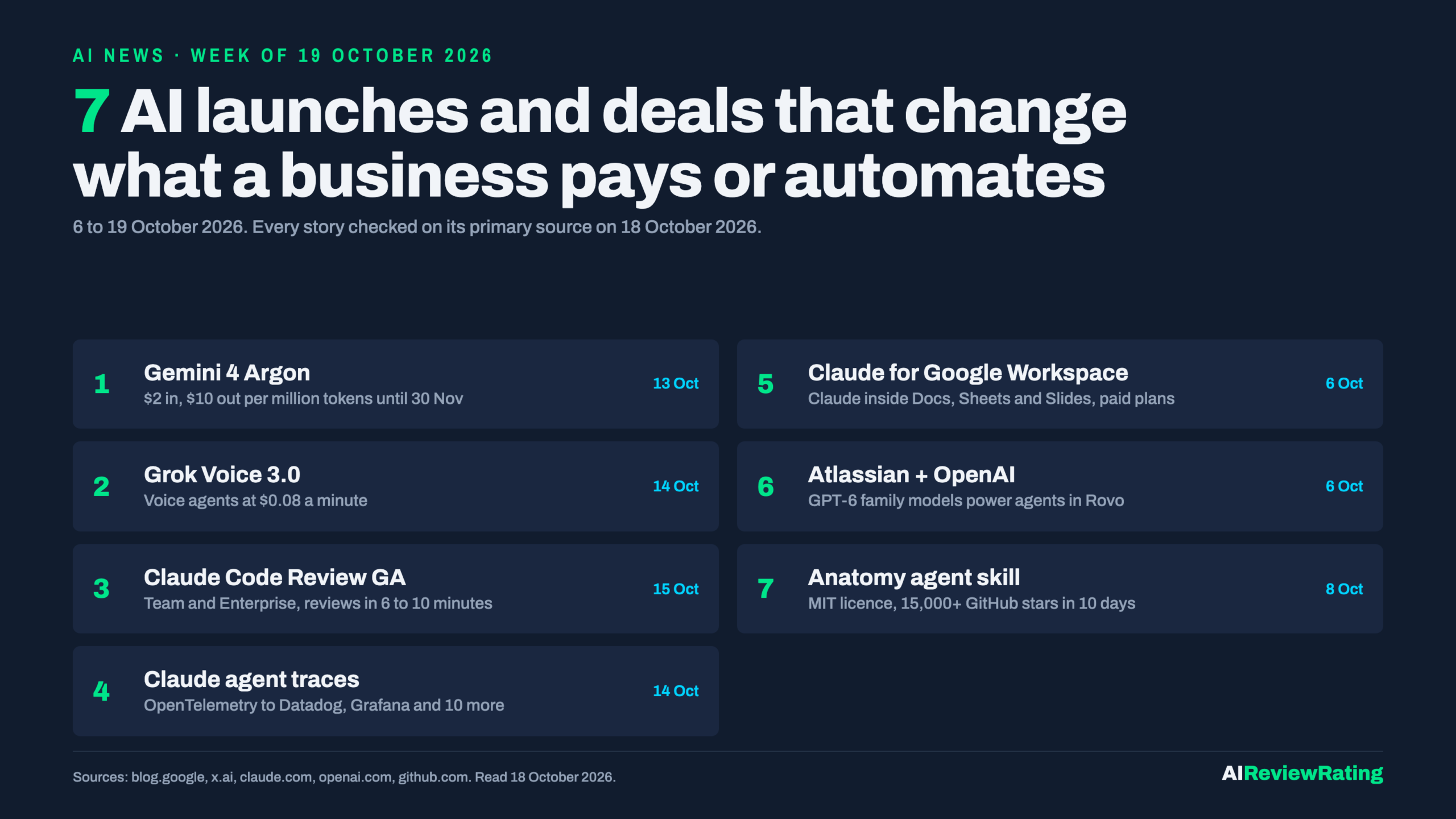
The short version: seven launches and deals from 6 to 19 October 2026 that change what a small business, developer or creator pays for AI, or what it can hand off. Google priced Gemini 4 Argon at $2 per million input tokens until 30 November, SpaceXSI held Grok Voice 3.0 at $0.08 a minute, Anthropic took Claude Code Review to general availability and put Claude inside Google Docs, Sheets and Slides, and a free MIT-licensed agent skill passed 15,000 GitHub stars in 10 days. Every story links its primary source with the date it was published, and every image is our own screenshot of that page, captured 18 October 2026.
In this edition
- Google’s Gemini 4 Argon launches at $2 per million input tokens and $10 output until 30 November 2026 (13 October 2026)
- SpaceXSI’s Grok Voice 3.0 costs $0.08 a minute, the same price as Grok Voice 2.0, in the Voice Agent API (14 October 2026)
- Claude Code Review leaves research preview for Team and Enterprise plans, cutting typical reviews to 6 to 10 minutes (15 October 2026)
- Claude Platform sends OpenTelemetry traces from Managed Agents and the Messages API to Datadog, Grafana and 10 more tools (14 October 2026)
- Claude for Google Workspace puts Claude inside Docs, Sheets and Slides on every paid Claude plan, in public beta (6 October 2026)
- Atlassian signs a new OpenAI agreement so GPT-6 family models power agents across its platform and Rovo (6 October 2026)
- Anatomy, a free MIT-licensed agent skill, draws interactive isometric figures and passes 15,000 GitHub stars in 10 days (8 October 2026)
1. Google’s Gemini 4 Argon launches at $2 per million input tokens and $10 output until 30 November 2026
Google released Gemini 4 Argon, its new frontier model, to the API, the Gemini app and AI Mode in Search at an introductory price that doubles after 30 November 2026.
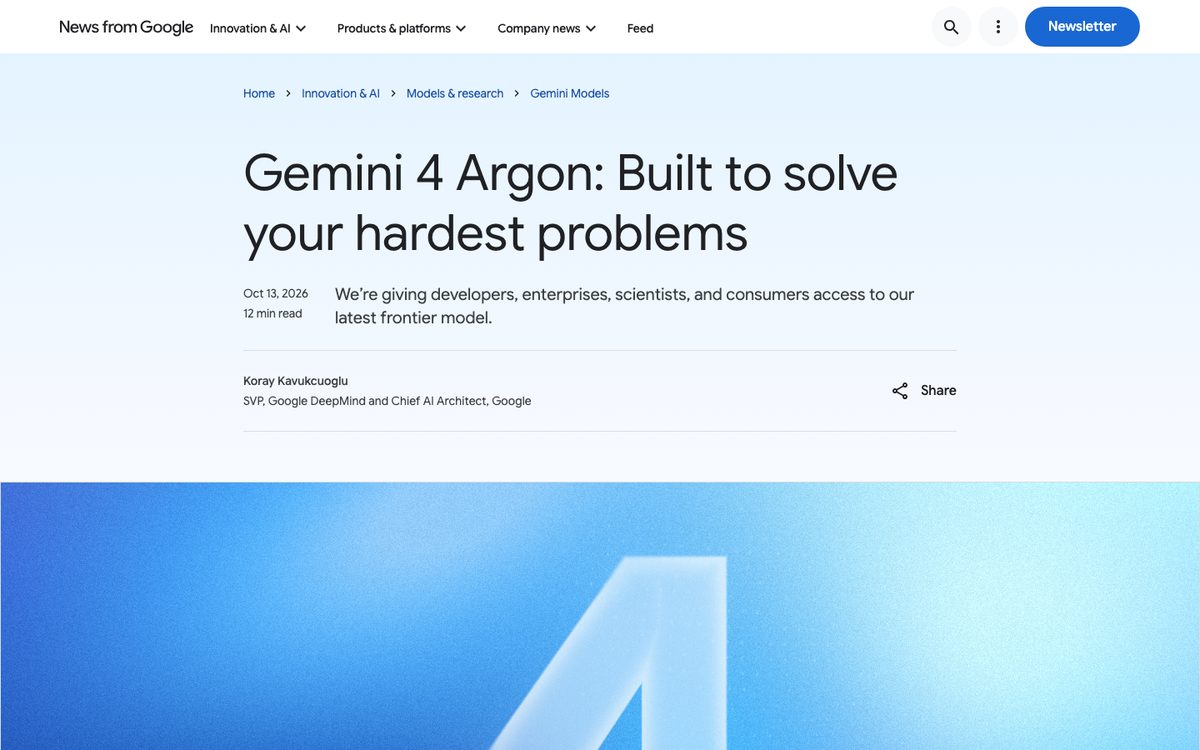
- Gemini 4 Argon became available on 13 October 2026 through the Gemini API in AI Studio and the Gemini platform, in Google Antigravity for Google AI Ultra subscribers, and in the Gemini app and AI Mode in Search for AI Pro and Ultra subscribers.
- The introductory price is $2 per million input tokens and $10 per million output tokens, with cached input tokens 95% off; after the introductory period ends on 30 November 2026 the price is $4 and $20.
- The Gemini API gives Argon a 1 million token unified input and output limit.
- Google’s companion post says the Gemini app now connects to more than 40 apps, including Instacart, OpenTable, Adobe and Shopify, and adds a toggle from chat to tasks.
Vendor claims, not tested by us: Ranks first on the Vals Index across finance, coding, legal and tax work (Google). Inside Google, Argon in Antigravity raised agentic code submissions by more than 35% and cut code rollbacks by nearly a third (Google).
Why it matters: A team pricing frontier model APIs can test Argon at half its later list price until 30 November 2026; budget for the move to $4 and $20 per million tokens before you put production work on it.
Source: Gemini 4 Argon: Built to solve your hardest problems, Google, published 13 October 2026. Also: Google post on Gemini 4 Argon in the Gemini app.
Our review and score: Gemini on AI Review Rating.
2. SpaceXSI’s Grok Voice 3.0 costs $0.08 a minute, the same price as Grok Voice 2.0, in the Voice Agent API
SpaceXSI shipped Grok Voice 3.0, a speech-to-speech model for voice agents, and kept the per-minute price of the model it replaces.
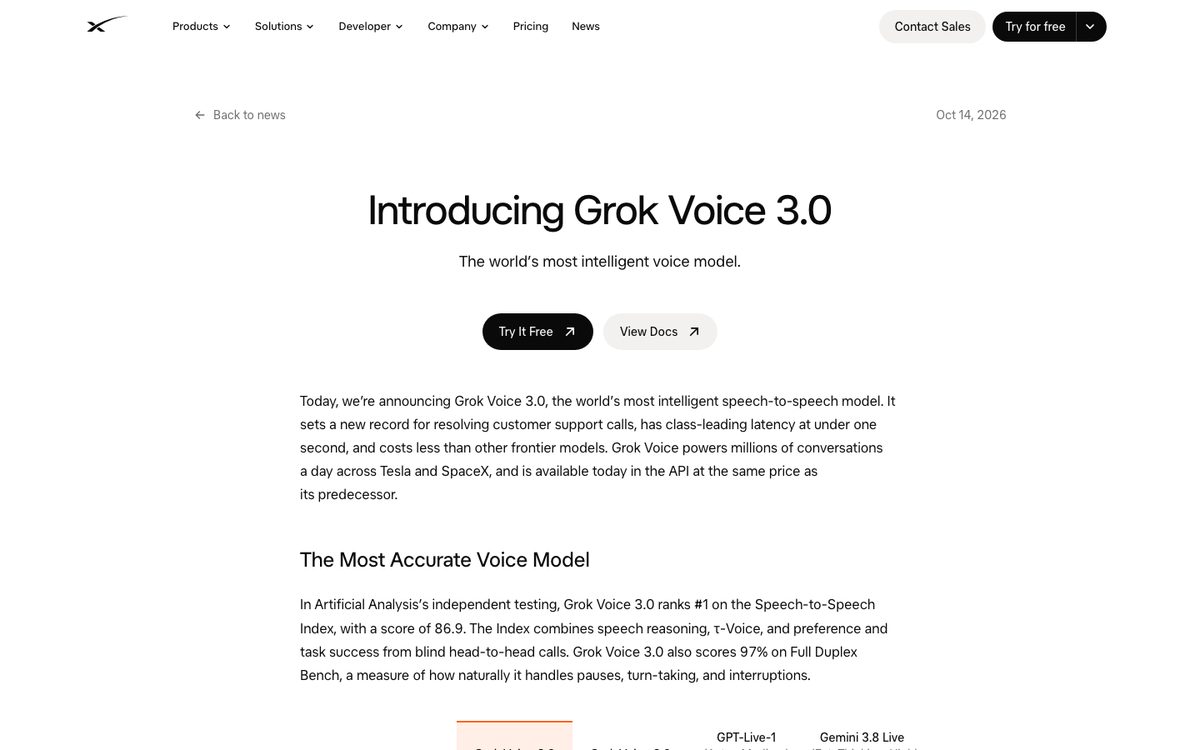
- Grok Voice 3.0 is a speech-to-speech model, available from 14 October 2026 in the Voice Agent API at $0.08 per minute ($4.80 per hour), the same price as Grok Voice 2.0.
- Agents that call grok-voice-latest were switched to the new model automatically, with no code changes needed.
- It also powers the voice mode of Grok Bot, SpaceXSI’s agent product.
Vendor claims, not tested by us: Scores 86.9 on the Artificial Analysis Speech-to-Speech Index, ahead of GPT-Live-1 at 83.2 (Artificial Analysis figures dated 13 October 2026, as published by SpaceXSI). Averages $0.025 per task on Artificial Analysis’s Big Bench Audio run against $0.030 for GPT-Live-1 (SpaceXSI). Starlink call centers answer 20,000 calls a day on Grok Voice, with roughly 70% resolved with no human (SpaceXSI).
Why it matters: A business that runs phone support can price a voice agent at $4.80 per hour of talk time; test it on your own recorded calls before counting on the 70% resolution figure.
Source: Introducing Grok Voice 3.0, SpaceXSI, published 14 October 2026.
3. Claude Code Review leaves research preview for Team and Enterprise plans, cutting typical reviews to 6 to 10 minutes
Anthropic’s Code Review for Claude Code is out of research preview: it reviews new pull requests on its own once an admin turns it on for a repository.
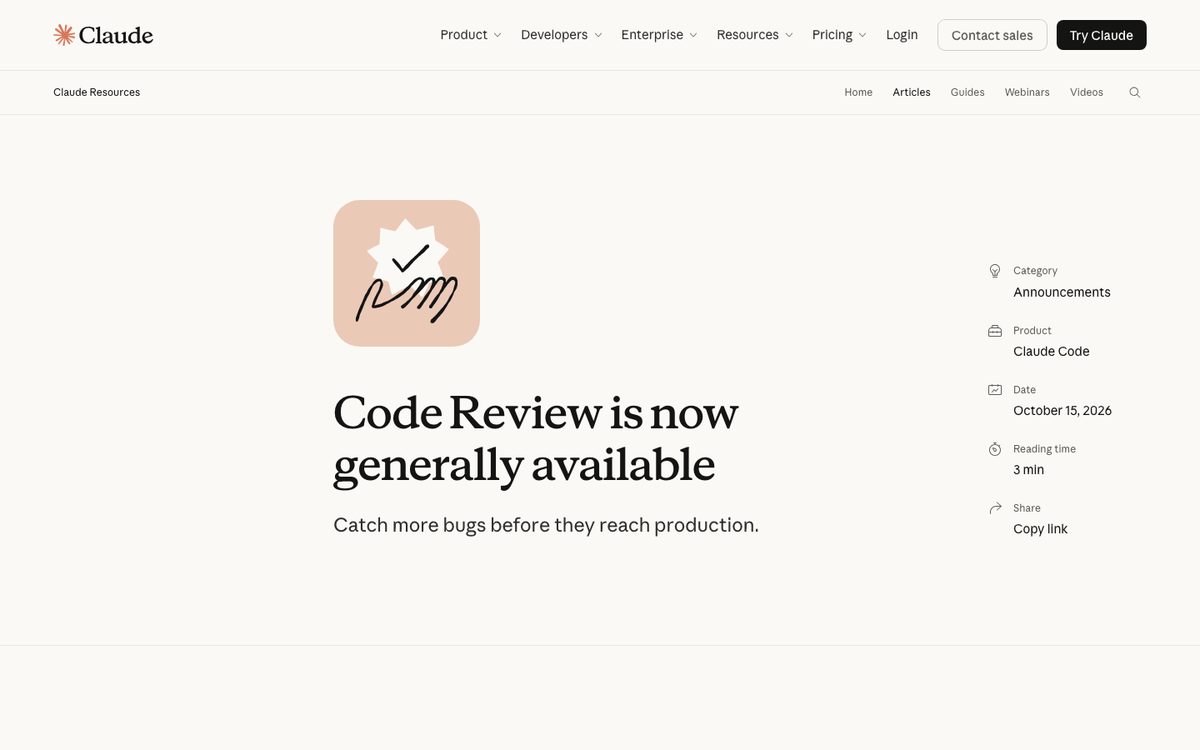
- Code Review became generally available on 15 October 2026 for Claude Team and Enterprise organizations.
- Admins choose Quick, Standard (the default) or Deep review for each repository.
- Setup: an admin enables Code Review in Claude Code settings, installs the GitHub App and selects repositories; reviews then run on new pull requests with no developer configuration.
- Eligible Claude Enterprise organizations can claim at least $10,000 in Code Review credits by 15 January 2027; credits expire 30 days after they are claimed.
Vendor claims, not tested by us: Reviews finish about 3x faster than during the preview, from around 20 minutes to 6 to 10 minutes (Anthropic).
Why it matters: An engineering team on Enterprise can claim at least $10,000 in credits and trial automated pull request review on its riskiest repositories at the Deep setting before it pays anything for the service.
Source: Code Review is now generally available, Anthropic, published 15 October 2026.
Our review and score: Claude on AI Review Rating.
4. Claude Platform sends OpenTelemetry traces from Managed Agents and the Messages API to Datadog, Grafana and 10 more tools
Agents built on the Claude Platform can now send OpenTelemetry traces of every step, with tokens and latency, to the observability tools a team already runs.
- In public beta from 14 October 2026: OpenTelemetry traces from Claude Managed Agents, the Messages API and the Claude SDKs.
- Managed Agents and the Messages API need a destination added in the Claude Console; the Claude SDKs export traces automatically.
- Each agent turn, model call and tool use arrives as a standard trace with latency, tokens and IDs, following the OpenTelemetry GenAI semantic conventions.
- Named tools: Grafana Cloud, Honeycomb, Sentry, Splunk, Arize AI, Braintrust, Datadog, Langfuse, LangSmith, New Relic, PostHog and Databricks Unity Gateway, plus any tool that accepts a standard OTLP endpoint.
Vendor claims, not tested by us: Ramp says its trace-scoring system cut token usage by 10 to 20% and made sessions 30% faster on some agents (customer quote on Anthropic’s page).
Why it matters: A team already paying for Datadog or Langfuse can see the token cost of every step a Claude agent takes without building its own logging, and trim the steps that cost the most.
Source: Agent observability on the Claude Platform, Anthropic, published 14 October 2026.
5. Claude for Google Workspace puts Claude inside Docs, Sheets and Slides on every paid Claude plan, in public beta
Claude for Google Workspace opens Claude in a sidebar next to a Google doc, sheet or deck and edits the file in place, with each change held for approval by default.
- Claude for Google Workspace entered public beta on all paid Claude plans on 6 October 2026; install it from the Google Workspace Marketplace, then open Extensions, Claude, Open Claude in a file.
- In Sheets, Claude writes formulas, builds pivot tables and native charts, adds tabs, and can pull a range into Python and write the results back.
- The default Ask before edits mode shows each change as an approval card; Accept all edits applies changes without stopping.
- New Google Docs, Sheets and Slides connectors, also in beta, let Claude create and edit Google files from the chat, with access matching your existing Google sharing permissions.
Why it matters: A team that runs on Google Workspace can have Claude build a budget against actuals sheet or a customer review deck inside the file it already shares, using the Claude plan it already pays for, with every edit held for approval by default.
Source: Claude now works with Google Docs, Sheets, and Slides, Anthropic, published 6 October 2026.
Our review and score: Claude on AI Review Rating.
6. Atlassian signs a new OpenAI agreement so GPT-6 family models power agents across its platform and Rovo
Atlassian signed a new agreement with OpenAI so Rovo, its AI layer over Jira and Confluence, runs agents on OpenAI’s GPT-6 family models.
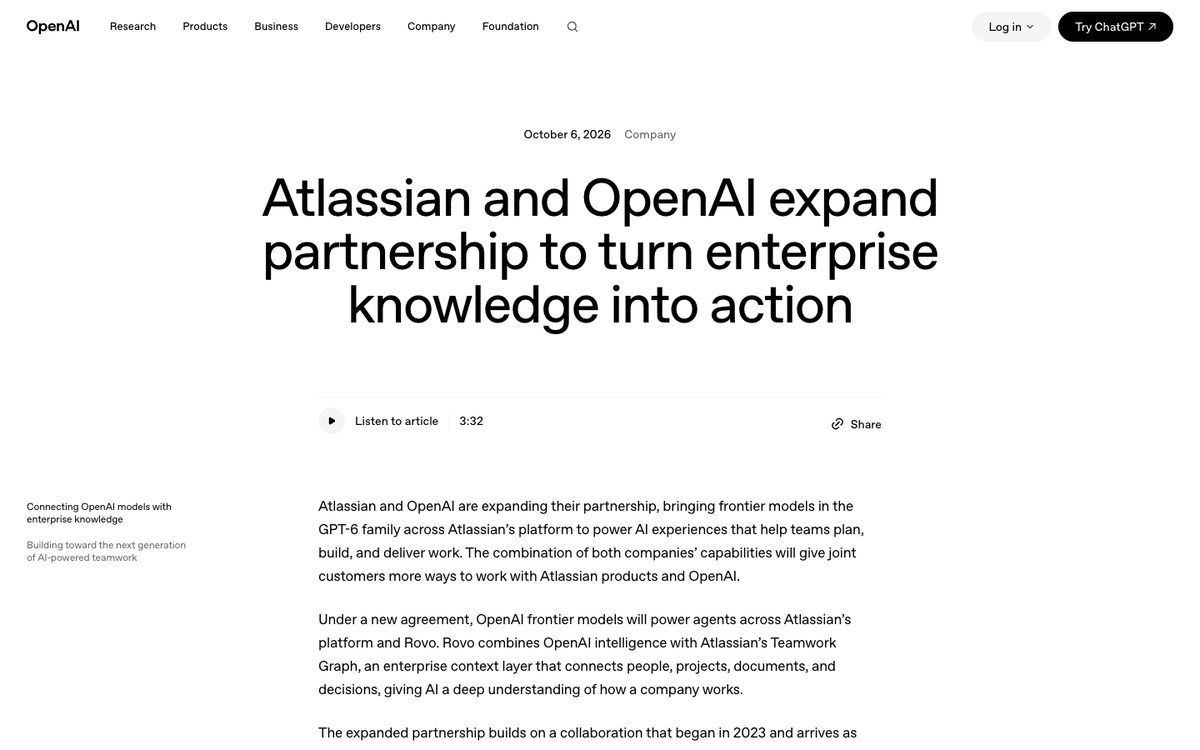
- Under a new agreement announced on 6 October 2026, OpenAI frontier models in the GPT-6 family will power agents across Atlassian’s platform and Rovo.
- Atlassian gets expanded access to OpenAI models including GPT-6 Astra and the GPT-5.6 series.
- Atlassian and Teamwork Graph CLI plugins for ChatGPT and Codex bring Jira work items, Confluence content and project context into prompts, subject to permissions.
- The two companies say they are exploring deeper Jira integrations for assigning work to AI agents; no date was given.
Vendor claims, not tested by us: More than 3,000 Atlassian developers use Codex (OpenAI).
Why it matters: A team already on Jira and Confluence can ask Rovo whether a launch is on track from its own tickets and documents, and Codex users can pull Jira context into code work through the plugins instead of a custom integration.
Source: Atlassian and OpenAI expand partnership to turn enterprise knowledge into action, OpenAI, published 6 October 2026.
7. Anatomy, a free MIT-licensed agent skill, draws interactive isometric figures and passes 15,000 GitHub stars in 10 days
Anatomy is an open-source agent skill that turns a technical idea into an interactive isometric figure, and it runs in Claude Code, Codex and three other agents.
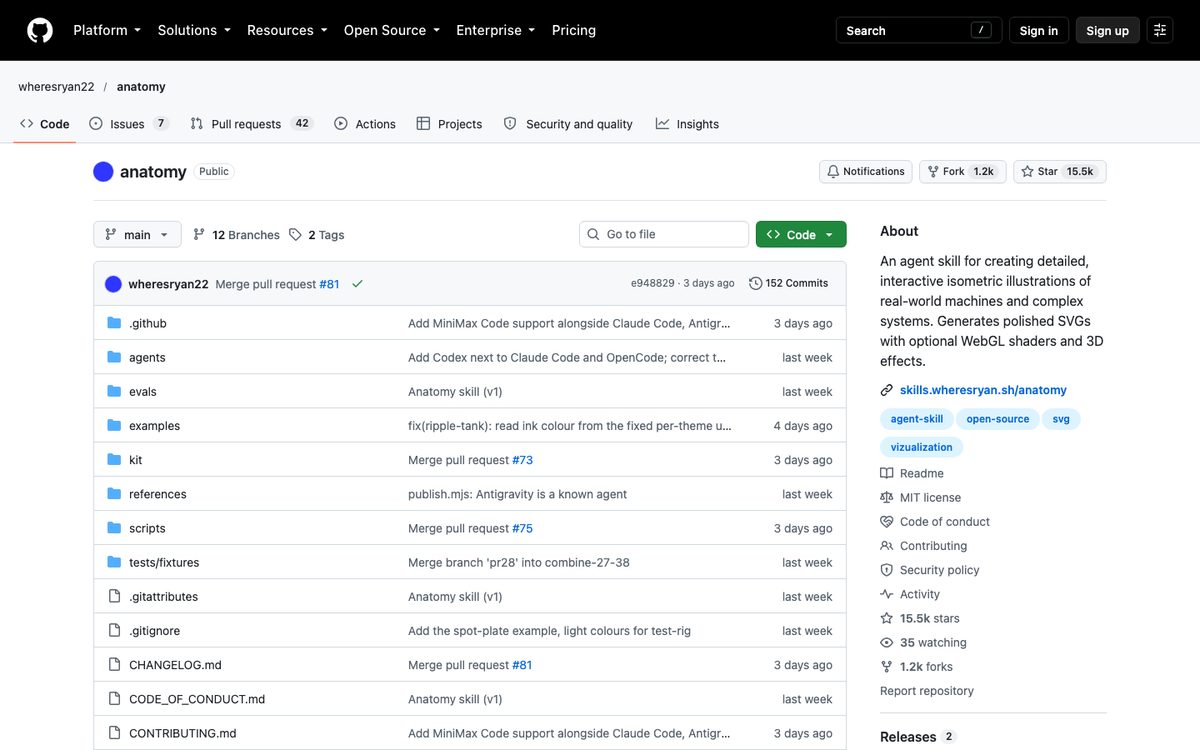
- The repository was created on 8 October 2026; v1.0.0 was released on 10 October and v1.1.0 on 12 October 2026 (GitHub API, read 18 October 2026).
- 15,473 stars and 1,182 forks on 18 October 2026; forks per star 0.076, above the 0.02 line where bought stars tend to sit.
- MIT licence; it installs with npx skills add wheresryan22/anatomy and runs in Claude Code, Antigravity, OpenCode, Codex and MiniMax Code, and its README says it needs no API keys and no npm install.
- It produces interactive isometric figures in SVG, with optional WebGL shaders and 3D effects.
Why it matters: A software team that pays for explainer diagrams can make interactive technical figures for docs and landing pages with the coding agent it already uses, at no licence cost.
Source: wheresryan22/anatomy on GitHub, wheresryan22 (Anatomy), repository created 8 October 2026.
Trending repos, week of 19 October 2026
Open-source repos that two or more of the creators we watch featured between 6 October and 18 October 2026, and that already have an AIRR page. Stars and licence from the GitHub API, read 18 October 2026.
- REA (morluto/rea): agents that reverse engineer an app, from its behavior down to native binaries. 313,065 stars, MIT, featured by 4 creators we watch.
- VoiceStudio (debpalash/VoiceStudio): local voice cloning, dubbing, dictation and transcription that its README pitches against ElevenLabs. 73,976 stars, AGPL-3.0, featured by 3 creators we watch.
- claude-mem (thedotmack/claude-mem): persistent memory across sessions for Claude Code, Codex, Gemini and other coding agents. 101,496 stars, Apache-2.0, featured by 2 creators we watch.
- HyperFrames (heygen-com/hyperframes): HeyGen’s framework for agents to write HTML and render it as video. 66,193 stars, Apache-2.0, featured by 2 creators we watch.
- OpenRig (mvschwarz/openrig): persistent teams of Claude Code, Codex and Pi agents with roles, shared context and owned work. 7,747 stars, Apache-2.0, featured by 2 creators we watch.
How we picked and checked these stories
We lead with launches and tools a business can use or price, and leave out stories that only describe risk unless they change what a buyer should do. Creator posts and videos are where we hear about a story; they are never the source. Every fact above comes from the company’s own page, the GitHub API or a primary news outlet, read on 18 October 2026, and every story is dated inside 6 to 19 October 2026. Numbers we could not test ourselves are labelled as vendor claims. Stories we could not verify on a primary source in that window were cut. More editions: all AI News editions.
Your turn
Which would you switch on first: automated code review on your pull requests, or Claude working inside the Google Sheets your team already shares? Reply to our newsletter and tell us; the answers shape what we test next.
Get the next edition by email: join our free newsletter with the new AI tools we score.
Related reading
- AI News, week of 12 October 2026: the previous edition
- Our weekly AI tools digest for 12 October 2026: the tools we scored
- Open-source alternatives to paid AI tools
Sources
- Gemini 4 Argon: Built to solve your hardest problems (Google, 13 October 2026), read 18 October 2026.
- Google post on Gemini 4 Argon in the Gemini app, read 18 October 2026.
- Introducing Grok Voice 3.0 (SpaceXSI, 14 October 2026), read 18 October 2026.
- Code Review is now generally available (Claude, 15 October 2026), read 18 October 2026.
- Agent observability on the Claude Platform (Claude, 14 October 2026), read 18 October 2026.
- Claude now works with Google Docs, Sheets, and Slides (Claude, 6 October 2026), read 18 October 2026.
- Atlassian and OpenAI expand partnership to turn enterprise knowledge into action (OpenAI, 6 October 2026), read 18 October 2026.
- wheresryan22/anatomy on GitHub (repository created 8 October 2026), read 18 October 2026.
- GitHub REST API, repository and release records for wheresryan22/anatomy and the trending repos above, read 18 October 2026.
Comments
Sign in to join the discussion.
Login to comment