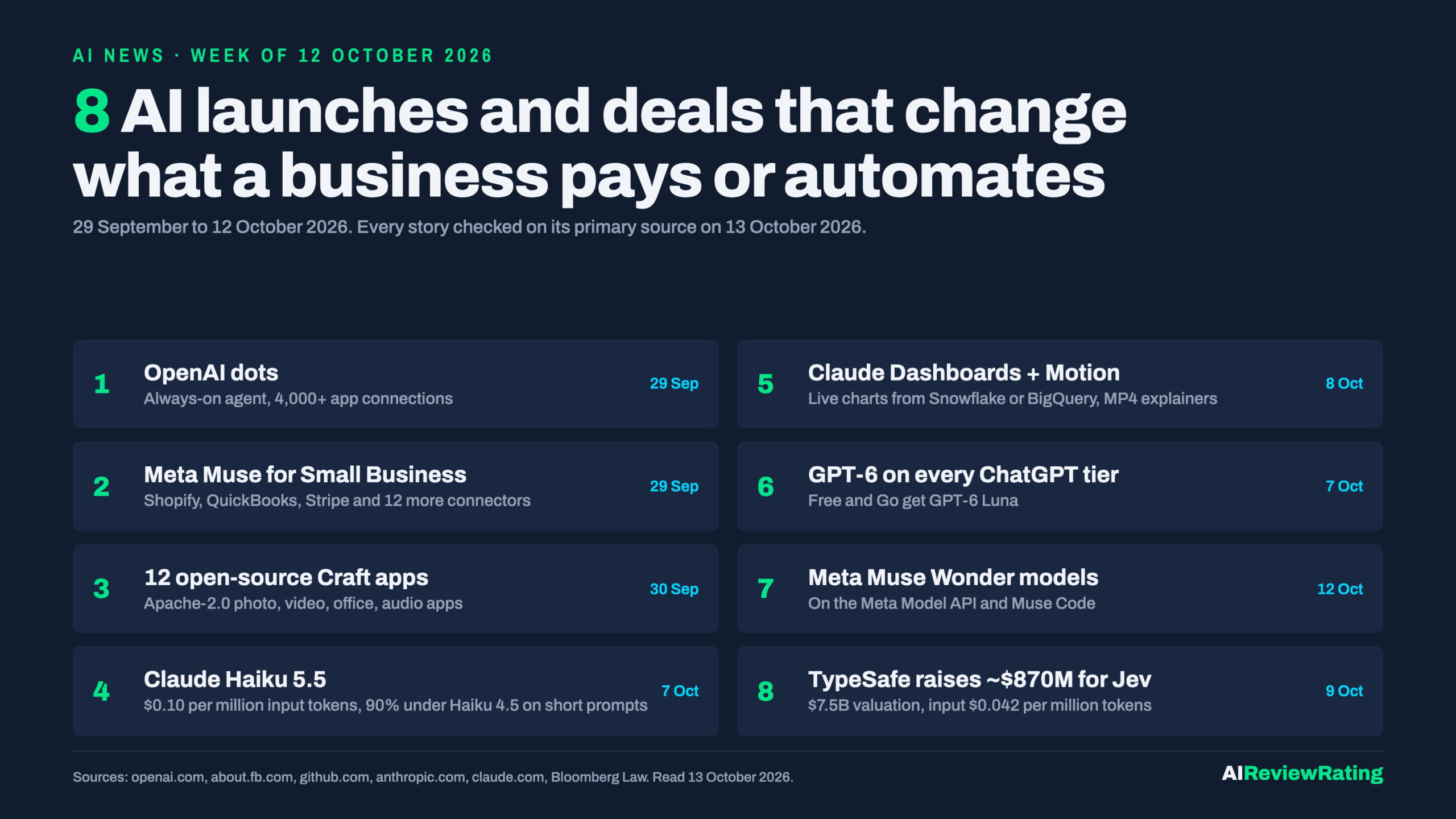
The short version: eight launches and deals from 29 September to 12 October 2026 that change what a small business or creator pays for AI, or what it can hand off. OpenAI and Meta both shipped background agents, Anthropic cut its small-model price by 90% on short prompts, and an open-source suite of 12 Apache-licensed apps rebuilds paid photo, video and office software. Every story links its primary source with the date it was published, and every image is our own screenshot of that page, captured 13 October 2026.
In this edition
- OpenAI’s dots give Pro and Business Premium users an always-on agent with its own cloud computer that connects to over 4,000 apps (29 September 2026)
- Meta’s Muse for Small Business connects Shopify, QuickBooks, Stripe and 12 more tools to a background agent (29 September 2026)
- ArtCraft publishes 12 open-source Craft apps that rebuild photo, video, office and audio software in Rust (30 September 2026)
- Claude Haiku 5.5 costs $0.10 per million input tokens, 90% less than Haiku 4.5 on prompts up to 100,000 tokens (7 October 2026)
- Claude Dashboards turns Snowflake, BigQuery or Salesforce data into live charts, and Claude Motion exports MP4 explainers (8 October 2026)
- GPT-6 reaches every ChatGPT tier, with Intelligent UI answers that build charts, forms and calculators in the chat (7 October 2026)
- Meta releases Muse Wonder and Muse Wonder Full, agent models for developers on its Meta Model API (12 October 2026)
- TypeSafe raises about $870 million at a $7.5 billion valuation for Jev, its decision model priced at $0.042 per million tokens (9 October 2026)
1. OpenAI’s dots give Pro and Business Premium users an always-on agent with its own cloud computer that connects to over 4,000 apps
OpenAI’s new dots are agents that keep working after you log off. Each one runs on GPT-6 Astra with its own cloud computer and browser, and you can message it in ChatGPT, Slack or Teams.
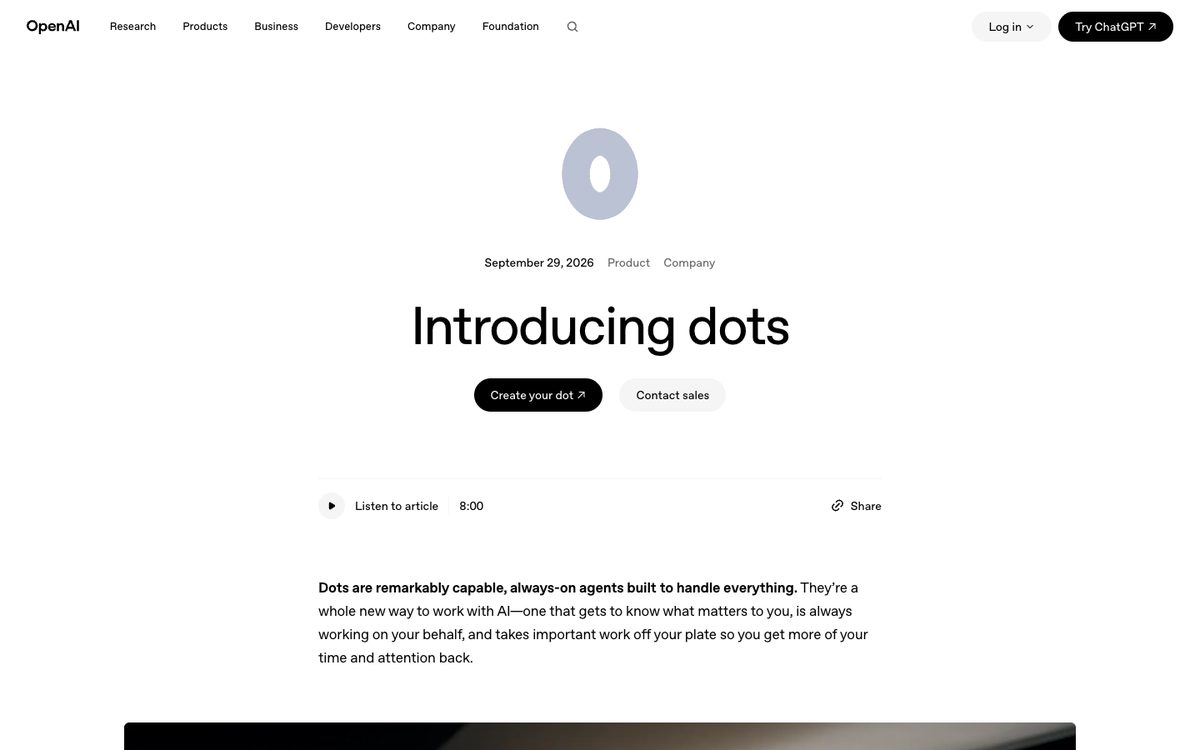
- Dots run on GPT-6 Astra, each with its own cloud computer and browser, and work toward goals 24/7.
- Through OpenAI’s plugins a dot can connect to over 4,000 apps; you reach it in ChatGPT, Slack, Teams or by voice call.
- Rolling out to Pro and Business Premium in eligible markets; Enterprise, Edu and Healthcare get a beta when the workspace admin enables it.
- The first dot is included in Pro or Business Premium at no extra cost, and conversations with it do not count toward ChatGPT usage limits.
- Background ‘proactive research’ uses read-only tools; Custom Rules can allow, require approval for, or block actions; changing a password always stays with the user.
Vendor claims, not tested by us: An early tester’s dot noticed a forgotten invoice, prepared it and sent it after his approval (OpenAI’s example).
Why it matters: A founder already on Pro or Business Premium gets a background agent for follow-ups like unsent invoices at no added plan cost; set a Custom Rule that requires approval before anything is sent.
Source: Introducing dots, OpenAI, published 29 September 2026.
Our review and score: ChatGPT on AI Review Rating.
2. Meta’s Muse for Small Business connects Shopify, QuickBooks, Stripe and 12 more tools to a background agent
Meta added Muse for Small Business: new skills and connectors that let its personal agent work inside the tools a small business already pays for, from Shopify and QuickBooks to Stripe and Klaviyo.
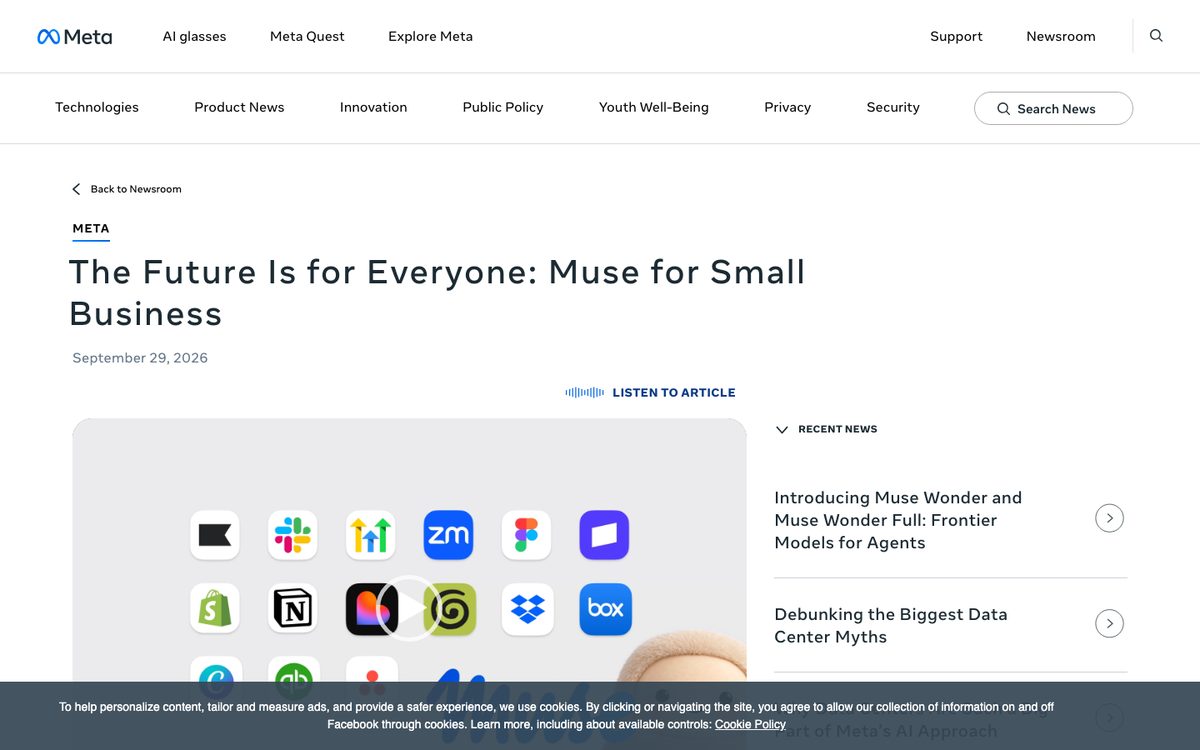
- New connectors: Asana, Box, Canva, Dropbox, Figma, Granola, HighLevel, Intuit QuickBooks, Klaviyo, Lovable, Notion, Shopify, Slack, Stripe and Zoom, plus Facebook and Instagram business accounts.
- Muse is a personal AI agent available in the US and Canada; custom connectors cover services Meta does not support yet.
- Meta says Muse is free for most of what people need, with paid subscription plans for more.
- Meta’s sample prompts include a growth plan from the year’s sales and campaigns, and a monthly check for expenses that look off.
Why it matters: A shop owner who runs on Shopify, QuickBooks and Instagram can hand Muse the monthly expense check and a draft ad campaign without paying for a separate agent tool.
Source: The Future Is for Everyone: Muse for Small Business, Meta, published 29 September 2026.
3. ArtCraft publishes 12 open-source Craft apps that rebuild photo, video, office and audio software in Rust
The team behind ArtCraft published 12 open-source Craft apps in eight days, each a clean-room rebuild of a familiar paid app category written in Rust and licensed Apache-2.0.
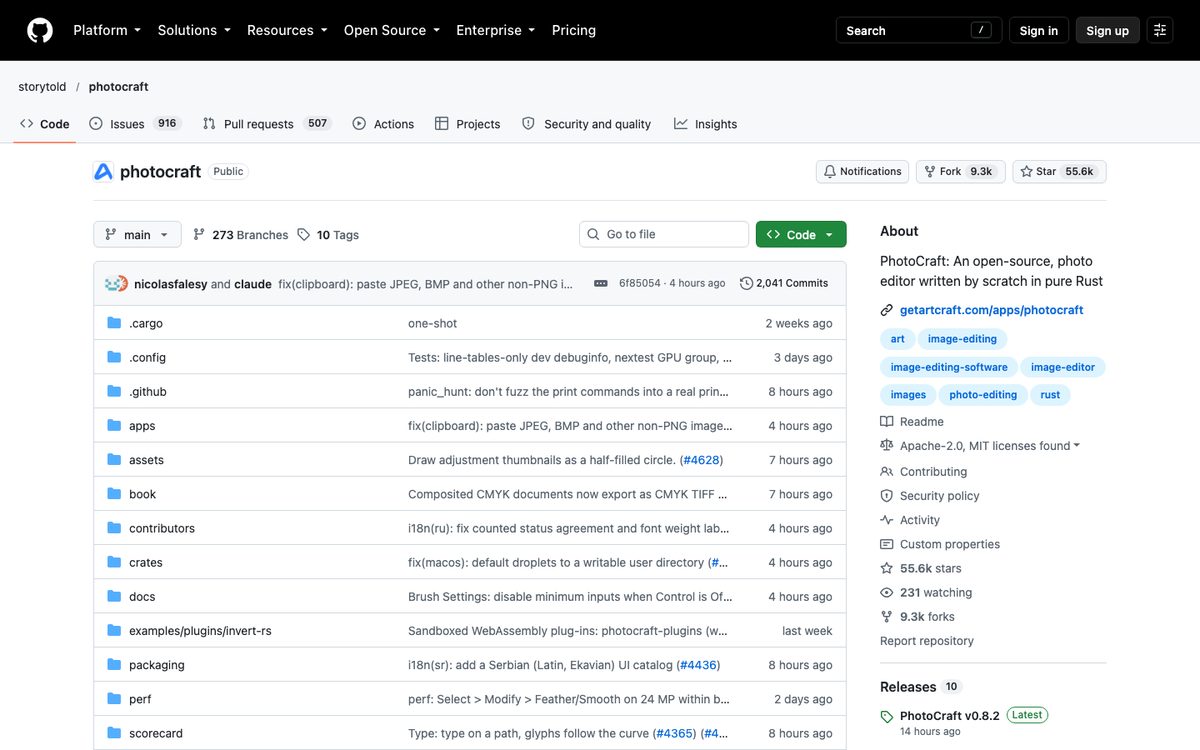
- Between 30 September and 7 October 2026 the storytold GitHub account created 12 Craft app repositories, all Apache-2.0 (GitHub API, read 13 October 2026).
- PhotoCraft: 55,602 stars, 9,322 forks, 231 watchers on 13 October 2026; forks per star 0.17, well above the 0.02 line where bought stars tend to sit.
- Other apps by stars on 13 October 2026: PdfCraft 12,037, FilmCraft (video editor) 11,972, LightCraft 11,598, WordCraft (Word-style) 10,077, VectorCraft 8,141, EffectCraft 5,989, GridCraft (Excel-style) 4,126, CADCraft 3,801, DesignCraft 3,548, DeckCraft (PowerPoint-style) 2,757, SoundCraft (Pro Tools-style) 2,381.
- ArtCraft’s PhotoCraft page lists it as early alpha, free and open source, for macOS, Windows, Linux and the web, and says it opens and saves layered PSD and PSB files.
Vendor claims, not tested by us: 134 of 135 real-world PSD test files round-trip byte for byte (ArtCraft’s PhotoCraft page).
Why it matters: A creator paying for photo, video or office seats can test Apache-licensed replacements at no cost; they are early alpha, so keep the paid tool for client deadlines until your own files open cleanly.
Source: storytold/photocraft on GitHub, storytold (ArtCraft), repository created 30 September 2026.
4. Claude Haiku 5.5 costs $0.10 per million input tokens, 90% less than Haiku 4.5 on prompts up to 100,000 tokens
Anthropic’s Claude Haiku 5.5 is priced at a tenth of Haiku 4.5 on prompts up to 100,000 tokens, and it arrives with a cache-read price cut on Sonnet 5.5 and new API credit for Max and Team plans.
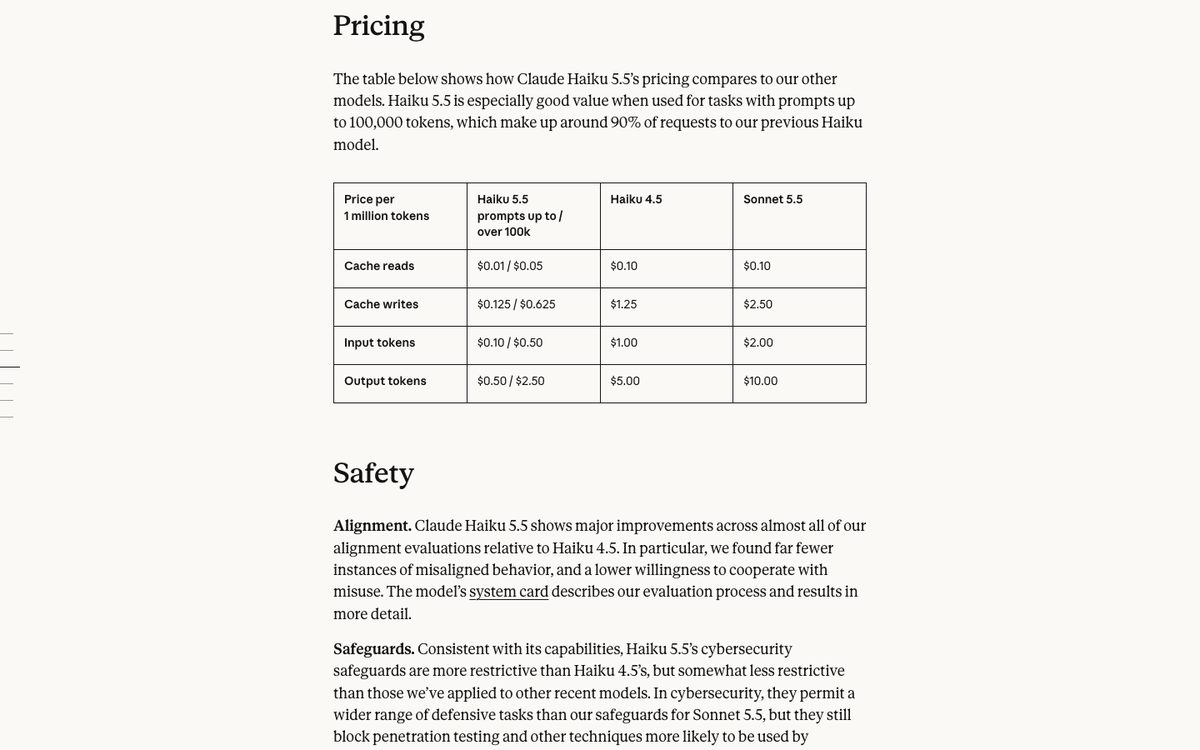
- Haiku 5.5 is $0.10 input and $0.50 output per million tokens on prompts up to 100,000 tokens, and $0.50 and $2.50 above that; Haiku 4.5 is $1.00 and $5.00.
- Anthropic halved Sonnet 5.5 cache reads from $0.20 to $0.10 per million tokens.
- New monthly API credit: Max 5x subscribers get $100, Max 20x $200, and Team up to $500 pooled across users.
- Available on the Claude Platform, Amazon Web Services, Google Cloud and Microsoft Azure; it is the first Haiku with an adjustable effort setting.
Vendor claims, not tested by us: Around 75% cheaper to run than Haiku 4.5 on average, after its new tokenizer (Anthropic). Sonnet 5.5 runs around 20% cheaper on most agentic work after the cache-read cut (Anthropic).
Why it matters: A team running a support bot or ticket classifier at volume can move that traffic to Haiku 5.5 and cut the per-token bill by 90% on short prompts; Max and Team plans now include API credit to build with.
Source: Introducing Claude Haiku 5.5, Anthropic, published 7 October 2026.
Our review and score: Claude on AI Review Rating.
5. Claude Dashboards turns Snowflake, BigQuery or Salesforce data into live charts, and Claude Motion exports MP4 explainers
Claude Dashboards builds a chart from a plain-language question against your data warehouse and keeps it current, while Claude Motion turns a report into a short animated MP4.
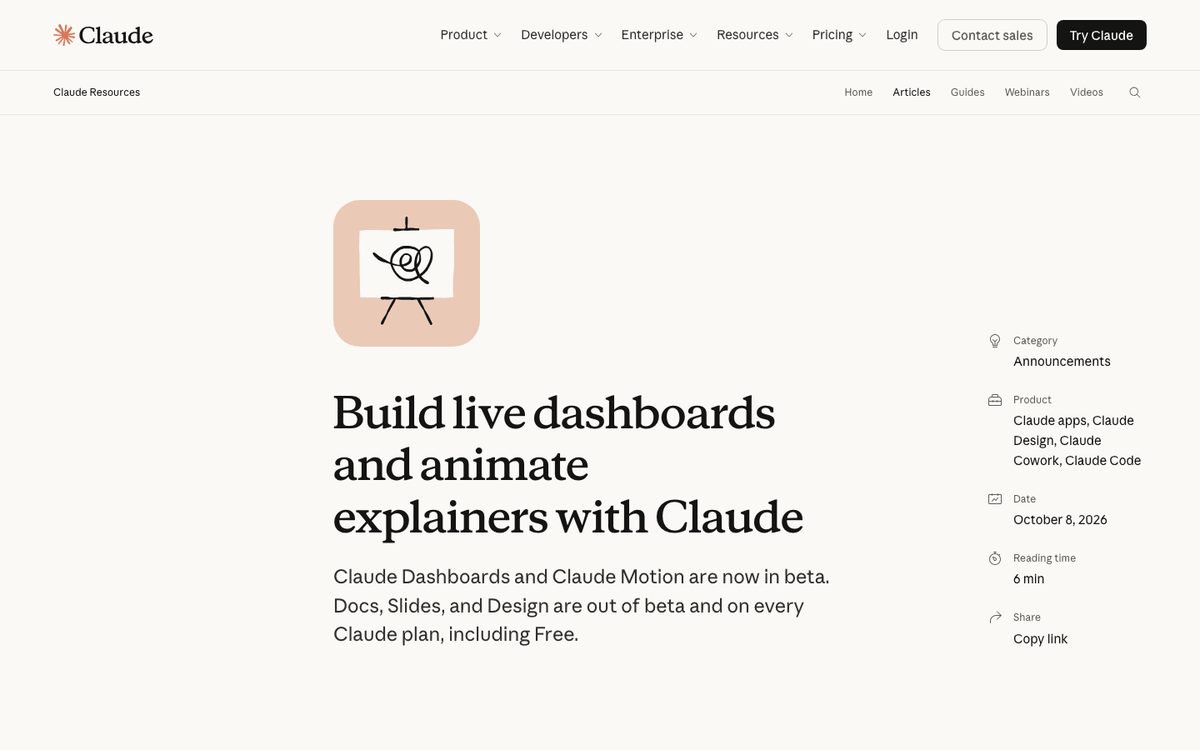
- Claude Dashboards is in beta on paid plans and connects to Amazon Redshift, BigQuery, ClickHouse, Databricks or Snowflake, plus connectors such as Salesforce.
- Each chart shows the query behind it and when its data was last refreshed.
- Claude Motion is in beta on Team and Enterprise; it builds animations as editable code, downloads as MP4, and uses no video generation model and no AI-generated people.
- Docs, Slides and Design left beta and are on every Claude plan, including Free; Anthropic says people have made more than 45 million docs, decks and designs.
- The standalone claude.ai/design site stays up until 14 December 2026; Enterprise admins must switch Dashboards and Motion on.
Why it matters: An ops or sales lead can get a live revenue or pipeline dashboard without filing a ticket or writing SQL, and turn a quarterly report into a 30-second MP4 for an all-hands.
Source: Build live dashboards and animate explainers with Claude, Anthropic, published 8 October 2026.
Our review and score: Claude on AI Review Rating.
6. GPT-6 reaches every ChatGPT tier, with Intelligent UI answers that build charts, forms and calculators in the chat
OpenAI moved every ChatGPT plan to GPT-6, and its new Intelligent UI lets an answer arrive as charts, buttons, forms or a small working tool instead of only text.
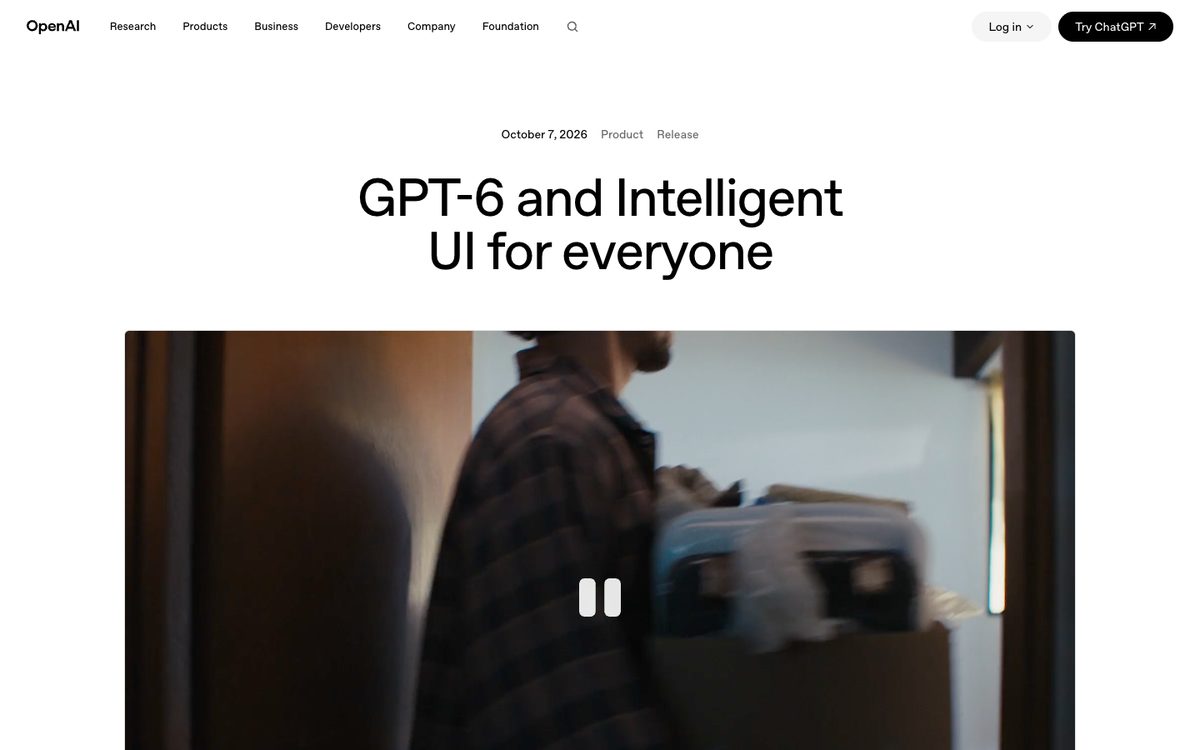
- GPT-6 with Intelligent UI started rolling out globally to Plus, Pro, Business and Enterprise on 7 October 2026, and to Free and Go from the next day.
- GPT-6 Sol powers the paid tiers; GPT-6 Luna powers Free and Go.
- Intelligent UI answers can include graphics, tappable buttons, forms, charts and small tools such as a bill splitter or a retirement savings calculator.
- ChatGPT can now begin answering while it keeps thinking.
Vendor claims, not tested by us: GPT-6 Instant starts answering 44% sooner than GPT-5.6 Instant on questions that need web search (OpenAI internal measure). More than 1.2 billion people use ChatGPT each week (OpenAI).
Why it matters: A small team on the Free or Go tier gets a GPT-6 model at no added cost, and anyone can ask ChatGPT to build a quick pricing or savings calculator instead of a spreadsheet.
Source: GPT-6 and Intelligent UI for everyone, OpenAI, published 7 October 2026.
Our review and score: ChatGPT on AI Review Rating.
7. Meta releases Muse Wonder and Muse Wonder Full, agent models for developers on its Meta Model API
Meta released Muse Wonder and Muse Wonder Full, the models it built for agent work, to developers through its Meta Model API and Muse Code.
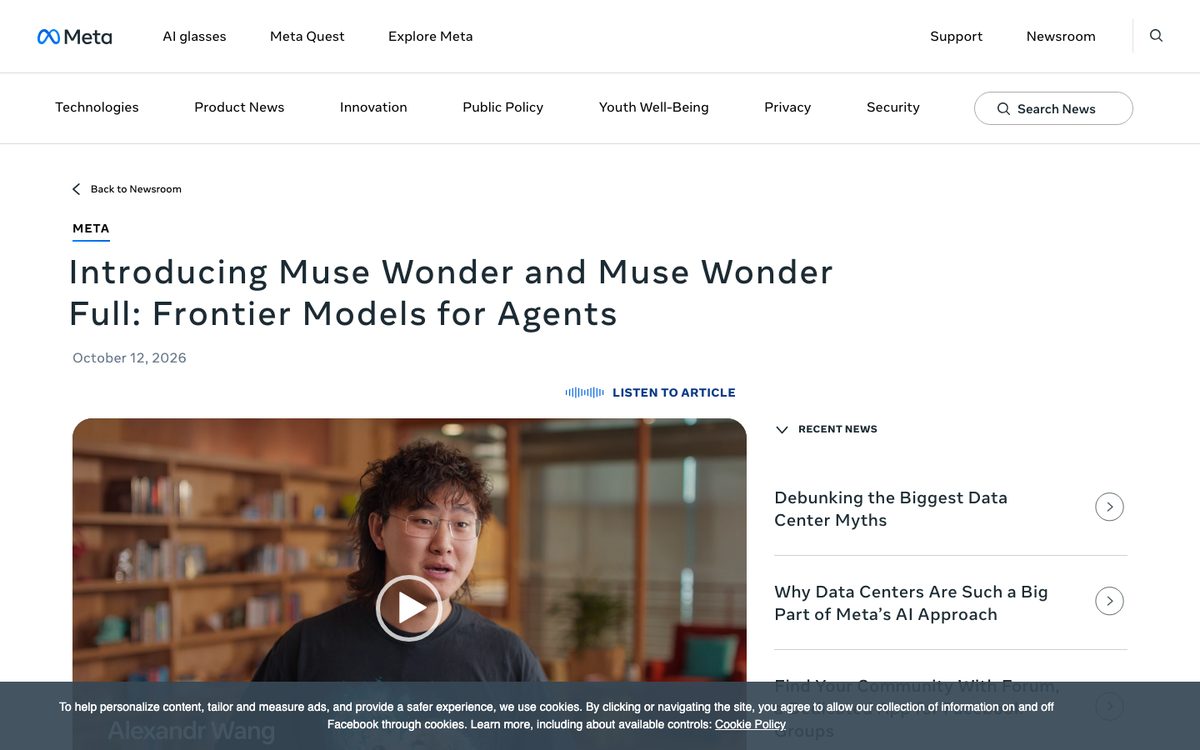
- Muse Wonder is available through the Meta Model API and Muse Code; Muse Wonder Full is available to Muse Code subscribers.
- Muse Wonder will power more of the Muse agent, rolling out first to subscribers.
- Meta names two features: Active Memory (carries context across conversations) and Active Focus (keeps working through errors and checks in before anything important).
- Meta says a full report with more safety evaluations will be available later; it was not published with the announcement.
Vendor claims, not tested by us: State-of-the-art performance on personal and professional agentic tasks (Meta; no benchmark table in the newsroom post).
Why it matters: Developers building agents get one more frontier model API to price against OpenAI and Anthropic; wait for the safety report and your own tests before moving production work.
Source: Introducing Muse Wonder and Muse Wonder Full: Frontier Models for Agents, Meta, published 12 October 2026.
8. TypeSafe raises about $870 million at a $7.5 billion valuation for Jev, its decision model priced at $0.042 per million tokens
TypeSafe AI, maker of the Jev decision model, raised about $870 million at a $7.5 billion valuation less than four weeks after Jev launched on 15 September 2026.
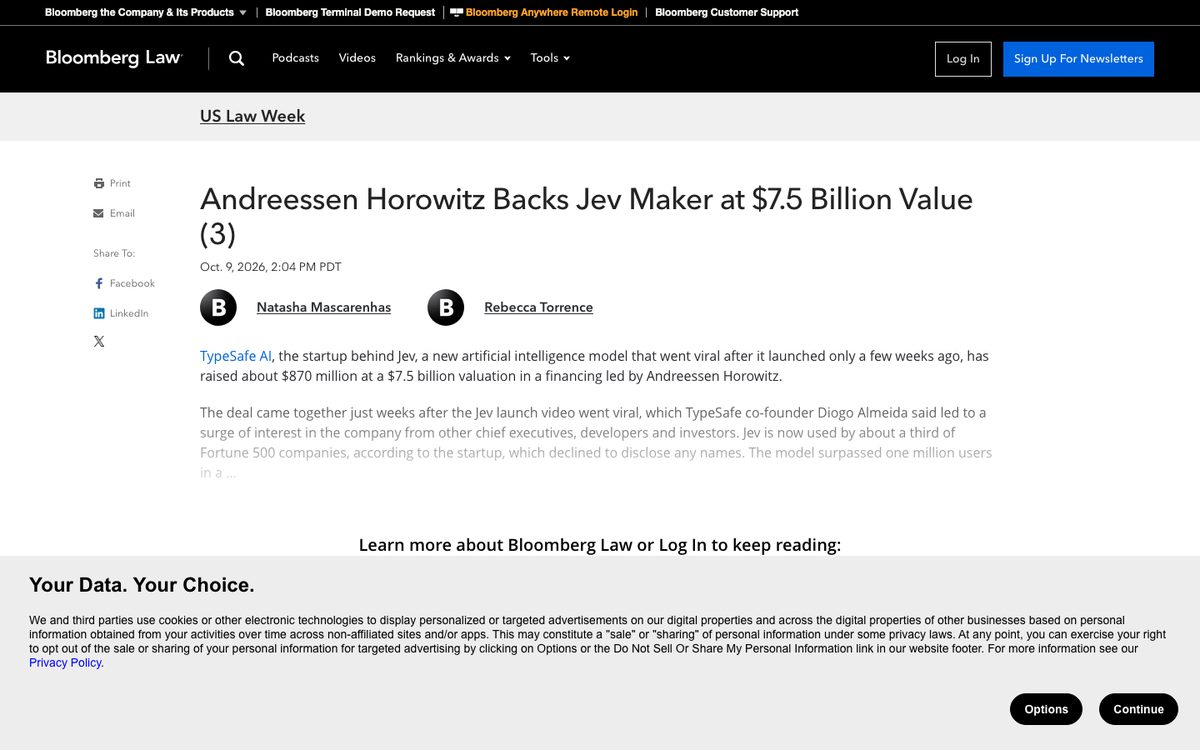
- Bloomberg reported on 9 October 2026 that TypeSafe AI raised about $870 million at a $7.5 billion valuation, led by Andreessen Horowitz.
- TypeSafe’s own post names Sequoia Capital and existing investor DCVC as participants and Martin Casado joining the board.
- Jev returns structured decisions (choices, scores, probabilities) instead of text; TypeSafe lists input at $0.042 per million tokens with output free, in early access with a waitlist.
Vendor claims, not tested by us: 193.6x faster and 444.6x cheaper than LLMs on its recorded demo; TypeSafe itself calls these the higher end of real-world gains. End-to-end response time of 70 to 500 ms (TypeSafe). About a third of Fortune 500 companies use Jev (TypeSafe, names not disclosed).
Why it matters: If your software makes high-volume yes, no or scoring calls such as lead scoring or ticket routing, a decision model billed per billion tokens may cost far less than a chat model; test it on your own data before switching.
Source: Andreessen Horowitz Backs Jev Maker at $7.5 Billion Value, Bloomberg Law, published 9 October 2026. Also: TypeSafe AI post. Also: TypeSafe AI post.
Trending repos, week of 12 October 2026
Open-source repos that two or more of the creators we watch featured between 29 September and 12 October 2026, and that already have an AIRR page. Stars and licence from the GitHub API, read 13 October 2026.
- REA (morluto/rea): agents that reverse engineer an app, from its behavior down to native binaries. 185,521 stars, MIT, featured by 3 creators we watch.
- ECC (affaan-m/ECC): a harness for Claude Code and other coding agents with skills, memory and security checks. 278,210 stars, MIT, featured by 3 creators we watch.
- VoiceStudio (debpalash/VoiceStudio): local voice cloning, dubbing, dictation and transcription that its README pitches against ElevenLabs. 61,365 stars, AGPL-3.0, featured by 2 creators we watch.
- Agent Skills (addyosmani/agent-skills): engineering skills packaged for AI coding agents. 105,926 stars, MIT, featured by 2 creators we watch.
How we picked and checked these stories
We lead with launches and tools a business can use or price, and leave out stories that only describe risk unless they change what a buyer should do. Creator posts and videos are where we hear about a story; they are never the source. Every fact above comes from the company’s own page, the GitHub API or a primary news outlet, read on 13 October 2026, and every story is dated inside 29 September to 12 October 2026. Numbers we could not test ourselves are labelled as vendor claims. Stories we could not verify on a primary source in that window were cut. More editions: all AI News editions.
Your turn
Which would you hand real work to first: a background agent such as dots or Muse, or a cheaper model such as Haiku 5.5 inside the tools you already run? Reply to our newsletter and tell us; the answers shape what we test next.
Get the next edition by email: join our free newsletter with the new AI tools we score.
Related reading
- Our weekly AI tools digest for 12 October 2026: the tools we scored
- Open-source alternatives to paid AI tools
- Open-source AI tools we rate
Sources
- Introducing dots (OpenAI, 29 September 2026), read 13 October 2026.
- The Future Is for Everyone: Muse for Small Business (Meta Newsroom, 29 September 2026), read 13 October 2026.
- storytold/photocraft on GitHub (repository created 30 September 2026), read 13 October 2026.
- Introducing Claude Haiku 5.5 (Anthropic, 7 October 2026), read 13 October 2026.
- Build live dashboards and animate explainers with Claude (Claude, 8 October 2026), read 13 October 2026.
- GPT-6 and Intelligent UI for everyone (OpenAI, 7 October 2026), read 13 October 2026.
- Introducing Muse Wonder and Muse Wonder Full: Frontier Models for Agents (Meta Newsroom, 12 October 2026), read 13 October 2026.
- Andreessen Horowitz Backs Jev Maker at $7.5 Billion Value (Bloomberg Law, 9 October 2026), read 13 October 2026.
- TypeSafe AI blog, read 13 October 2026.
- TypeSafe AI blog, read 13 October 2026.
- ArtCraft, PhotoCraft, read 13 October 2026.
- GitHub REST API, repository records for the storytold account, read 13 October 2026.
1 comment
Sign in to join the discussion.
Login to comment