The short answer
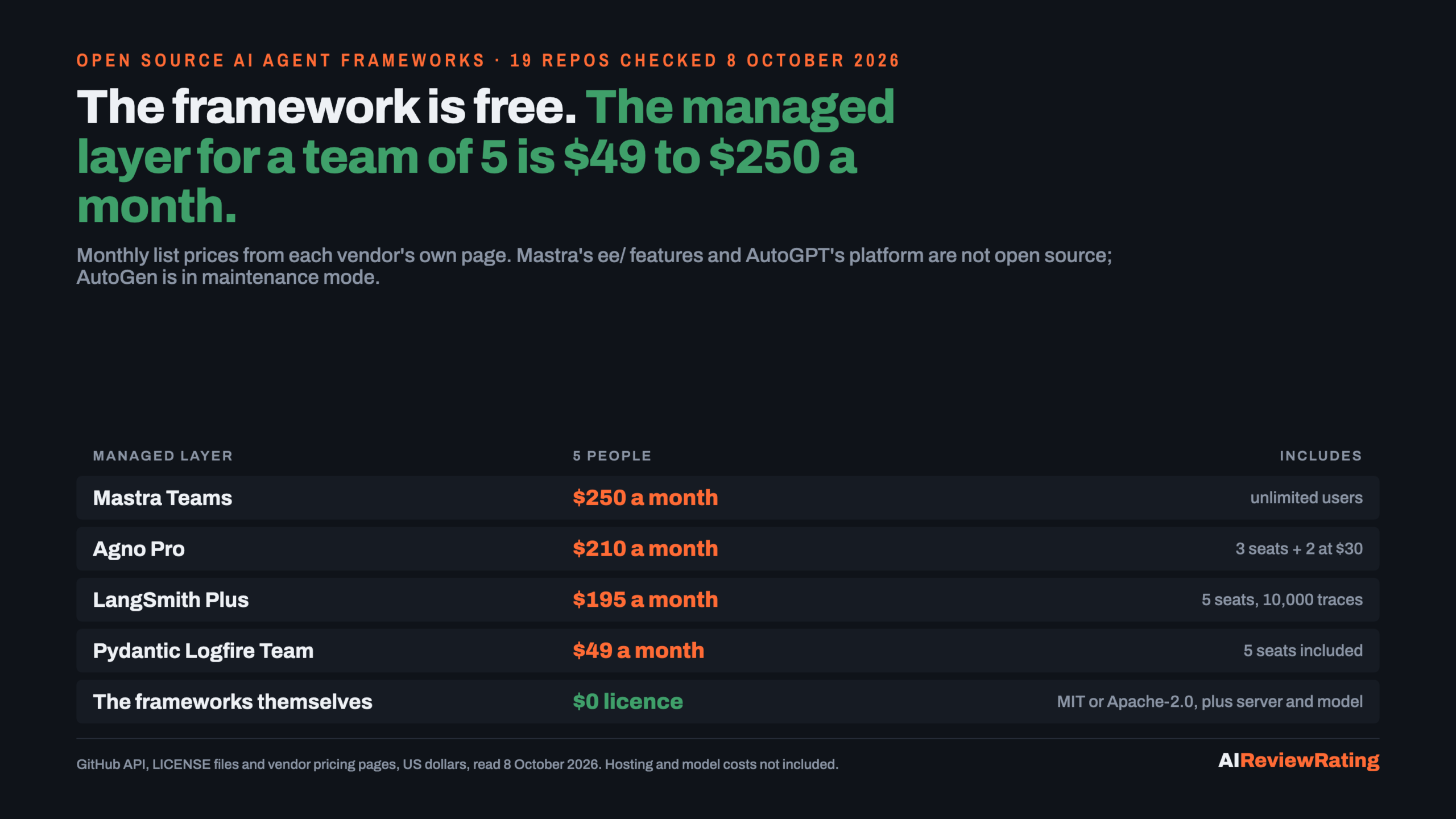
Short answer, checked on 8 October 2026: for a startup or small development team, the core of every framework we recommend is MIT or Apache-2.0 and free to self-host, so the framework itself costs $0. Pick LangGraph for resilient, stateful agents, CrewAI for teams of role-playing agents, Pydantic AI for typed Python, Mastra or the Vercel AI SDK for TypeScript, and Microsoft Agent Framework for .NET. Two things cost money or freedom. First, the managed layer each maker sells: for a team of 5 it runs from $49 a month (Pydantic Logfire Team) to $250 a month (Mastra Teams), with LangSmith at $195. Second, licence fine print: Mastra’s enterprise folders and AutoGPT’s platform are not open source, and AutoGen is in maintenance mode.
| If you need | Framework | Licence (file) | Managed layer for 5 people, per month |
|---|---|---|---|
| Resilient, stateful agents | LangGraph | MIT | LangSmith Plus $195 at 10,000 traces |
| Teams of role-playing agents | CrewAI | MIT | $0 up to 50 executions, then a quote |
| Typed Python agents | Pydantic AI | MIT | Logfire Team $49, 5 seats included |
| An agent platform you run yourself | Agno | Apache-2.0 | Agno Pro $210 ($150 for 3 seats plus 2 at $30) |
| TypeScript | Mastra | Apache-2.0, except ee/ folders | Mastra Teams $250, unlimited users |
| .NET, or moving off AutoGen | Microsoft Agent Framework | MIT | No Microsoft price read for this page |
All 19 repositories, checked the same morning
We read every repository below from the GitHub API on 8 October 2026, followed any redirect, and then read the licence file itself where GitHub’s detector could not name the licence. Rows are ordered by GitHub stars. Stars measure attention, not quality, so read the last two columns before you commit: they show whether anyone is still shipping.
| Project | Main language | GitHub stars | Licence | Latest GitHub release | Last push |
|---|---|---|---|---|---|
| AutoGPT | Python | 187,695 | MIT, except the platform (PolyForm Shield) | autogpt-platform-beta-v0.8.3, 8 October 2026 | 8 October 2026 |
| LangChain | Python | 147,559 | MIT | langchain-core==1.6.7, 6 October 2026 | 8 October 2026 |
| MetaGPT | Python | 70,773 | MIT | v0.8.1, 22 April 2024 | 21 January 2026 |
| AutoGen | Python | 61,293 | MIT code, CC-BY-4.0 docs | python-v0.7.5, 30 September 2025 | 15 April 2026 |
| CrewAI | Python | 59,446 | MIT | 1.15.25, 7 October 2026 | 8 October 2026 |
| Goose | Rust | 55,054 | Apache-2.0 | v1.53.0, 2 October 2026 | 8 October 2026 |
| LlamaIndex | Python | 52,436 | MIT | v0.14.25, 21 September 2026 | 6 October 2026 |
| LangGraph | Python | 42,877 | MIT | cli==0.4.33, 7 October 2026 | 8 October 2026 |
| Agno | Python | 42,610 | Apache-2.0 | v3.1.1, 2 October 2026 | 8 October 2026 |
| OpenAI Agents SDK | Python | 29,903 | MIT | v0.23.1, 2 October 2026 | 8 October 2026 |
| smolagents | Python | 29,729 | Apache-2.0 | v1.26.0, 29 May 2026 | 6 October 2026 |
| Mastra | TypeScript | 28,635 | Apache-2.0, except ee/ folders | @mastra/core@1.75.0, 7 October 2026 | 8 October 2026 |
| Semantic Kernel | C# | 28,634 | MIT | dotnet-1.81.0, 6 October 2026 | 7 October 2026 |
| Vercel AI SDK | TypeScript | 27,164 | Apache-2.0 | @ai-sdk/zai@3.0.28, 8 October 2026 | 8 October 2026 |
| Haystack | Python | 26,694 | Apache-2.0 | v3.3.0, 1 October 2026 | 7 October 2026 |
| Letta | not reported | 25,073 | Apache-2.0 | 0.16.8, 14 May 2026 | 10 September 2026 |
| Google ADK | Python | 21,739 | Apache-2.0 | v2.11.0, 2 October 2026 | 8 October 2026 |
| Pydantic AI | Python | 20,482 | MIT | v2.54.0, 3 October 2026 | 8 October 2026 |
| Microsoft Agent Framework | Python | 14,000 | MIT | dotnet-1.24.0, 7 October 2026 | 8 October 2026 |
Three projects the star counts flatter
AutoGen: 61,293 stars, maintenance mode
AutoGen‘s README opens with a warning box: “AutoGen is now in maintenance mode.” It adds that AutoGen will not receive new features, that contributions are limited to bug fixes, security patches and documentation, and it recommends Microsoft Agent Framework for new projects. Its latest release, python-v0.7.5, is dated 30 September 2025, 373 days before our check. When we captured Google’s AI Overview for this search on 28 September 2026, it said only that “older 0.x versions have shifted toward maintenance mode”. The README does not limit maintenance mode to older versions. Our CrewAI vs LangGraph vs AutoGen comparison covers the move in detail.
MetaGPT: 70,773 stars, no push since 21 January 2026
MetaGPT still sits third by stars in this census. Its last push was 260 days before our check, and its latest GitHub release, v0.8.1, is dated 22 April 2024. The repository is not archived and carries no maintenance notice, so treat it as a reference design, not a dependency, until that changes.
AutoGPT: 187,695 stars, and the part you would build on is not MIT
AutoGPT has more stars than any other project here and pushed code on 8 October 2026. Its LICENSE file splits the repository: everything in the autogpt_platform folder is under the PolyForm Shield License, and everything outside it, including the original stand-alone agent, is MIT. PolyForm Shield allows any purpose “except for providing any product that competes with the software”. A startup building an agent platform should read that clause before forking the platform folder.
The licence fine print a startup should read
Most of the roster is plainly MIT or Apache-2.0 in its LICENSE file. Four projects need a second look, and in two of them GitHub’s own licence detector returns NOASSERTION, meaning it could not name the licence.
- Mastra: Apache-2.0, except anything under a folder named
ee/, for example@mastra/core/auth/ee,@mastra/core/agent-builder/ee,@mastra/editor/ee. Those fall under the Mastra Enterprise Edition License 2.0, effective 22 September 2026, which says plainly: “They are not open source.” Production use of an enterprise feature needs a written agreement with Kepler and a valid License Key, and you may not offer one to third parties as a hosted or managed service. The core framework outsideee/stays Apache-2.0. - AutoGPT: MIT, except the platform folder, which is PolyForm Shield with a noncompete clause (above).
- AutoGen: GitHub reports CC-BY-4.0, which is the documentation licence. The code is MIT under a separate LICENSE-CODE file.
- Vercel AI SDK: GitHub reports NOASSERTION, but the LICENSE file is Apache-2.0, copyright Vercel.
This is a reading of the files, not legal advice. If a licence decides whether you can sell your product, have counsel read the same file.
The frameworks, one by one
In star order on 8 October 2026. Where a quote appears, it is the project’s own one-line description on GitHub that day.
LangChain (147,559 stars, MIT)
LangChain calls itself “The agent engineering platform” and is LangGraph’s parent project. Use it for model wrappers and integrations; the agent orchestration library is LangGraph, below.
CrewAI (59,446 stars, MIT)
CrewAI‘s README describes Crews of role-based agents and Flows, event-driven automations with native support for Crews. It shipped 1.15.25 on 7 October 2026.
LlamaIndex (52,436 stars, MIT)
LlamaIndex now describes itself as “the document processing platform for AI”. Pick it when the agent’s main job is reading your documents; our RAG framework comparison covers that layer.
LangGraph (42,877 stars, MIT)
LangGraph‘s README calls it a “low-level orchestration framework for building stateful agents” and lists durable execution that resumes after failures, human-in-the-loop checkpoints and long-term memory. We have no LangGraph review page yet, so the link goes to its repository and the LangChain score box above stands in.
Agno (42,610 stars, Apache-2.0)
Agno is the project formerly called Phidata: GitHub resolves the old repository to agno-agi/agno, and our review page is still filed under the old name. Its pricing page says “The runtime is free and open source”; what it sells is the hosted control plane, priced below.
OpenAI Agents SDK (29,903 stars, MIT)
OpenAI Agents SDK is OpenAI’s own library, described as “a lightweight, powerful framework for multi-agent workflows”. Model prices are outside this page.
smolagents (29,729 stars, Apache-2.0)
smolagents is Hugging Face’s “barebones library for agents that think in code”. Its latest GitHub release is dated 29 May 2026, although pushes continued to 6 October 2026.
Mastra (28,635 stars, Apache-2.0, except ee/ folders)
Mastra calls itself “the modern TypeScript framework for AI-powered applications and agents” and sells a hosted platform, priced below. Read the ee/ licence note above before using auth, agent-builder or editor features in production.
Semantic Kernel (28,634 stars, MIT)
Semantic Kernel is Microsoft’s SDK to integrate LLM technology into existing apps; GitHub detects C# as its main language.
Vercel AI SDK (27,164 stars, Apache-2.0)
The Vercel AI SDK is “The AI Toolkit for TypeScript” from Vercel, Apache-2.0 by its LICENSE file.
Haystack (26,694 stars, Apache-2.0)
Haystack is deepset’s orchestration framework; its GitHub description centres on modular pipelines and agent workflows.
Letta (25,073 stars, Apache-2.0)
Letta describes a “platform for stateful agents” with advanced memory. Its latest GitHub release is dated 14 May 2026 and its last push was 10 September 2026.
Google ADK (21,739 stars, Apache-2.0)
Google ADK is Google’s “code-first Python toolkit for building, evaluating, and deploying” agents.
Pydantic AI (20,482 stars, MIT)
Pydantic AI comes from the Pydantic team, which also sells the Logfire observability service priced below. Its description ends “typed end to end”.
Microsoft Agent Framework (14,000 stars, MIT)
Microsoft Agent Framework is AutoGen’s named successor and supports Python and .NET. Its latest tag is dotnet-1.24.0, published 7 October 2026.
Goose (55,054 stars), named by Google but an agent, not a framework
Google’s AI Overview lists Goose among the frameworks. Its own description calls it “an open source, extensible AI agent”: a ready-made agent you run, written in Rust, rather than a library you build on. The repository moved from block/goose to aaif-goose/goose, which the GitHub API confirms by redirect.
What a team of 5 pays for the managed layer
The frameworks are free. What their makers sell is the hosted layer around them: tracing, evaluation, a control plane or a deployment platform. These products are not identical, so compare what each includes, not just the price. For 5 people, on each vendor’s own page on 8 October 2026:
| Managed layer | Pairs with | 5 people, per month | Per year | What the price includes |
|---|---|---|---|---|
| LangSmith Plus | LangGraph | $195 | $2,340 | 5 seats at $39, 10,000 base traces; $395 at 50,000 traces and $645 at 100,000 by its calculator |
| Pydantic Logfire Team | Pydantic AI | $49 | $588 | 5 seats, 10M records, then $2 per million |
| Agno Pro | Agno | $210 | $2,520 | 3 seats and 1 live AgentOS connection; $30 a month per extra seat |
| Mastra Teams | Mastra | $250 | $3,000 | Unlimited users, 1M observability events, 250 CPU hours, 6 months retention |
| CrewAI | CrewAI | $0, then a quote | not published | Basic: 50 workflow executions a month; Enterprise is custom |
So self-hosting the open source pieces avoids between $588 and $3,000 a year in managed fees for a team of 5, before you pay for the server and the tracing you run instead. Two vendors make the self-hosted route explicit: LangSmith lists self-hosted and hybrid deployment under Enterprise, and Pydantic offers Logfire Enterprise as a self-hosted option. Agno’s page says it holds no copy of your data and charges no per-event fees, because the agents run in your own cloud. Mastra’s gateway adds market rate + 5.5% to model tokens routed through it.
Which one should your team pick?
- Long-running agents that must survive failures and pause for approval: LangGraph. Budget $195 a month for 5 LangSmith seats if you want hosted traces.
- A workflow that reads like a job description: CrewAI. The hosted plan is free to 50 executions a month.
- Typed Python and the lowest published team price for hosted tracing: Pydantic AI with Logfire Team at $49 a month.
- A TypeScript stack: Mastra if you want its platform (read the ee/ licence), or the Vercel AI SDK for a plain Apache-2.0 library.
- .NET, or existing AutoGen code: Microsoft Agent Framework.
- About to start on AutoGen or MetaGPT: check the dates in the census table first.
What self-hosting does not remove
- The model. Every framework here calls a model through an API key or a local runner. Our break-even for self-hosting a model shows when running it yourself beats paying per token.
- The server and the tracing. We did not price hosting for this page. Without a managed layer you run your own logging and evaluation.
- A no-code builder. If your team wants a visual builder rather than a library, our self-hosted AI agent platforms guide covers that class of tool.
How we checked
Stars, licences, release tags, push dates, archive status and repository moves come from the GitHub REST API on 8 October 2026. Where GitHub returned NOASSERTION or a documentation licence, we read the LICENSE file itself the same day. AutoGen’s status is quoted from its README. Prices were read on each vendor’s own pricing page in a rendered browser, with no cookie banner clicked, and the LangSmith totals are the figures its calculator returned for 5 seats. The Google AI Overview quote is from our capture on 28 September 2026. We did not benchmark speed or token use and quote no third-party comparison tables. Scores in the boxes come from our desk review rubric, which this article does not change. For other self-hostable tools, see our open source AI tools list.
Related reading on this site
- CrewAI vs LangGraph vs AutoGen: three of these frameworks head to head, with LangSmith’s calculator for 5 seats.
- Self-hosted AI agent platforms: Dify, Langflow, n8n and the no-code class of agent tools.
- RAG frameworks compared: the retrieval layer most agents sit on.
- Self-hosting an LLM against paying per token: the model half of a self-hosted agent’s bill.
Questions people ask about open source agent frameworks
What is the most popular open source AI agent?
By GitHub stars on 8 October 2026, AutoGPT leads this census with 187,695, but its platform folder is under the PolyForm Shield licence, not MIT. Among the libraries teams build on, LangChain has 147,559 stars, CrewAI 59,446 and LangGraph 42,877. Stars measure attention, not quality.
What is the best framework to build AI agents?
It depends on the job. As of 8 October 2026: LangGraph (42,877 stars, MIT) for resilient stateful agents, CrewAI (59,446, MIT) for role-based agent teams, Pydantic AI (20,482, MIT) for typed Python, Mastra (28,635) for TypeScript, and Microsoft Agent Framework (14,000, MIT) for .NET.
What is the best open source AI agent builder?
If you want a library, see the table above: every active framework in it is MIT or Apache-2.0. If you want a visual builder you self-host, that is a different class of tool, covered in our self-hosted AI agent platforms guide. Checked 8 October 2026.
Is AutoGen still maintained?
Only for fixes. AutoGen’s README, read on 8 October 2026, says it is in maintenance mode, will not receive new features, and recommends Microsoft Agent Framework for new projects. Its latest release is python-v0.7.5, dated 30 September 2025.
Is Mastra open source?
Mostly. Its LICENSE file puts the framework under Apache-2.0, but anything in an ee/ folder is under the Mastra Enterprise Edition License 2.0, which says those features are not open source and need a written agreement and licence key for production. Read 8 October 2026.
How much does it cost to run an open source agent framework for a team?
The framework is $0. The optional managed layer for 5 people, read on 8 October 2026: Pydantic Logfire Team $49 a month, LangSmith Plus $195, Agno Pro $210, Mastra Teams $250. CrewAI is free to 50 executions, then a quote. Servers and model calls are extra.
Is Phidata the same as Agno?
Yes. On 8 October 2026 the GitHub API resolves phidatahq/phidata to agno-agi/agno, which had 42,610 stars and an Apache-2.0 licence.
Sources
- AutoGen README, read 8 October 2026.
- AutoGen LICENSE-CODE, read 8 October 2026.
- Mastra LICENSE.md, read 8 October 2026.
- Mastra Enterprise Edition License (ee/LICENSE), read 8 October 2026.
- Vercel AI SDK LICENSE, read 8 October 2026.
- AutoGPT LICENSE, read 8 October 2026.
- LangSmith pricing, langchain.com, read 8 October 2026.
- CrewAI pricing, read 8 October 2026.
- Agno pricing, read 8 October 2026.
- Pydantic Logfire pricing, read 8 October 2026.
- Mastra pricing, read 8 October 2026.
- AutoGPT on GitHub (Significant-Gravitas/AutoGPT), read 8 October 2026.
- LangChain on GitHub (langchain-ai/langchain), read 8 October 2026.
- MetaGPT on GitHub (FoundationAgents/MetaGPT), read 8 October 2026.
- AutoGen on GitHub (microsoft/autogen), read 8 October 2026.
- CrewAI on GitHub (crewAIInc/crewAI), read 8 October 2026.
- Goose on GitHub (aaif-goose/goose), read 8 October 2026.
- LlamaIndex on GitHub (run-llama/llama_index), read 8 October 2026.
- LangGraph on GitHub (langchain-ai/langgraph), read 8 October 2026.
- Agno on GitHub (agno-agi/agno), read 8 October 2026.
- OpenAI Agents SDK on GitHub (openai/openai-agents-python), read 8 October 2026.
- smolagents on GitHub (huggingface/smolagents), read 8 October 2026.
- Mastra on GitHub (mastra-ai/mastra), read 8 October 2026.
- Semantic Kernel on GitHub (microsoft/semantic-kernel), read 8 October 2026.
- Vercel AI SDK on GitHub (vercel/ai), read 8 October 2026.
- Haystack on GitHub (deepset-ai/haystack), read 8 October 2026.
- Letta on GitHub (letta-ai/letta), read 8 October 2026.
- Google ADK on GitHub (google/adk-python), read 8 October 2026.
- Pydantic AI on GitHub (pydantic/pydantic-ai), read 8 October 2026.
- Microsoft Agent Framework on GitHub (microsoft/agent-framework), read 8 October 2026.
- Google AI Overview for ‘best open source ai agent frameworks’ (our capture), captured 28 September 2026.
Comments
Sign in to join the discussion.
Login to comment