Prices verified 27 September 2026 on each vendor’s own pricing page, price document or official repository, with monthly billing selected and no promotion applied. Popularity figures come from GitHub’s API on the same date and from install counts from the open Claude Code Templates registry (aitmpl.com), 2026-09-26.
Our pick means we earn a commission if you subscribe through our link, and we list those tools first. Firecrawl is our pick on this page. That does not change any score: Firecrawl scores 7.7 and Bright Data scores 7.9 on our published rubric, and every score below is printed unchanged, so you can see exactly how far a tool has been moved. Read the ranking as our pick first, then score. The prices are the vendors’ own.
The short answer
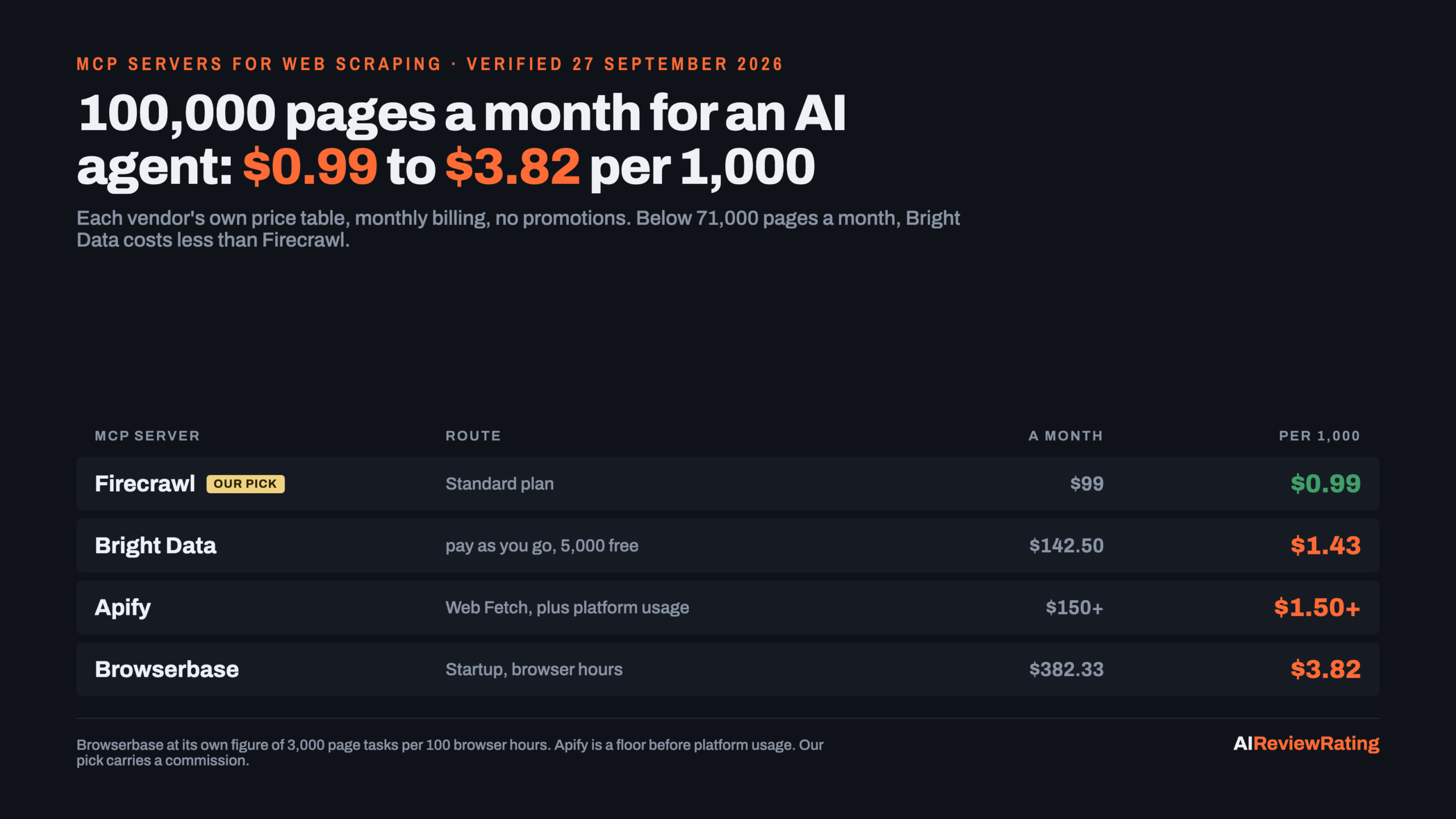
For a team feeding live web pages to AI agents, the MCP server that costs least depends on monthly volume. At 100,000 pages a month, the allowance of the plan Firecrawl marks Recommended, Firecrawl Standard is $99, or $0.99 per 1,000 pages. Bright Data pay as you go comes to $142.50 after its 5,000 free monthly requests, Apify‘s default fetch tool costs at least $150 before platform usage, and Browserbase‘s MCP server, which bills browser hours rather than pages, comes to $382.33 on Browserbase’s own rule of thumb. Below 71,000 pages a month, Bright Data costs less than Firecrawl.
| MCP server | Best for | Per 1,000 pages at 100,000 a month | Free without paying |
|---|---|---|---|
| 🥇 Firecrawl Our pick | Clean Markdown for an agent or RAG index, 1 credit a page | $0.99, Standard at $99 a month | 1,000 credits a month, plus a keyless hosted tier |
| 🥈 Bright Data | Under 71,000 pages a month, and 45 ready-made site extractors | $1.43, pay as you go, $142.50 | 5,000 requests a month |
| 🥉 Browserbase | Agents that must click, type or log in | $3.82, Startup plan, $382.33 | 1 browser hour a month |
| Apify | A ready-made scraper from a store of 75,753 Actors | $1.50 or more, Starter, $150 plus platform usage | $5 of usage a month |
Pick by the job, not the brand:
- Reading pages into an agent at 72,000 to 142,000 a month: Firecrawl Standard, $99 for the first 100,000. Try Firecrawl free.
- Fewer than 71,000 pages a month, or pages from Amazon, LinkedIn and other sites with a ready-made extractor: Bright Data, $1.50 per 1,000 after 5,000 free.
- An agent that has to click, type or log in: Browserbase, billed by the browser minute.
- One named site that already has a scraper in the Apify Store: Apify, priced per Actor.
What 10,000, 100,000 and 300,000 pages a month cost on each MCP server
Every vendor here prints a plan table, and most print a pay-as-you-go rate beside it. Neither number is your bill. The bill is the cheapest route through the vendor’s own table at your volume: at 10,000 pages on Firecrawl, a $19 plan plus 5 top-ups of $5, not the $99 plan. Each route counts the plan fee, what it includes, and what each page past the allowance costs. We walked each table at three volumes. 10,000 pages is one agent in development, 100,000 is Firecrawl’s Recommended allowance, and 300,000 is a production pipeline that still sits below 383,000, the point past which Bright Data’s plans would need an overage rate its MCP price page does not print.
| MCP server and route | 10,000 pages | 100,000 pages | 300,000 pages |
|---|---|---|---|
| Firecrawl Our pick | $44 ($4.40) Hobby plus 5 top-ups |
$99 ($0.99) Standard |
$399 ($1.33) Growth |
| Bright Data | $7.50 ($0.75) pay as you go |
$142.50 ($1.43) pay as you go |
$442.50 ($1.48) pay as you go |
| Browserbase, browser hours | $48 ($4.80) Developer |
$382.33 ($3.82) Startup |
$1,049 ($3.50) Startup |
| Apify, Web Fetch tool | $19 ($1.90) or more Starter |
$150 ($1.50) or more Starter |
$375 ($1.25) or more Scale |
- Firecrawl. Hobby is $19 for 5,000 credits and tops up at 1,000 credits per $5, so 10,000 pages is $19 plus five top-ups. Past 21,000 pages, Standard’s flat $99 is cheaper, and it covers 100,000. Growth is $399 for 500,000. On annual billing Standard is $990 a year and Growth $3,990, which is $0.83 and $0.67 per 1,000 pages at full use.
- Bright Data. Its MCP documentation and README describe an account-level free tier of 5,000 requests a month, renewing on the 1st, then $1.50 per 1,000 results for search, scrape and extract. That pool is shared with any other Bright Data product on the account, because the MCP server runs on its Web Unlocker API. The monthly plans ($499 for 383,000 results, $999 for 908,000, $1,999 for 2 million) only beat pay as you go from 337,667 pages a month.
- Browserbase. Its MCP server runs a cloud browser, so the meter is browser time, billed by the minute with a one-minute minimum per session. Developer is $20 for 100 hours, then $0.12 an hour; Startup is $99 for 500 hours, then $0.10. Its pricing page says 100 hours is roughly 3,000 page-level tasks, and we used that figure unchanged.
- Apify. Its MCP server fetches single pages through the Web Fetch Actor by default, priced per successful fetch at $1.50 per 1,000 on the Free and Starter plans, $1.25 on Scale and $1.00 on Business. Each plan fee is prepaid usage, so a month costs the fee or the usage, whichever is larger.
Firecrawl or Bright Data: the cheaper one changes four times by 500,000 pages
These are the two servers that price a page outright, so they can be compared at any volume without an assumption. Walking both tables in steps of 1,000 pages, monthly billing, gives four bands. Google autocompletes “bright data vs firecrawl” as if there were one answer; by volume there are four.
| Pages a month | Costs less | Why |
|---|---|---|
| Up to 70,000 | Bright Data | 5,000 free, then $1.50 per 1,000, stays under Firecrawl Standard’s $99 |
| 72,000 to 142,000 | Firecrawl | Standard’s $99 covers 100,000, then top-ups at $2.50 per 1,000 |
| 143,000 to 270,000 | Bright Data | Past 100,000 Firecrawl adds $2.50 per 1,000 in top-ups, then $399 for Growth; Bright Data stays at $1.50 |
| 272,000 to 500,000 | Firecrawl | Growth is $399 for 500,000 pages |
The gap is narrow at the edges and wide in the middle. At 100,000 pages Firecrawl is $43.50 a month cheaper; at 200,000 Bright Data is $56.50 cheaper. On Firecrawl’s annual billing the first crossover moves down from 71,000 to 60,000 pages.
One setting moves Firecrawl more than any volume does. Asking it for JSON rather than Markdown adds 4 credits a page, so Standard buys 20,000 JSON pages and the rate rises from $0.99 to $4.95 per 1,000. Bright Data’s MCP price page puts its structured data from named platforms under the same $1.50 per 1,000 as a plain scrape.
What each MCP server gives an agent
Price is half the decision. The other half is what the server exposes, whether an agent can connect without installing anything, and whether anyone still maintains the code.
| MCP server | Hosted endpoint | Tools | Licence, GitHub stars | Registry installs |
|---|---|---|---|---|
| Firecrawl Our pick | mcp.firecrawl.dev/v2/mcp |
26 in the full profile, 3 with no API key | MIT, 7,518 | 592, 27th of 104 |
| Bright Data | mcp.brightdata.com/mcp |
69, including 45 platform extractors | MIT, 2,659 | 616, 25th of 104 |
| Browserbase | mcp.browserbase.com/mcp |
6 browser-session tools | Apache-2.0, 3,413, repository archived | 415, 35th of 104 |
| Apify | mcp.apify.com |
Any of 75,753 Store Actors, 2 loaded by default | MIT, 8,651 | 119, 72nd of 104 |
Two columns in that table disagree, and the disagreement is the useful part. Apify’s server has the most GitHub stars of the four, 8,651, and the fewest registry installs, 119. Bright Data has the fewest stars, 2,659, and the most installs, 616. Stars measure attention on GitHub; installs measure people adding a server to Claude Code. Neither tells you whether a server returns your pages.
The four MCP servers, ranked
Our pick first, then our score, which is the default order of every listing on this site. Each score is our rubric’s number, shown unchanged, and each price was read on 27 September 2026.
🥇 1. Firecrawl Our pick: Markdown per page, from $19 a month
Our score 7.7 out of 10. Free plan 1,000 credits a month; paid plans from $19 a month on monthly billing.
Firecrawl turns a URL into clean Markdown or JSON for a model, and its MCP server puts scrape, search, map, crawl, document parsing, an autonomous agent, a browser interact tool and page monitoring in front of an agent: 26 tools in the full profile. The hosted endpoint needs no install, and with no API key at all it still runs scrape, search and parse, rate-limited. That makes it the only one of the four an agent can use free without a key or an account. The MCP server is MIT licensed, with 7,518 GitHub stars, last pushed 26 September 2026.
| Plan | Monthly billing | Annual billing | Pages a month | Per 1,000, monthly |
|---|---|---|---|---|
| Free | $0 | $0 | 1,000 | $0 |
| Hobby | $19 | $190 a year | 5,000 | $3.80 |
| Standard | $99 | $990 a year | 100,000 | $0.99 |
| Growth | $399 | $3,990 a year | 500,000 | $0.80 |
| Scale | $749 | $7,190 a year | 1,000,000 | $0.75 |
What to watch
- JSON output adds 4 credits a page, so Standard buys 20,000 JSON pages, $4.95 per 1,000.
- A scrape that returns no result is not charged, but a page that answers 403 or 404 still costs 1 credit.
- Credits roll over only on Scale, for one month. Hobby, Standard and Growth lose what they do not use.
- Top-ups come in $5 steps up to a monthly limit you set: 1,000 credits on Hobby, 2,000 on Standard, 2,500 on Growth, 5,000 on Scale.
Verdict: the lower cost per page of the two per-page servers from 72,000 to 142,000 pages a month and again from 272,000 to 500,000, and the one to try first because it needs no key. Full review, pricing and alternatives: Firecrawl review. Start on Firecrawl’s free plan.
🥈 2. Bright Data: 69 tools and 5,000 free requests a month
Our score 7.9 out of 10. Free tier 5,000 requests a month; pay as you go $1.50 per 1,000 results.
Bright Data sells proxies and scraping infrastructure, and its MCP server runs on its Web Unlocker API, which handles proxy rotation, anti-bot challenges and CAPTCHAs on every request, by its own documentation. It exposes 69 tools: search on Google, Bing and Yandex, any URL as Markdown or HTML, 45 platform extractors that return JSON from sites such as Amazon, LinkedIn and Zillow, and 13 remote-browser tools. The rest come in groups on top of 5 base tools that always load, so an agent carries only what it needs. MIT licensed, 2,659 GitHub stars, last pushed 17 September 2026.
| Plan | Price | Included | Per 1,000 at full use | Browser |
|---|---|---|---|---|
| Free | $0 | 5,000 requests a month | $0 | in the free tier |
| Pay as you go | $1.50 per 1,000 | none | $1.50 | $8 per GB |
| Scale | $499 a month | 383,000 results | $1.30 | $6 per GB |
| Scale | $999 a month | 908,000 results | $1.10 | $6 per GB |
| Scale | $1,999 a month | 2,000,000 results | $1.00 | $6 per GB |
What to watch
- When the free requests run out, requests stop unless you have deposited funds, and the control panel takes a spend cap. That is a built-in brake on a runaway agent.
- Free requests do not roll over, and on a team account the pool is shared by every user.
- The Web Unlocker price page, the API the MCP server runs on, says “Pay only for success”.
Verdict: the cheaper per-page server under 71,000 pages a month and between 143,000 and 270,000, with 69 tools, the widest set of the four. Full review: Bright Data review.
🥉 3. Browserbase: a cloud browser, billed by the minute
Our score 4.4 out of 10. Free plan 1 browser hour a month; paid plans from $20 a month.
Browserbase runs headless browsers in the cloud, and its MCP server hands an agent one: 6 tools that start and end a session, navigate, and act, observe or extract in plain English through Stagehand, the browser framework Browserbase maintains. It is built for pages an agent has to operate rather than read: a login, a form, an infinite scroll. The trade is the meter, which is browser time, not pages.
The self-hostable repository is archived. GitHub’s API reports browserbase/mcp-server-browserbase as archived, last pushed 20 July 2026, and its README says it is retained for historical purposes. Browserbase’s setup documentation points to the hosted endpoint instead. The repository still shows 3,413 stars and the registry still counts 415 installs under its name.
| Plan | Price a month | Browser hours | Then per hour | Concurrent browsers |
|---|---|---|---|---|
| Free | $0 | 1 | not available | 3 |
| Developer | $20 | 100 | $0.12 | 25 |
| Startup | $99 | 500 | $0.10 | 100 |
| Scale | custom | 500 or more | custom | 250 or more |
How the per-page figure is made. Browserbase’s pricing page says a typical web scrape runs in under 2 minutes and that 100 hours is roughly 3,000 page-level tasks. At that rate 100,000 pages is 3,333.33 hours, which on Startup is $99 plus 2,833.33 hours at $0.10: $382.33. The break-even is the more useful number. Startup’s 500 included hours cover 100,000 pages only if the agent averages 18 seconds a page or less, and because each session bills at least one minute, that means reusing one session across many pages rather than opening one per page.
Browserbase also sells a Fetch API priced per call: 1,000 calls included on Free and Developer and 10,000 on Startup, then $1 per 1,000 on Developer, $4 with proxies. Called directly, 100,000 fetches on Developer cost $119. Three things keep it out of the comparison: the MCP server does not expose Fetch as a tool, Fetch does not execute JavaScript and stops at 5 MB, and the pricing page contradicts itself on Startup, where the plan card says $1 per 1,000 after the included calls and both the comparison table on the same page and the plans documentation say $0.50.
What to watch: the plans documentation calls the included hours allocations, not limits, and says “No caps. No cut-offs.” An agent that loops keeps billing browser minutes at the overage rate. The Free plan also ends every session at 15 minutes.
Verdict: the server for agents that must click and log in, budgeted in hours rather than pages. Full review: Browserbase review.
4. Apify: any of 75,753 Actors, each priced on its own
Our score 4.2 out of 10. Free plan with $5 of usage a month; paid plans from $19 a month.
Apify runs a store of 75,753 ready-made scrapers and automations it calls Actors, and its MCP server lets an agent search that store, read an Actor’s details and run it as a tool. By default it loads two Actors, RAG Web Browser for search and read and Web Fetch for a single URL, plus helper tools. The hosted server at mcp.apify.com connects with OAuth, so a client such as Claude.ai needs only the URL, and Apify’s pricing page says an agent with a crypto wallet can pay per run through x402 with no account. MIT licensed, 8,651 GitHub stars, last pushed 26 September 2026.
| Plan | Price a month | Prepaid usage | Compute unit | Web Fetch per 1,000 |
|---|---|---|---|---|
| Free | $0 | $5 | $0.20 | $1.50 |
| Starter | $19 | $19 | $0.20 | $1.50 |
| Scale | $199 | $199 | $0.16 | $1.25 |
| Business | $999 | $999 | $0.13 | $1.00 |
Why the Apify figures are floors. Web Fetch charges one event per successful fetch and nothing for a failure, plus a small Actor Start event per run. Apify’s documentation says some pay-per-event Actors also bill platform usage separately, and the Store listing data for Web Fetch marks platform usage as paid by the user. Apify publishes no per-page figure for that usage. The nearest vendor estimate is on its Website Content Crawler page: $0.50 to $5 per 1,000 pages with a headless browser and $0.20 with a raw HTTP crawler, worked out at a $0.25 compute unit, which is above every compute unit price on the plan table. The RAG Web Browser Actor is billed on compute units alone and publishes latency benchmarks, not a price per page, so we did not convert it.
Verdict: $1.50 per 1,000 or more is not the cheapest way to read arbitrary pages at 100,000 a month, but Apify is the only server here that can call any of 75,753 ready-made Actors. Full review: Apify review.
BrowserAct: an MCP server, but not priced per page
BrowserAct also ships an MCP server, with 67 registry installs and our score of 5.7, and we checked whether it belongs in the comparison. It does not, for two reasons we can source. Its MCP server exposes Bots you have already built and published in BrowserAct as tools, so the unit it bills is a Bot run or a workflow step, not a page. And its own pages disagree on that unit: the pricing page says a workflow step costs 3 credits, while its Billing and Credits documentation says 1 executed step is 5 credits.
The plans themselves are verifiable. On monthly billing, Basic is $16 for 10,000 credits, Essential $70 for 50,000 and Advanced $120 for 100,000, each shown against a struck-through $20, $100 and $200. Yearly billing is $156, $672 and $1,152 a year. By the vendor’s own estimate a simple Bot takes 300 to 500 credits to build and 10 to 20 a run, and its cloud browser and dynamic proxy are marked free for a limited time. Full review: BrowserAct review.
Five billing rules to read before an agent runs unattended
- What a failed page costs. Firecrawl charges nothing for a scrape that returns no result, but 1 credit for a 403 or 404 page. Apify’s Web Fetch charges only successful fetches, though a 404 page converted to Markdown counts as one. Bright Data’s MCP runs on its Web Unlocker API, whose price page bills success only. Browserbase bills the browser minutes either way.
- What stops a runaway bill. Bright Data stops serving when the free requests run out unless funds are deposited, and takes a spend cap. Firecrawl’s pay as you go takes a monthly limit in $5 steps. Apify bills overage up to the usage limit you set. Browserbase’s plans documentation describes its allowances as having no caps and no cut-offs.
- Annual prices shown first. Firecrawl’s rendered pricing page opens on annual billing, so Standard shows as $83 a month; a monthly subscriber pays $99.
- Struck-through prices and promotions. BrowserAct shows every monthly plan against a higher struck-through price, and Bright Data’s price pages lead with a first deposit matched dollar for dollar, up to $500. Neither is in our figures.
- Allowances that expire. Firecrawl credits roll over only on Scale, Bright Data’s free requests never do, and Apify’s prepaid usage expires at the end of each cycle.
How we priced this
- Every price was read from the vendor’s own pricing page, price document, documentation or official GitHub repository on 27 September 2026, with monthly billing selected. Where a page opened on annual billing or carried a promotion, we used the monthly, unpromoted figure and said so.
- A monthly bill is the cheapest route through the vendor’s own table at that volume, so 100,000 Bright Data pages are priced at $1.50 per 1,000 after the free 5,000 rather than on its $499 plan. Routes include plan fees, allowances and top-up or overage rates. We did not multiply a headline rate by a volume.
- Where a vendor meters something other than pages, we used the vendor’s own conversion (Browserbase) or printed the rate on its own meter and a floor (Apify). We converted nothing with a figure of our own.
- Firecrawl’s 1,000 free credits belong to its Free plan, so they are not added to a paid plan. Bright Data’s documentation describes its 5,000 free requests as an account-level allowance, so they are applied first.
- GitHub stars and push dates come from GitHub’s REST API on 27 September 2026. Installs are install counts from the open Claude Code Templates registry (aitmpl.com), 2026-09-26. Both measure popularity, not quality.
- Scores come from our own rubric and are printed unchanged. Firecrawl is placed first because we earn a commission on it, as the disclosure at the top says.
- We did not run these servers for this article. Every figure is a published price, a published allowance, or arithmetic on them.
What we could not verify, and therefore did not print
- Success rates and speed. None of the four publishes a comparable figure and we have not benchmarked them on the same pages, so no success or latency claim appears here.
- Pages per compute unit on Apify, and the platform usage Web Fetch adds on top of its event price.
- The overage rate past the allowance of Bright Data’s MCP plans, which is why the three-volume table stops below that point.
- Whether Browserbase bills the tokens of
google/gemini-2.5-flash-lite, the model its MCP tools use by default. Its setup documentation names the model and says a key is needed only for another one; it does not say how the default is billed.
Questions people ask
Is the Firecrawl MCP server free?
Partly. Its hosted endpoint at mcp.firecrawl.dev/v2/mcp runs scrape, search and parse with no API key at all, rate-limited, according to the server’s own README read on 27 September 2026. A free account adds 1,000 credits a month, about 1,000 pages, with no card. Crawl, map and agent need a key, and anything past the free credits needs a paid plan from $19 a month.
How much does the Bright Data MCP server cost?
The first 5,000 requests each month are free and renew on the 1st. After that, search, scrape and structured extraction cost $1.50 per 1,000 results on pay as you go, and browser navigation costs $8 per GB. Monthly plans start at $499 for 383,000 results. At 100,000 pages a month the bill is $142.50. Its price page also offers a first deposit matched dollar for dollar, up to $500, which we left out of every figure.
Firecrawl vs Apify: which costs less per page?
At 100,000 pages a month, Firecrawl Standard is $99, or $0.99 per 1,000. Apify’s MCP server fetches pages through its Web Fetch Actor at $1.50 per 1,000 successful fetches on Free and Starter, $1.25 on Scale and $1.00 on Business, and platform usage is billed on top, so $150 is a floor for the same volume. Apify earns its place when a ready-made Actor already scrapes the site you need.
Firecrawl vs Browserbase for an AI agent?
They meter different things. Firecrawl charges per page, 1 credit each. Browserbase’s MCP server drives a cloud browser and bills browser time by the minute: 100 hours on the $20 Developer plan, 500 on the $99 Startup plan, then $0.12 or $0.10 an hour. On Browserbase’s own rule of thumb of 3,000 page tasks per 100 hours, 100,000 pages cost $382.33. Choose Browserbase when the agent must click, type or log in, and Firecrawl when it only needs to read.
What is the Firecrawl MCP server URL?
mcp.firecrawl.dev/v2/mcp over HTTPS, for an API key sent in an Authorization header or for the keyless free tier, and mcp.firecrawl.dev/v2/mcp-oauth for clients that connect an account through OAuth. The README says never to put an API key in the server URL.
Can I self-host the Firecrawl MCP server?
Yes. The MCP server repository is MIT licensed and can point at any Firecrawl API through its FIRECRAWL_API_URL setting, including one you host. The Firecrawl engine itself is AGPL-3.0, per GitHub’s API on 27 September 2026, which matters if you offer it to other people as a service; our open source scrapers article covers that condition.
Is the Browserbase MCP server on GitHub still maintained?
No. GitHub’s API reports browserbase/mcp-server-browserbase as archived, last pushed 20 July 2026, and its README says it is retained for historical purposes. Browserbase points users to its hosted server at mcp.browserbase.com/mcp, which exposes 6 tools: start, end, navigate, act, observe and extract.
What is the best free MCP server for web scraping?
Bright Data’s 5,000 requests a month buy the most pages at $0. Apify’s $5 of monthly usage covers at most 3,333 Web Fetch calls, Firecrawl’s free account 1,000 credits, and Browserbase’s free plan 1 browser hour. Firecrawl’s hosted endpoint also runs scrape, search and parse at no cost with no key and no account, rate-limited, which none of the other three allows.
Bright Data vs Apify for structured data from sites like Amazon or LinkedIn?
Bright Data’s MCP server includes 45 platform-specific extractors that return JSON, and its MCP price page bills structured data at the same $1.50 per 1,000 as a plain scrape. Apify’s MCP server can call any of 75,753 Store Actors, and each Actor states its own price on its Store page, so the cost depends on which one the agent picks.
Related reading on this site
- Open source web scrapers for lead lists: the self-hosted route at $0 in licence, and the licence terms that decide whether you can sell the output.
- Best AI lead generation tools: what an enriched contact costs once the pages are fetched.
- Open source alternatives to paid AI tools: the same licence audit applied across a whole software bill.
Sources
- Firecrawl pricing document, read 27 September 2026.
- Firecrawl pricing page, read 27 September 2026.
- Firecrawl MCP server README, read 27 September 2026.
- Bright Data MCP server pricing, read 27 September 2026.
- Bright Data MCP README, read 27 September 2026.
- Bright Data MCP documentation, read 27 September 2026.
- Bright Data Web Unlocker pricing, read 27 September 2026.
- Browserbase pricing, read 27 September 2026.
- Browserbase plans documentation, read 27 September 2026.
- Browserbase MCP setup documentation, read 27 September 2026.
- Browserbase Fetch documentation, read 27 September 2026.
- Browserbase MCP repository (archived), read 27 September 2026.
- Apify pricing, read 27 September 2026.
- Apify Web Fetch Actor, read 27 September 2026.
- Apify Website Content Crawler, read 27 September 2026.
- Apify RAG Web Browser, read 27 September 2026.
- Apify MCP server README, read 27 September 2026.
- Apify docs, Actors in Store, read 27 September 2026.
- BrowserAct pricing, read 27 September 2026.
- BrowserAct billing and credits, read 27 September 2026.
- BrowserAct MCP documentation, read 27 September 2026.
- GitHub REST API, repository records, read 27 September 2026.
- Claude Code Templates registry, snapshot of 2026-09-26.
Comments
Sign in to join the discussion.
Login to comment