Short answer: the repositories below are free, and each one removes a cost or creates a billable service for a business with no employees. This is not a list of impressive projects. It is a list of things that map to an invoice you can send or a subscription you can cancel.
The honest framing before the list
A GitHub repository does not make money. A repository plus a customer makes money, and the second part is the hard part. What free software actually gives a one-person business is a lower floor: you can offer a service, or run an operation, without first raising capital to pay for tooling.
So read this as a cost structure, not a business plan. Every entry answers one of two questions: what am I no longer paying for, or what can I now charge for?
Services you can sell
Lead lists and data collection
Structured data extraction is the most direct route from a repository to an invoice, because businesses pay for prospect lists and market data continuously rather than once. Firecrawl converts sites into clean model-ready text, and ScrapeGraphAI infers page structure with a model instead of brittle selectors, which is what makes an ongoing service viable rather than a maintenance treadmill.
Say the quiet part plainly: legality is the constraint here, not capability. What you may collect and resell is governed by each site’s terms and by data protection law where your customers are. Get that right first, because a data business built on an unexamined assumption is a liability, not an asset.
Automation of things that live in a browser
Browser Use drives a real browser with an agent. That covers the enormous category of business processes trapped inside web interfaces with no API: portals, admin panels, legacy systems. Small firms pay for this work today by having a person do it. It is the most sellable automation on this page precisely because it is unglamorous.
Content production
MoneyPrinterTurbo generates short-form video from a topic through an automated workflow. Treat the output as a first draft rather than a deliverable; the leverage is in volume of drafts, not in shipping unreviewed. We run our own video production on a similar principle and the human edit is where the quality lives.
Custom AI builds
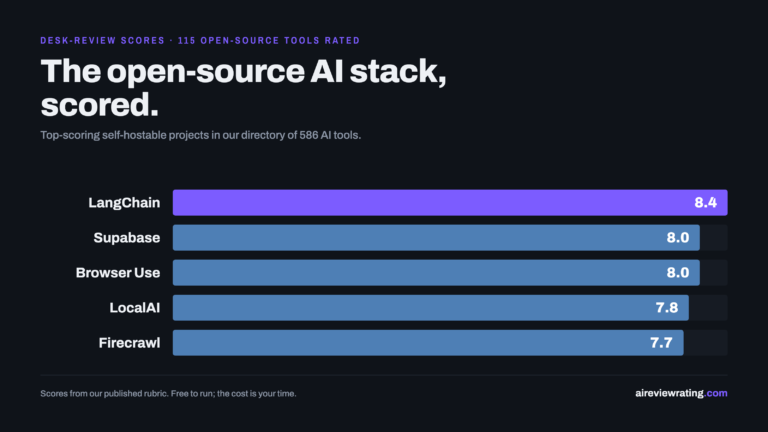
LangChain is the highest-scoring open-source project in our directory, and building bespoke assistants on top of it is a straightforward consulting offer for small businesses that want AI but have no engineering team. Langflow‘s visual builder shortens the distance between a client conversation and something they can see working, which is most of the sales cycle.
Costs you can delete
Your model bill
LocalAI serves models on your own hardware behind an API-compatible interface. For a solo operator the calculation is simple: if your monthly token spend exceeds what the hardware costs to amortise, you are renting when you could own. If it does not, keep renting, and revisit when volume grows.
Your coding assistant seat
OpenHands is the open-source coding agent. One seat of a commercial assistant is a modest monthly cost; the reason to evaluate the alternative is that it does not scale with headcount if you ever hire.
Your back office
paperless-ngx replaces a document management subscription and, more usefully, replaces the hour you spend looking for an invoice. Supabase is the database, auth and storage layer under most small AI products, and it runs hosted or self-hosted, so the choice does not have to be made on day one.
What this actually costs you
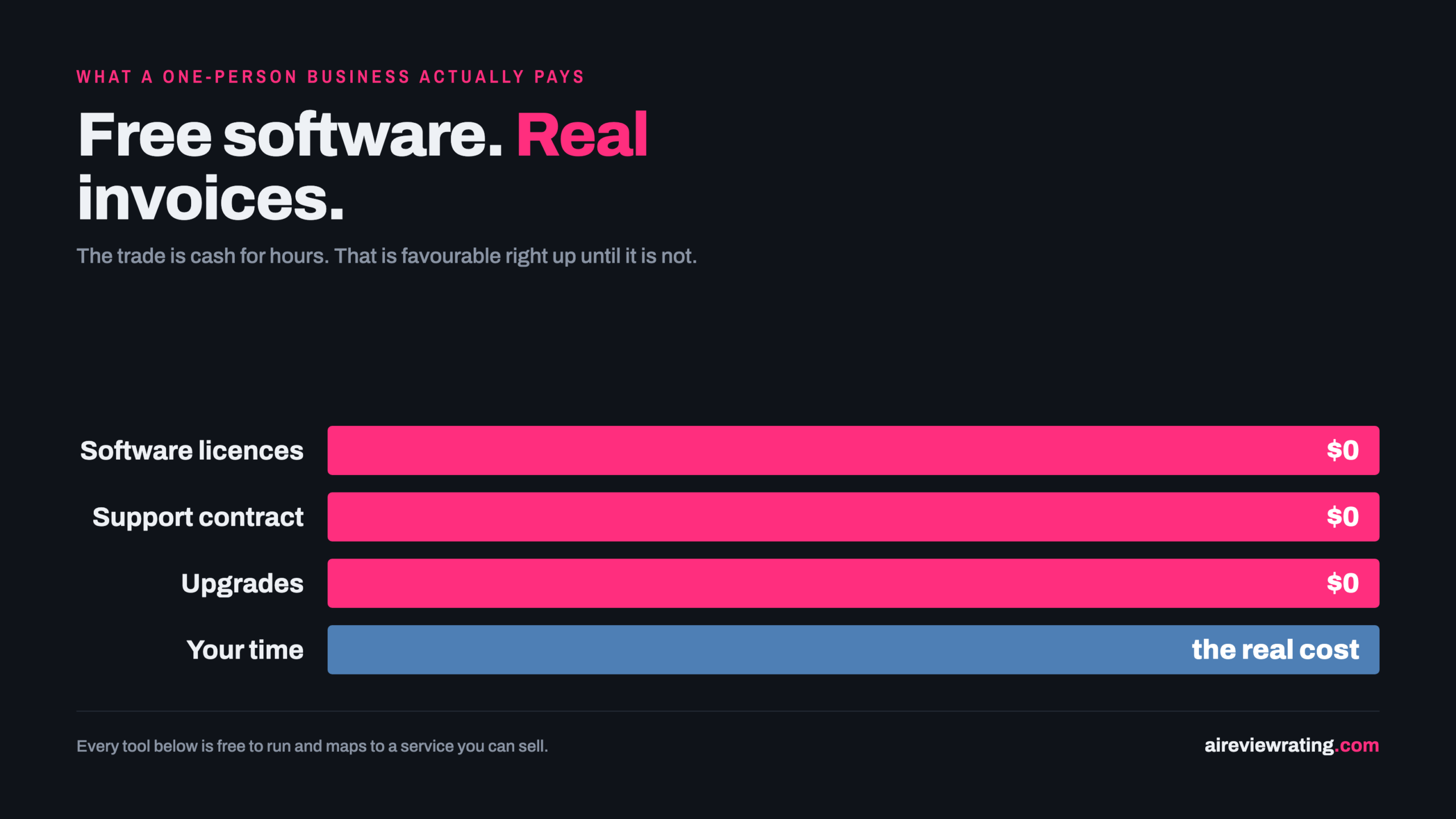
Nothing on this page is free in the sense that matters. Here is the real cost structure of running a business on open source, stated plainly:
| Line | Cash | What you pay instead |
|---|---|---|
| Software licences | $0 | Setup hours, per tool |
| Hosting | Server or instance | Being your own on-call |
| Support | $0 | Your time, at the worst moment |
| Upgrades | $0 | Breakage you own entirely |
For a one-person business starting out, that trade is usually right, because time is the resource you have and cash is the one you do not. The moment your time becomes the constraint, buy the subscription back. Treating that as a failure is how solo operators end up maintaining infrastructure instead of serving customers.
Frequently asked questions
Can you really start a business with only open-source AI tools?
You can start one, yes, and several categories on this page map directly to services people pay for. What free tooling removes is the capital requirement, not the requirement to find customers, which remains the actual difficulty.
Which repository should I start with?
The one matching a service you can already sell. If you have prospects who need data, start with Firecrawl. If they need a process automated, start with Browser Use. Starting with the technology rather than the demand is the most common way this goes wrong.
Is it legal to sell services built on open-source software?
Usually, but it depends on the licence. Permissive licences generally allow commercial use; copyleft licences impose conditions, particularly if you distribute or host a modified version. Read the licence file before you build a business on it.
What is the realistic monthly cost?
A server, and your time. The software is free and the hosting is often modest. The expense that surprises people is the hours, which is why the table above prices it as a trade rather than a saving.
Comments
Sign in to join the discussion.
Login to comment