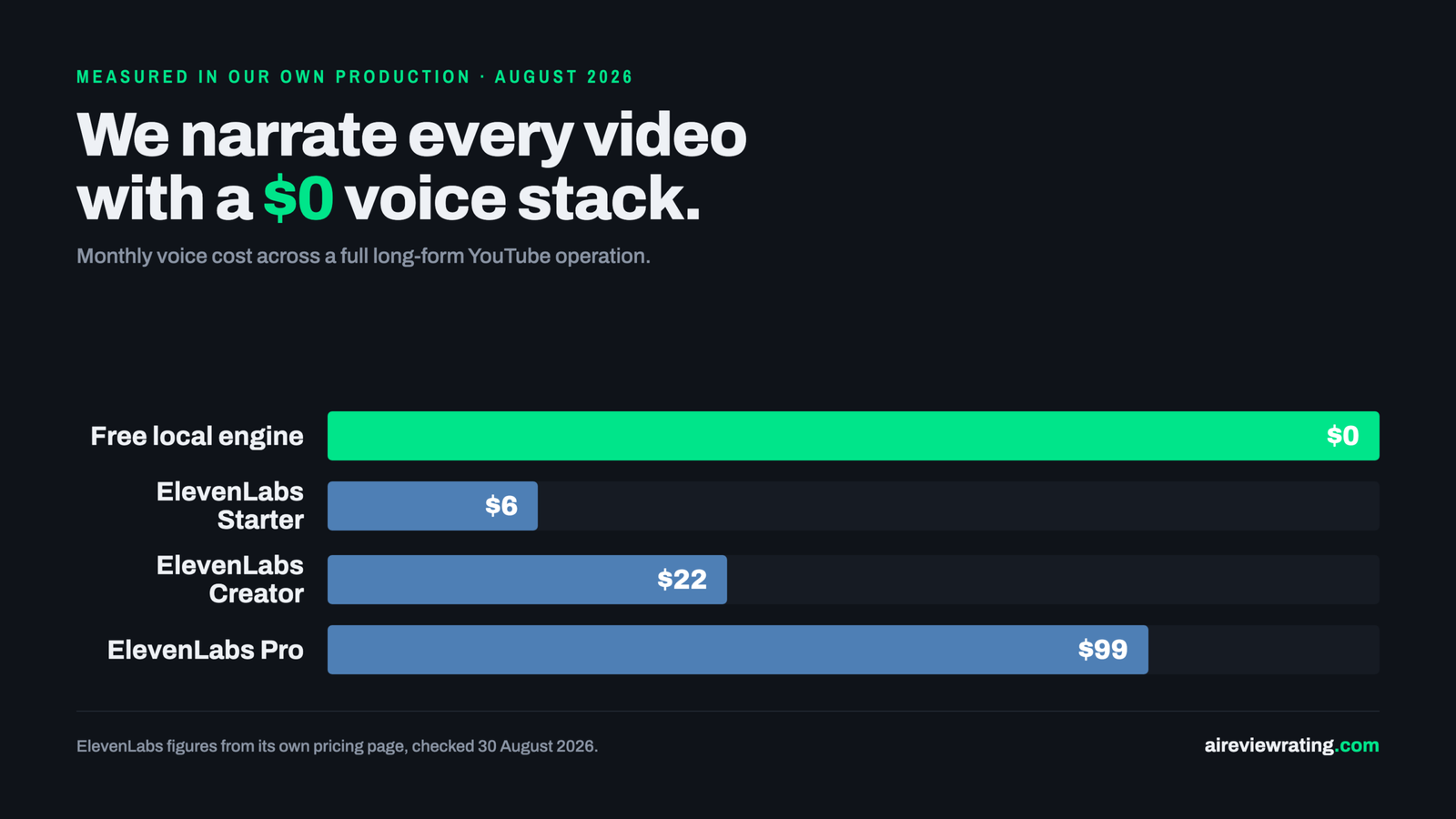
Short answer, as of August 2026: for narration at volume, free is now good enough, and we can prove it because our own YouTube channels run on a $0 voice stack. Pay for ElevenLabs when you need emotional range, cloning, or a language you cannot get elsewhere. If you are producing long-form narration on a schedule, the honest recommendation is to try free first and see whether your audience notices.
What we actually run, and what it costs
Most comparisons of AI voice tools are written by people who have never shipped a hundred hours of narration. We produce long-form YouTube video every week, and the voice line item on that operation is $0 per month.
The stack is a local text-to-speech engine running on a Mac, plus a free system voice played at 0.90 speed because the default rate reads slightly hot for narration. We tested paid alternatives, shipped with them, and moved back. That is not a philosophical position about open source. It is what the retention graphs and the comments did not show: nobody remarked on the change in either direction.
Two numbers from that operation that no vendor publishes, because no vendor benefits from you knowing them:
| Measurement | Value | Why it matters |
|---|---|---|
| Measured reading rate, our narration voice | 161 words per minute | Script length does not predict runtime. Rate does. |
| Overrun on number-heavy scripts | about 12% longer | Figures are read out slowly. Budget for it or your cut breaks. |
| Monthly voice cost, full production | $0 | The paid tier bought nothing our audience detected. |
The practical consequence: if you are choosing a voice tool for narration, the first question is not which voice is best. It is whether your use case needs anything the free tier cannot do.
When paying is the right call
Three cases where the paid tools earn the money, and they are specific rather than general.
Emotional range in dialogue. Narration is a flat delivery problem and free engines handle it. Character work, advertising reads and anything with emotional turns are not flat, and this is where the gap is still audible.
Voice cloning. If the deliverable must sound like a particular person, that is a paid feature almost everywhere, and the open-source options require setup time that has its own cost.
Language coverage. Free engines cover major languages well and long-tail languages poorly. If you publish in one of the latter, the decision is made for you.
The tools worth your time
ElevenLabs
ElevenLabs is the strongest paid option and the highest-scoring voice tool in our directory. Pricing as of August 2026, from its own page: a free tier at 10,000 credits per month, Starter at $6 for 30,000 credits, Creator at $22 per month for 121,000 credits (advertised at $11 for the first month), Pro at $99 for 600,000 credits, Scale at $299 for 1.8 million, and Business at $990 for 6 million.
Note what the credit model does to your planning: credits are consumed by characters synthesized, so a re-record costs the same as the original. Budget for iterations, not for final runtime.
Murf AI and WellSaid Labs
Murf and WellSaid Labs both target corporate and e-learning narration, where consistency across a long library matters more than expressive range. We could not verify current pricing for either from their own pages at the time of writing, so we have left the figures out rather than repeat numbers from another blog. Use the links for current rates.
The open-source options
VoxCPM and GPT-SoVITS are the two we would actually try. GPT-SoVITS is the cloning option and expects you to be comfortable with a Python environment and a GPU. VoxCPM is the more straightforward text-to-speech engine. Both cost nothing to run and both cost time to set up, which is the real trade: you are exchanging a subscription for an afternoon.
pyVideoTrans is worth knowing about separately, because dubbing an existing video is a different job from generating narration and it is built for exactly that.
Dictation, which is the opposite problem
If what you actually want is your own voice turned into text, Wispr Flow and Superwhisper are the tools, and Superwhisper runs locally so your audio never leaves the machine. People land on voice-generator articles looking for this surprisingly often.
How to decide in an afternoon
- Write one representative script, roughly 200 words, containing whatever your content actually contains. If that includes numbers, include numbers.
- Synthesize it on the free tier of two candidates and on a free local engine.
- Play all three to somebody who has not read this article and ask which is worst. If they cannot pick, your decision is made and it is the free one.
- Measure the runtime of each. That is your words-per-minute figure, and it is what you plan scripts against from then on.
The tools change every quarter. The measurement does not.
Frequently asked questions
What is the best free AI voice generator?
For narration, a local text-to-speech engine is the honest answer, because it is unlimited, private, and good enough that our own audience did not notice when we switched to it. ElevenLabs also has a genuine free tier at 10,000 credits per month, which is enough to evaluate it properly but not enough to produce with.
How much does ElevenLabs cost?
As of August 2026, from its own pricing page: free at 10,000 credits per month, Starter $6 for 30,000, Creator $22 for 121,000, Pro $99 for 600,000, Scale $299 for 1.8 million, and Business $990 for 6 million credits per month.
Can AI voices be used commercially on YouTube?
Generally yes, but the licence is per-tool and per-tier, and some free tiers grant personal use only. Check the specific plan you are on before publishing, because this is the one place where getting it wrong is expensive rather than merely embarrassing.
Is a paid AI voice actually better than a free one?
For flat narration, in our own production, the difference was not something our audience remarked on. For emotional dialogue, cloning a specific person, or less common languages, the paid tools are still clearly ahead. Decide by use case, not by price.
Comments
Sign in to join the discussion.
Login to comment