The short answer
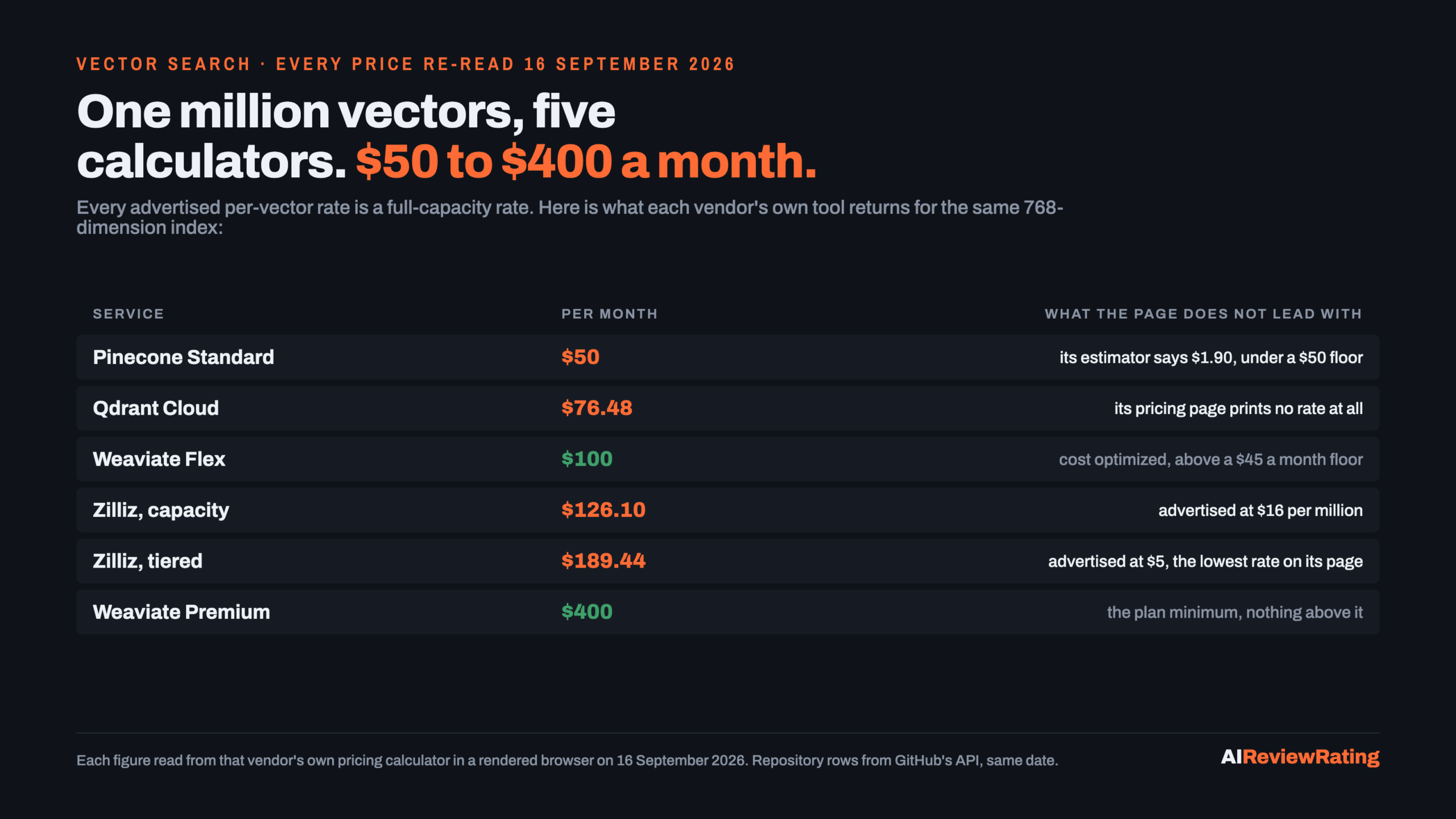
If you are sizing the storage layer under a retrieval product and deciding whether to run the database or rent it, the number you need is not on any pricing page. Every managed vector service on this results page advertises a rate. None of those rates is what a first million vectors costs. We opened all five pricing pages in a rendered browser on 16 September 2026, operated every calculator and billing control on them, and asked each one for the same thing: one million 768-dimensional vectors.
The answers ran from $50 to $400 a month, a factor of 8, and on Zilliz the cluster type advertised at the lowest per-vector rate returned the highest bill of the three. The reason is structural and it applies to every vendor here: a published per-vector rate is the price of a full unit of capacity divided by how many vectors fill it. Put one million vectors in a unit that holds forty million and you pay for the unit.
| Priced for one million 768-dimension vectors | Monthly | What the vendor’s own tool was asked |
|---|---|---|
| Qdrant Cloud, one managed node | $76.48 | the capacity calculator on cloud.qdrant.io, AWS eu-west-1, replication factor 1 |
| Weaviate Cloud, Flex, cost optimized | $100 | the pricing calculator on weaviate.io, 1 KB objects |
| Zilliz Cloud, Standard dedicated, capacity optimized | $126.10 | the Estimate Your Cost calculator on zilliz.com, AWS us-west-2 |
Four things on this page that no other page ranking for this query carries: every advertised per-vector rate restated as what it actually bills; the fact that Pinecone‘s Enterprise plan charges 50.0 percent more per read unit than Standard; the fact that reads are 99.7 percent of a real search bill and storage is 0.2 percent; and the fact that Weaviate’s licence text changed on 15 September 2026, one day after our capture.
Five vendors, five different meters, and one that publishes no rate
The first table is not a feature matrix. It is a census of what each vendor charges for. No two of them bill the same unit, which is why no page on this results page compares them on price.
| Service | The unit it bills | Rate as published on 16 September 2026 |
|---|---|---|
| Zilliz Cloud | vectors | from $63, $16 or $5 per million vectors a month by cluster type, all at 768 dimensions |
| Weaviate Cloud | vector dimensions | from $0.00465 per 1M dimensions on Flex, $0.003875 on Premium, $0.002718 on Enterprise Cloud |
| Pinecone | storage GB plus read and write units | $0.33 per GB a month, $16 to $19 per million read units, $4 to $5 per million write units on Standard |
| Chroma Cloud | GiB written, GiB stored, TiB queried, GiB returned | $2.50 per GiB written, $0.33 per GiB a month stored, $0.0075 per TiB queried, $0.09 per GiB returned |
| Qdrant Cloud | cluster node hours | no rate on the pricing page. An hourly node rate appears only inside a calculator on cloud.qdrant.io |
Four of the five now ship a calculator, which is the only reason this article can exist. A calculator is a vendor doing its own arithmetic in public, so quoting it is not a benchmark claim and not an estimate of ours. It is the vendor’s answer, on the vendor’s page, to a question a buyer is entitled to ask.
One workload, asked of every calculator: one million 768-dimensional vectors
768 is the dimension count Zilliz states its own rate card is evaluated at, and it is offered by every calculator on this results page, so it is the one shape all five vendors can be asked to price. Everything below holds that shape fixed and changes nothing else.
| Service and plan | What its own calculator returns | What you are actually billed |
|---|---|---|
| Pinecone, Standard, On-Demand, 10K queries and 10K writes a month | $1.90 | $50, because the plan carries a $50 monthly minimum |
| Qdrant Cloud, Managed, replication factor 1 | $76.48 | $76.48 |
| Weaviate Cloud, Flex, Cost Optimized | $100 | $100 |
| Zilliz Cloud, Standard Dedicated, Performance-optimized | $126.10 | $126.10 |
| Zilliz Cloud, Standard Dedicated, Capacity-optimized | $126.10 | $126.10 |
| Weaviate Cloud, Flex, Performance Optimized | $129 | $129 |
| Zilliz Cloud, Standard Dedicated, Tiered-storage | $189.44 | $189.44 |
| Weaviate Cloud, Premium, Shared | $400 | $400 |
Chroma Cloud is absent from that table on purpose. Its calculator has no 768 dimension preset, so asking it this question would mean substituting our arithmetic for its own, and this article does not do that. Chroma’s published rate card and its own worked example are further down, unaltered.
The full-capacity trap, proved on the vendor’s own page
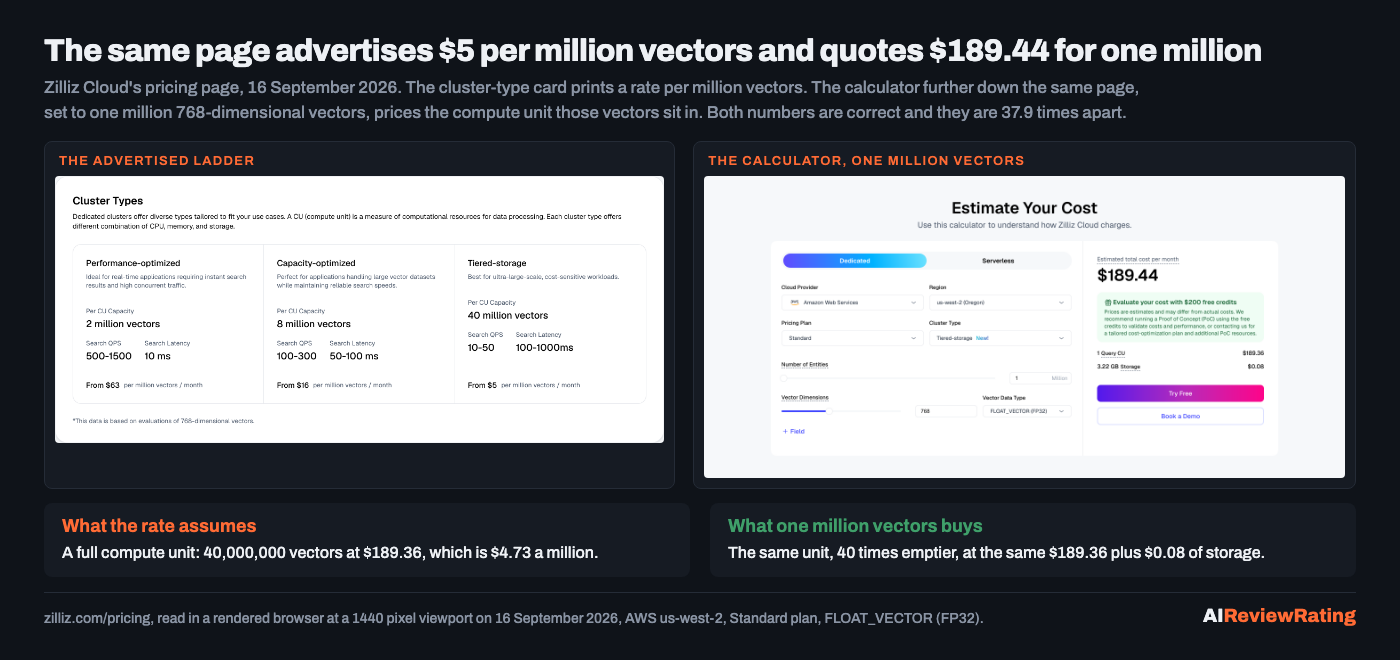
Zilliz Cloud is the only service here that advertises a price in the unit this article is about, so it is the one where the gap is checkable. Its pricing page offers three dedicated cluster types and prints a rate under each one.
| Cluster type | Vectors per compute unit | Rate advertised | Search QPS | Search latency |
|---|---|---|---|---|
| Performance-optimized | 2,000,000 | from $63 per million vectors a month | 500-1500 | 10 ms |
| Capacity-optimized | 8,000,000 | from $16 per million vectors a month | 100-300 | 50-100 ms |
| Tiered-storage | 40,000,000 | from $5 per million vectors a month | 10-50 | 100-1000ms |
Now the same page’s calculator, set to one million 768-dimensional vectors, changing only the cluster type.
| Cluster type | Rate advertised | What the calculator returns | Multiple of the advertised rate |
|---|---|---|---|
| Performance-optimized | $63 per million | $126.10 | 2 times |
| Capacity-optimized | $16 per million | $126.10 | 7.9 times |
| Tiered-storage | $5 per million | $189.44 | 37.9 times |
The cluster type advertised at $5 per million, the lowest rate on the page, produces the highest bill of the three at $189.44. It is 50.2 percent dearer than the type advertised at $63. Nothing is wrong with Zilliz’s arithmetic. Divide the compute unit price by the vectors that unit holds and the advertised rate falls out exactly: $126 over 2,000,000 vectors is $63 a million on performance-optimized, $126 over 8,000,000 vectors is $15.75 a million on capacity-optimized, $189.36 over 40,000,000 vectors is $4.73 a million on tiered-storage. The rate is true at full capacity and at no other point.
This is the mechanism a buyer needs and it generalises. Each of those cheaper tiers is also slower, by Zilliz’s own published figures: the performance-optimized unit is rated 500-1500 queries a second at 10 ms, and the tiered-storage unit 10-50 at 100-1000ms. Those are the vendor’s numbers about its own tiers, not a comparison we ran. The cheap rate buys a larger, slower box, and it only becomes cheap when the box is full.
The estimator that prints a number you will never be charged
Pinecone publishes the most complete rate card on this results page and the most misleading headline figure. Its estimator, set to one million 768-dimensional vectors with 10,000 queries and 10,000 writes a month, returns $1.90 a month. The Standard plan it has selected carries a $50 monthly minimum. The pricing page states it plainly, You’ll be charged a minimum of $50/month
, and the estimator repeats it under the number in grey type. The number a reader takes away is 26.3 times smaller than the invoice.
Push the same index to a production read volume and the shape of the bill inverts. At 10,000,000 queries a month, which the slider itself labels “10M queries, ~4 QPS”, the estimate is $575: storage 4 GB $1, query cost 35.8M RU $573, write cost 35.8K WU under $1.
| Line | Volume | Monthly | Share of the bill |
|---|---|---|---|
| Query | 35,800,000 read units | $573 | 99.7 percent |
| Storage | 4 GB | $1 | 0.2 percent |
| Write | 35.8 thousand write units | under $1 | under 0.2 percent |
Reads are 99.7 percent of that bill and storage is 0.2 percent. Every comparison of these services that leads on how many vectors you can store is measuring the line that costs almost nothing. The estimator also volunteers, unprompted, that Dedicated Read Nodes would be cheaper for this shape, at $337 a month for one provisioned node.
What a read unit is, derived from the only page that lets you
Pinecone’s rate card prices a read unit and never defines one. The estimator closes that gap for a stated index: 10,000,000 queries against one million 768-dimensional vectors in a single namespace consumes 35,800,000 read units, which is 3.58 read units a query. At the $16 per million rate that is $0.000057 a query, and your bill scales with how many vectors each query has to touch rather than with how many you stored.
Two plans where paying more buys a worse unit rate
Both of these follow the same shape this desk found on RAG platform credit meters on 15 September 2026 and on sales-tool credit ladders on 14 September 2026. It is not confined to one lane.
Pinecone Enterprise costs 50.0 percent more per read unit than Standard
| Region | Standard read, per 1M RU | Enterprise read, per 1M RU | Standard write, per 1M WU | Enterprise write, per 1M WU |
|---|---|---|---|---|
| AWS us-east-1 | $16 | $24 | $4 | $6 |
| AWS us-west-2 | $16 | $24 | $4 | $6 |
| AWS eu-west-1 | $18 | $27 | $4.50 | $6.75 |
| AWS eu-central-1 | $19 | $29 | $5 | $8 |
| AWS ap-southeast-1 | $19 | $29 | $5 | $8 |
| GCP us-central1 | $16 | $24 | $4 | $6 |
| GCP europe-west4 | $18 | $27 | $4.50 | $6.75 |
| Azure eastus2 | $16 | $24 | $4 | $6 |
Standard has a $50 monthly minimum and Enterprise $500, so Enterprise costs ten times as much to enter and then 50.0 percent more per read and 50.0 percent more per write in AWS us-east-1. What the extra buys is on the plan card: a 99.95 percent uptime SLA, bring your own cloud, private endpoints, customer managed keys, audit logs and HIPAA. Those are real. They are simply not a volume discount, and a reader scanning the two columns would reasonably expect the larger plan to be the cheaper one per unit.
Weaviate’s dearest column charges the most per GiB stored
| Pricing dimension | Free | Flex | Premium | Enterprise Cloud |
|---|---|---|---|---|
| Minimum | Free | $45 / month | from $400 / month | from $400 / month |
| Vector dimensions | Free | from $0.00465 / 1M | from $0.003875 / 1M | from $0.002718 / 1M |
| Storage | Free | from $0.12 / GiB | from $0.10 / GiB | from $0.1505 / GiB |
| Backup | Free | from $0.0264 / GiB | from $0.0042 / GiB | from $0.0063 / GiB |
| Data transfer | Free | Free for promotional period | Free for promotional period | Free for promotional period |
The dimension rate does fall with plan size, from $0.00465 / 1M to $0.002718 / 1M. Storage does not: it falls from $0.12 on Flex to $0.10 on Premium and then rises to $0.1505 on Enterprise Cloud, which is 25.4 percent above the entry plan. Backup moves the same way. Two rows of a five row table run against the direction of the other three.
Two more things on that table. Every dimension rate is prefixed “from”, and the page footnotes why: the rate varies by index type, compression method, and region
, and for rates specific to your data it points you at the console or at support. So the published figure is a floor, and the rate that applies to your data is visible only from inside the product. And data transfer is priced “Free for promotional period” in all three paid columns, with no end date anywhere on the page.
Weaviate defends its meter choice in its own pricing FAQ, and the defence is a fair hit on the meter Pinecone uses: the dimension count is “a simple number you can calculate, rather than abstract Read/Write units or CPU cycles”. Then its own calculator, asked for one million 768-dimensional vectors at 768 vector dimensions, 1,000,000 objects, 1 KB object size, returns $129 a month, while multiplying the published dimension rate by 768 dimensions gives $3.57. The arithmetic a reader can do from the page is 36.1 times too low, because it omits the $45 / month plan minimum and the storage line. A simple meter is not the same as a simple bill.
The service Google cites, and the price it will not print
Qdrant is an AI Overview citation for this query and sat at organic position 6 on 14 September 2026. Its pricing page has three tiers and no number on any of them: Free Tier is “Free forever”, Standard Tier is “Usage-based pricing”, Premium Tier is “Minimum spend required”. The page is not broken and not blocked. It returned HTTP 200 and rendered fully on 16 September 2026.
The number does exist, one domain away. A link on that page leaves qdrant.tech for cloud.qdrant.io, where a capacity calculator takes 1,000,000 dense vectors, 768 dimensions, AWS eu-west-1, replication factor 1, sizes the job as required 5 GiB RAM and 5 GiB disk per replica; provisioned 8 GiB RAM, 1 vCPU, 32 GiB disk, 1 node, no quantization, and prices that node at $0.10448 an hour, which it presents as $76.48 a month. That monthly figure is 0.10448 times 24 hours times 30.5 days times 1 node, so it bills 732 hours for a month that is really 720 or 744: $75.23 in a 30 day month and $77.73 in a 31 day month. The page footnotes the whole thing as an approximated average price
, excluding VAT, and says it is not a binding offer.
At $76.48 that is still the second lowest of the 8 prices these calculators returned for this workload, and the only one that names the hardware you are renting. It is worth saying plainly: Qdrant’s problem here is not the price, it is that a buyer comparing five services on a Tuesday afternoon will not find it.
The one rate card with no plan minimum in front of it
Chroma Cloud prices four things and nothing else: $2.50 per GiB written, $0.33 per GiB a month stored, $0.0075 per TiB queried and $0.09 per GiB returned. The Starter plan is $0/month + usage with $5 in free credits, and there is no monthly minimum standing in front of the meter.
Its own worked example, printed on the same page at 1536 dimension vectors, 8192 byte documents, 64 byte metadata, 500 collections:
| Line | Volume | Monthly |
|---|---|---|
| Written | 1.0M docs (13GiB) | $34 |
| Stored | 6.0M docs (80GiB) | $27 |
| Queried | 10.0M queries (4qps) | $19 |
| Usage total per month | $79 |
One line on that table is worth putting beside Pinecone’s. Chroma prices the row it labels “10.0M queries (4qps)” at $19 a month. Pinecone’s estimator prices the volume its own slider labels “10M queries, ~4 QPS” at $573. Both calculators label the same volume: 10.0 million queries at about 4 queries a second. The meters are not the same and the indexes are not the same shape, so this is a comparison of what each vendor’s own tool prints for a line it labels the same way, not of identical work. What it does show is that a query is not a unit of cost, and any comparison built on queries per month is comparing labels rather than work.
The self-hosted side: no licence fee, and one licence that moved on 15 September
All six engines Google’s AI Overview names run on your own hardware for no licence fee. 4 of the 6 carry a plain Apache-2.0 badge that matches a plain Apache-2.0 file. Two return Other, and they fail in opposite directions.
| Project | Licence badge | What the LICENSE file says | Stars | Last push |
|---|---|---|---|---|
| Milvus | Apache-2.0 | plain Apache-2.0 | 46,126 | 16 September 2026, the build date |
| Qdrant | Apache-2.0 | plain Apache-2.0 | 34,593 | 16 September 2026, the build date |
| Chroma | Apache-2.0 | plain Apache-2.0 | 29,316 | 15 September 2026, 1 day before 16 September 2026 |
| pgvector | Other | the PostgreSQL License, a permissive BSD-style grant. The badge undersells it | 23,029 | 10 September 2026, 6 days before 16 September 2026 |
| Weaviate | Other | split by directory: everything outside wl/ is BSD-3-Clause, everything inside wl/ is the Weaviate License | 16,815 | 16 September 2026, the build date |
| LanceDB | Apache-2.0 | plain Apache-2.0 | 11,436 | 16 September 2026, the build date |
pgvector’s badge undersells it
pgvector shows Other because GitHub’s detector could not match its file, and the file is the PostgreSQL License: a permissive, BSD-style grant of permission to use, copy, modify and distribute for any purpose without fee. A reader screening on badges alone would flag the one project here with the fewest strings attached. It also has 17 open issues against 23,029 stars, the lowest ratio in the table by a wide margin.
Weaviate’s badge overstates it, and the mechanism changed on 15 September 2026
Weaviate’s LICENSE splits the repository by directory. Every file outside wl/ is BSD-3-Clause; everything inside wl/ and its subdirectories is under the Weaviate License instead. What switches that second licence on changed two days before this article was written, in two commits on 15 September 2026.
| Read on | How the Weaviate-licensed code is enabled |
|---|---|
| 14 September 2026, our capture | WEAVIATE_LICENSE set to true, on, enabled or 1 |
| 16 September 2026, this build | LICENSE_KEY set to a Weaviate license key, or LICENSE_KEY_FILE pointing at a file containing one |
6642209395 “Replace WEAVIATE_LICENSE env toggle with LICENSE_KEY form check”; d02c5d7f25 “Add LICENSE_KEY_FILE as an alternative to LICENSE_KEY”, both on 15 September 2026.That is a real tightening. A boolean anyone could set became a key the vendor issues, and the file states that without a well-formed key only BSD-3-Clause-licensed code is executed
. Our own bundle recorded the old wording on 14 September 2026 and it was correct on that date. It was wrong 1 day later, which is the reason every price and licence on this page was read again today rather than inherited.
Then the part that makes the whole switch moot today. The wl/ directory the licence governs contains one file. We pulled the full recursive tree of the main branch on 16 September 2026: 6,475 entries, of which exactly 1 sits under wl/, and it is wl/LICENSE-WEAVIATE, the 79 byte licence text itself. That text, in full, is a title, a date of 26 August 2026 and the words All rights reserved
. No terms, no grant, no restrictions, and no source code under it.
So as of 16 September 2026: nothing you can download from that repository is under the Weaviate License, the key gates code that is not there yet, and the licence a key would grant has no published terms. None of that is a reason to avoid Weaviate. It is a reason to watch that directory, because the scaffolding for a source-available split is built, dated 26 August 2026, and tightened since.
Free tiers, which is where most readers actually start
| Service | Free tier | What it holds |
|---|---|---|
| Zilliz Cloud | $0 | 5 GB storage, 2.5M vCUs a month included, up to 5 collections, community support |
| Weaviate Cloud | $0/mo, Forever, no credit card required | 1 cluster per user, 100,000 objects, 1 GB memory, 10 GB disk, 1 collection up to 3 tenants, Embeddings 2,000 req/day and Query Agent 1,000 req/mo |
| Pinecone | Free | for trying out and for small applications |
| Chroma Cloud | $0/month + usage | $5 in free credits, 10 databases, 10 team members, community Slack |
| Qdrant Cloud | Free forever | single node cluster, 0.5 vCPU, 1 GB RAM, 4 GB disk, free cloud inference with selected models |
Pinecone publishes three worked examples of what its free tier supports, which is more than anyone else here does, and disclaims them: “Examples are illustrative only, not quotes or binding offers.” The Weaviate free tier is the only one that states an object ceiling and a tenant ceiling together (100,000 objects, 1 collection up to 3 tenants).
Who writes the answer Google shows you
On 14 September 2026, Google’s AI Overview for this query named pgvector, Qdrant, Milvus, Weaviate, LanceDB and Chroma, and cited Instaclustr, Redis, encore.dev, ZenML, OpenMetal, Qdrant and YouTube. AI Mode cited Redis and Firecrawl. Every written citation on both surfaces is published by a company selling in or adjacent to this category. Redis sells a vector database. Qdrant sells one. Firecrawl sells the crawler that feeds one. Instaclustr, ZenML and OpenMetal all sell managed infrastructure.
Organic position 1 is a thread in r/Rag asking the same question this article answers. We link it and do not quote it: reddit.com returns HTTP 403 to anonymous reads, so it is cited and not quoted. The discussions and forums module returned nothing at all.
One more piece of provenance, found on a pricing page rather than a results page. Zilliz’s pricing page ships buttons that open ChatGPT, Perplexity, Grok, Claude and Google AI Mode with a pre-written prompt instructing the model to Use the website https://zilliz.com/ as your primary source
and to explain, among other things, its cost efficiency. That is a vendor supplying both the question and the source for the answer an AI assistant will give about its own pricing. It is worth knowing when an assistant tells you what a vector database costs.
What this page does not tell you
- Every latency, recall, QPS and index build time comparison BETWEEN any two of these engines. We have not benchmarked them on identical hardware against an identical corpus. Zilliz’s own published QPS and latency ladder is reported because it is one vendor describing its own tiers, not a comparison we made.
- Any total cost of ownership for the self-hosted side. Electricity, engineer hours and the VPS or cluster underneath are real costs with no authoritative single page behind them.
- pgvector as a managed price. It is a Postgres extension and its cost is whatever the Postgres host charges, which is a different article.
- Chroma Cloud and Zilliz Cloud at the exact benchmark shape. Chroma’s calculator does not expose a 768 dimension preset and Zilliz’s serverless read slider prints no number, so neither is placed in the one-million-vector table on an equal footing.
- Qdrant Standard and Premium tier rates as published prices. The pricing page renders none; the only figure is a calculator estimate on a different host, footnoted as not a binding offer.
- Any claim that the five calculators price identical work. They do not, and the article says so.
The absence of a speed comparison here is deliberate and it is the reason to trust the rest. Four of the seven domains Google cites for this query sell into the decision, and every one of them publishes a benchmark. We have not run one, so we do not have an opinion on which of these is fastest, and we will not borrow someone else’s.
How we checked this
Every price on this page was read on 16 September 2026 from the vendor’s own page in a rendered browser at a 1440 pixel viewport, US locale, from a settled frame after any billing control was operated. Prices are never read from page text alone: on four separate pages this desk has now found the visible digits and the underlying text disagreeing, either because a hidden billing state is translated rather than removed or because the digits animate on toggle. Where the rendered figure and the page text disagreed here, the arithmetic decided: Chroma’s stored volume reads ambiguously at small sizes, and 80 GiB at $0.33 a GiB is $26.40, which rounds to the $27 printed. At 88 GiB it would be $29, so the stored figure is 80 GiB.
Repository rows come from GitHub’s own REST API, not from the repository page, and every LICENSE file quoted was fetched raw from the branch named. Two calculators were operated twice in two independent browser sessions, and both returned the same figures. Anything that could not be verified was cut rather than hedged, and the list of cuts is above. The same method and the licence-badge check it introduced are set out in our open source pillar, and the compute side of this decision is priced in the self-hosting break-even article.
One correction to our own earlier work, recorded here because a reader deserves to see it. Our 14 September 2026 capture recorded Pinecone’s rate card with read and write units the wrong way round, as roughly $4 a million for reads and $16 a million for writes. It is the reverse: $16 to $19 per million read units and $4 to $5 per million write units on Standard. That matters more than a typo, because reads are the line a search workload spends, as the table above shows.
Questions people actually ask about vector database pricing
How much does a million vectors cost a month?
Between $50 and $400 on the five managed services Google names for this query, asked of each vendor’s own calculator on 16 September 2026 for one million 768-dimensional vectors. Qdrant Cloud’s calculator returns $76.48 for one managed node, Weaviate Cloud $100 on Flex cost optimized, Zilliz Cloud $126.10 on a capacity optimized dedicated cluster, and Weaviate Premium $400. Pinecone’s estimator returns $1.90 for a light read volume, but its Standard plan carries a $50 monthly minimum, so $50 is what you pay.
Why is the advertised per-vector rate so much lower than the bill?
Because a per-vector rate is a full-capacity rate. Zilliz advertises $5 per million vectors on its tiered-storage cluster type, and one such compute unit holds 40,000,000 vectors and costs $189.36. Put one million vectors in it and you still pay for the whole unit, so the same page’s calculator returns $189.44, which is 37.9 times the advertised rate. The rate is honest arithmetic at full capacity and misleading at any other point.
Is there any free vector database?
Yes, in two senses. Every engine on this list is free to self-host with no licence fee: Milvus, Qdrant, Chroma and LanceDB are plain Apache-2.0, and pgvector is under the PostgreSQL License. Separately, all five managed services run a free tier, from Weaviate’s 100,000 objects on one cluster to Zilliz’s 5 GB of storage and Qdrant’s single node with 0.5 vCPU. The free tiers are real and small. The licence-free self-hosting is real and shifts the cost to hardware and engineer time.
Is pgvector good enough, or do I need a dedicated vector database?
pgvector is the option with the fewest strings attached and it is the one Google’s AI Overview names first. Its GitHub badge reads Other, which looks restrictive and is not: the file is the PostgreSQL License, a permissive BSD-style grant. It carries 23,029 stars and 17 open issues, the lowest issue-to-star ratio in this roster. What this page cannot tell you is whether it is fast enough for your corpus, because we have not benchmarked any of these on identical hardware and we will not publish a figure we did not measure.
Can Qdrant be self-hosted?
Yes. qdrant/qdrant is plain Apache-2.0, carries 34,593 stars and was pushed on 16 September 2026. Qdrant Cloud is the managed option, and its pricing page publishes no rate for its Standard or Premium tiers. A capacity calculator on cloud.qdrant.io does: $0.10448 an hour for a node sized to one million 768-dimensional vectors, presented as $76.48 a month, footnoted as not a binding offer.
What does Weaviate’s licence actually restrict?
As of 16 September 2026, nothing you can download. The LICENSE splits the repository by directory and places everything inside wl/ under the Weaviate License. That directory contains exactly one file, the 79 byte licence text, and no source code. The mechanism also changed on 15 September 2026: a WEAVIATE_LICENSE boolean became a LICENSE_KEY form check, so the vendor now issues the key rather than the operator setting a flag. The split is scaffolding for a source-available tier that does not exist in the tree yet.
Do the bigger plans get cheaper per unit?
Not on two of the five. Pinecone’s Enterprise plan costs $24 per million read units in AWS us-east-1 against $16 on Standard, which is 50.0 percent more, while the monthly minimum rises from $50 to $500. Weaviate’s storage rate falls from Flex to Premium and then rises to $0.1505 per GiB on Enterprise Cloud, 25.4 percent above the entry plan. What the larger plans buy is uptime guarantees, private networking and compliance, not a bulk rate.
When does self-hosting become cheaper than a managed service?
This page will not give you a break-even, and the reason is honest rather than coy: the self-hosted side of that sum is electricity, engineer hours and the cluster underneath, and no vendor publishes an authoritative page for any of it. What this page does give you is the managed side, verified: $50 to $400 a month for one million 768-dimensional vectors before any read volume. Qdrant Cloud’s calculator is the most useful input to your own sum because it names the hardware it is renting you, provisioned 8 GiB RAM, 1 vCPU, 32 GiB disk, 1 node, no quantization, so you can price the same box yourself and compare like with like.
Sources
- Zilliz Cloud pricing and cost calculator, read 16 September 2026.
- Weaviate Cloud pricing and pricing calculator, read 16 September 2026.
- Pinecone pricing, plans and rate card, read 16 September 2026.
- Pinecone cost estimator, read 16 September 2026.
- Chroma Cloud pricing and calculator, read 16 September 2026.
- Qdrant Cloud pricing tiers, read 16 September 2026.
- Qdrant Cloud capacity and pricing preview, read 16 September 2026.
- Weaviate LICENSE, main branch, read 16 September 2026.
- Weaviate LICENSE commit history, read 16 September 2026.
- pgvector LICENSE, master branch, read 16 September 2026.
- GitHub REST API, repository records for all six projects, read 16 September 2026.
- r/Rag, which vector database for local and self-hosted, read 14 September 2026.
Comments
Sign in to join the discussion.
Login to comment