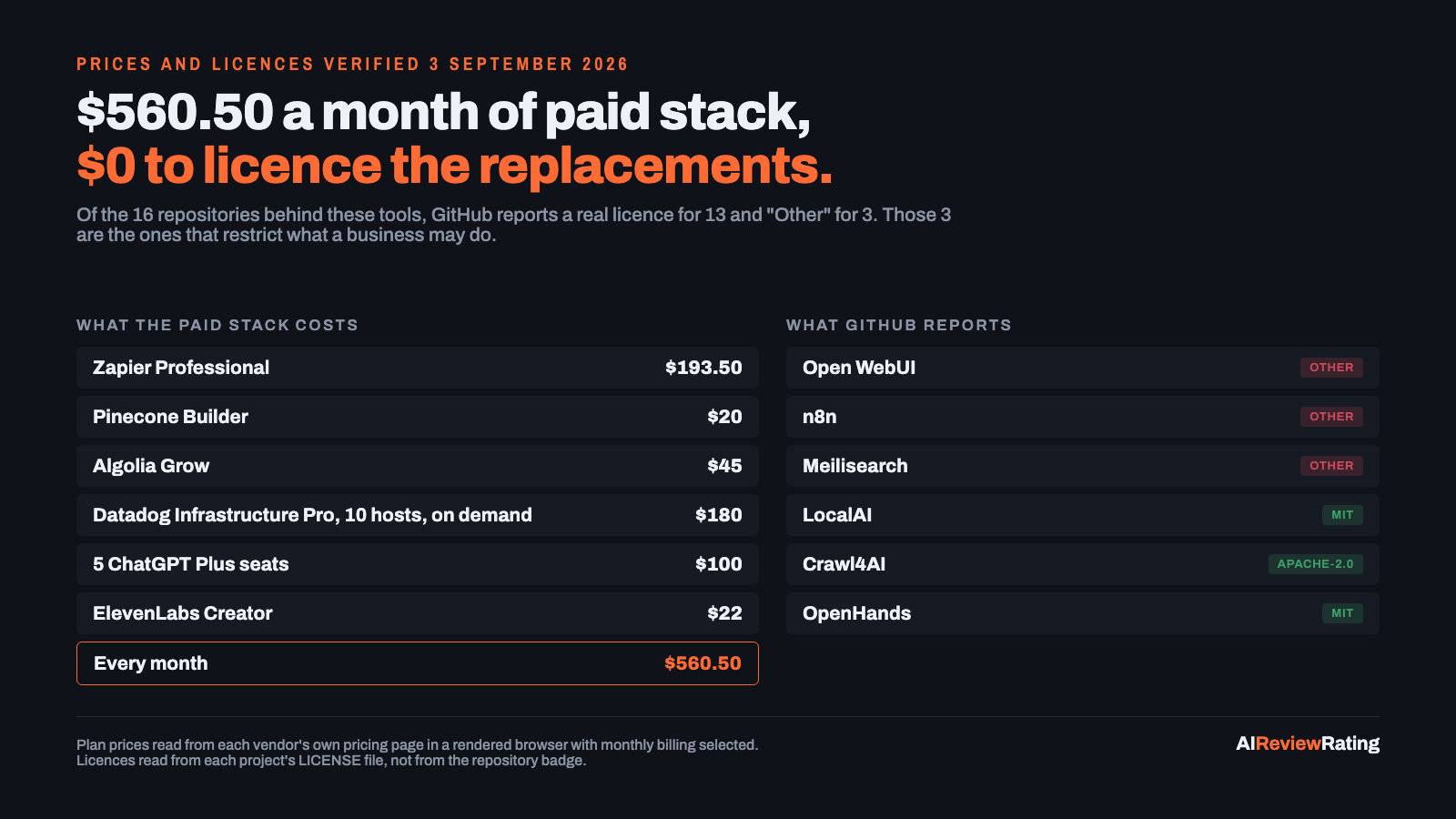
Short answer, prices and licences verified 3 September 2026: a small team running Zapier, Pinecone, Algolia, Datadog, five ChatGPT seats and ElevenLabs pays $560.50 a month, or $6,726 a year. The open source replacements for all six cost $0 to licence. The catch is not the software, it is the paperwork: of the 16 repositories behind these tools, GitHub reports a real licence for 13 and “Other” for 3, and those 3 are exactly the ones whose terms restrict what a business may do with them. Read those three licence files before you plan the migration.
| What the job is | What you pay for it | Per month | Self-hosted replacement | Licence check |
|---|---|---|---|---|
| Workflow automation | Zapier Professional at 10,000 tasks | $193.50 | n8n | Conditions apply |
| Vector database | Pinecone Builder | $20 | Qdrant | Sell what it makes |
| Site and app search | Algolia Grow at 100,000 searches a month | $45 | Meilisearch | Conditions apply |
| Infrastructure monitoring | Datadog Infrastructure Pro, 10 hosts, on demand | $180 | Netdata | Copyleft |
| Team chat assistant | 5 ChatGPT Plus seats | $100 | Ollama and Open WebUI | Conditions apply |
| Narration and voice | ElevenLabs Creator | $22 | VoxCPM and GPT-SoVITS | Sell what it makes |
| The six together | $560.50 |
This page is for a founder or a small team looking at that bill and asking what happens if they run the free version instead. It answers two questions and refuses a third. It answers what the paid tools cost at a stated volume, and what each replacement’s licence permits a company to do. It does not tell you the free one is as good, because we have not measured these tools against each other on identical hardware, and a number we did not measure is not going on this page. For the wider set of self-hostable tools we rate, read our guide to open source AI tools you can self-host.
What the number in that table is, and what it is not
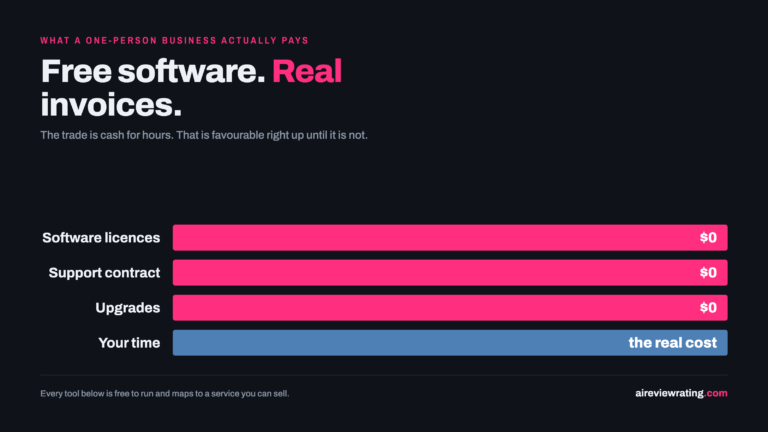
$560.50 a month is the licence cost that stops arriving. It is not profit and it is not the full picture. Software you host runs on hardware, and hardware costs money whether you rent it or own it. It also runs on somebody’s time: an upgrade nobody is paid to do is a bill that arrives later, as an outage.
What makes the licence saving worth stating on its own is that it is the only part of the comparison that is fixed and knowable in advance. Your compute bill depends on your traffic and your hardware. $560.50 a month is what the invoices say, $6,726 a year, before you have modelled anything.
Read the price at your volume, not the price on the poster
The single figure most often quoted for Zapier is around $20 a month. That figure is real and it is almost never the one you would pay. Zapier’s pricing page has a task volume slider and a billing toggle. Read at its default of 750 tasks on annual billing it shows $19.99. The same Professional plan at 10,000 tasks on monthly billing is $193.50. Both controls default to the flattering end.
So here is the whole ladder, stepped through the slider on 3 September 2026 with monthly billing selected, next to what the self-hosted replacement costs to licence at every step, which is the same number every time.
| Tasks a month | Zapier Professional | Zapier Team | n8n licence | Avoided a year on Professional |
|---|---|---|---|---|
| 750 | $29.99 | $103.50 | $0 | $359.88 |
| 1,500 | $58.50 | $103.50 | $0 | $702 |
| 2,000 | $73.50 | $103.50 | $0 | $882 |
| 5,000 | $133.50 | $178.50 | $0 | $1,602 |
| 10,000 | $193.50 | $253.50 | $0 | $2,322 |
| 20,000 | $283.50 | $373.50 | $0 | $3,402 |
| 50,000 | $433.50 | $598.50 | $0 | $5,202 |
| 100,000 | $733.50 | $898.50 | $0 | $8,802 |
The shape of that table is the argument. At 750 tasks a month the gap between paying and self-hosting is $29.99, which is less than an hour of anyone’s time, and self-hosting to save it is a bad trade. At 10,000 it is $193.50 a month, $2,322 a year, and the trade changes. Work out which line you are on before you read any further, because it decides whether the rest of this page matters to you.
The one minute licence check that catches all three problems
We queried GitHub’s own API for the licence of every repository behind the 16 tools in this article on 3 September 2026. 13 came back with a recognised identifier: MIT, Apache-2.0, GPL-3.0, AGPL-3.0. 3 came back as NOASSERTION, which the web interface renders as the word “Other”. Those three are Open WebUI, n8n and Meilisearch, and they are the three whose terms would stop a business doing something it assumed it could do.
That is not a coincidence and it is a usable rule. GitHub matches the text of a LICENSE file against a list of known licences. A project that wrote its own terms, or bolted a clause onto a standard licence, will not match. So the word “Other” on a repository page is a reliable signal that somebody wrote something custom, and custom licences on commercial open source are written to protect a revenue line. It takes one minute per tool and it is the check nobody in the search results for this query performs.
| Tool | What GitHub reports | What the LICENSE file says | AIRR score | Can a company sell what it makes |
|---|---|---|---|---|
| Open WebUI | Other |
Open WebUI License | 7.3 | Conditions |
| n8n | Other |
Sustainable Use License v1.0 | 7.0 | Conditions |
| Meilisearch | Other |
MIT AND BUSL-1.1 | 6.6 | Conditions |
| LocalAI | MIT |
MIT | 7.8 | Yes |
| Crawl4AI | Apache-2.0 |
Apache-2.0 | 7.7 | Yes |
| Firecrawl | AGPL-3.0 |
AGPL-3.0 | 7.7 | Yes, with a redistribution duty |
| OpenHands | MIT |
MIT | 7.7 | Yes |
| paperless-ngx | GPL-3.0 |
GPL-3.0 | 7.7 | Yes, with a redistribution duty |
| Netdata | GPL-3.0 |
GPL-3.0 | 7.6 | Yes, with a redistribution duty |
| vLLM | Apache-2.0 |
Apache-2.0 | 7.5 | Yes |
| AnythingLLM | MIT |
MIT | 7.5 | Yes |
| Ollama | MIT |
MIT | 7.3 | Yes |
| VoxCPM | Apache-2.0 |
Apache-2.0 | 7.0 | Yes |
| Qdrant | Apache-2.0 |
Apache-2.0 | 6.8 | Yes |
| GPT-SoVITS | MIT |
MIT | 6.2 | Yes |
| faster-whisper | MIT |
MIT | 5.0 | Yes |
n8n: internal business purposes only
n8n is the replacement for Zapier in nearly every list of this kind, and it is a genuinely good product. It is not, in the sense most readers mean, open source. Its terms are the Sustainable Use License v1.0, and the operative sentence grants use “only for your own internal business purposes or for non-commercial or personal use”.
Read that against what a small company actually does. Automating your own invoicing is internal business use and is permitted. Running an n8n instance that executes workflows for your clients, as a service you charge for, is not internal use. You may distribute the software to others only free of charge and for non-commercial purposes. An agency that planned to resell automation on this foundation has a licensing conversation ahead of it, not a deployment.
Two further limits sit above that sentence in the same file, read on 3 September 2026, and neither is mentioned in the summaries: source files with .ee. in the filename or .ee in the directory name are not covered by the sustainable use license at all and need a paid n8n enterprise license. And content of branches other than master is not licensed. Anyone who forked from a feature branch and assumed the repository licence travelled with it did not get one.
Open WebUI: the fifty user branding line
Google’s AI Overview for this exact query, captured 31 August 2026, opens by recommending Ollama and Open WebUI together as the way to stop paying for a chat subscription. That pairing is sound. Ollama is MIT and carries no conditions at all. Open WebUI does, and the AI Overview does not mention them.
Its licence is the three clause BSD text plus a fourth clause. Clause four prohibits “altering, removing, obscuring, or replacing any Open WebUI branding” in any deployment, with three exceptions. The first is the one that matters: it exempts deployments reaching no more than fifty (50) end users within any rolling thirty (30) day period. Above that line you either keep the branding or you obtain written permission from the copyright holder, or an enterprise licence.
For an internal tool at a company of forty people, nothing here applies and the pairing is exactly as good as the AI Overview says. For a white labelled assistant sold to customers under your own name, the fourth clause is the entire product decision, and it is 50 users away from you.
Meilisearch: which half of it are you running
Meilisearch publishes its licence as MIT AND BUSL-1.1, which is one identifier describing two different sets of rules. The MIT half is the search engine and it is genuinely permissive. The other half is files marked Enterprise Edition, in the enterprise_editions modules and folders, and those files are under the Business Source License, which grants non-production use only: testing, development or evaluation.
In the licence’s own words: “Production use of the Licensed Work requires a commercial license agreement”. The Business Source License is not permanent. This one names MIT as the change licence and four years from the date the licensed work is published as the change date, so each enterprise file becomes MIT four years after it ships. That is a real commitment and it is worth crediting. It is also four years away, which is longer than most of the plans being made on the strength of the word “open source” on the repository page.
The copyleft three, which are fine, and why people think they are not
Firecrawl, paperless-ngx and Netdata carry GPL-3.0 or AGPL-3.0. These get treated as contaminated in comments under every thread on this subject, and for the use in this article that is wrong.
| Tool | Licence | Replaces | What the licence actually asks of you |
|---|---|---|---|
| Firecrawl | AGPL-3.0 | Apify | You must publish your changes to users of the network service if you modify it and run it as a service |
| paperless-ngx | GPL-3.0 | document management SaaS | You must publish your changes if you distribute a modified build |
| Netdata | GPL-3.0 | Datadog Infrastructure | You must publish your changes if you distribute a modified build |
Running Netdata on your own servers to watch your own machines triggers nothing. You are not distributing anything. Modify Firecrawl and offer the modified version to the public as a service and AGPL-3.0 does reach you, which is the whole point of the A. Use it unmodified, or modify it for internal work, and it does not. The practical rule: copyleft asks a question about what you ship to other people, and the licences in the section above ask a question about what you are allowed to do at all. The second kind is the kind that ends a project.
The replacements with no conditions attached
10 of the 16 tools here are MIT or Apache-2.0 with no added clause, read from the file on 3 September 2026. You can build on them, sell what they produce, put your own name on the product and never contact the maintainer.
| Tool | Licence | What it does | What it replaces | AIRR score |
|---|---|---|---|---|
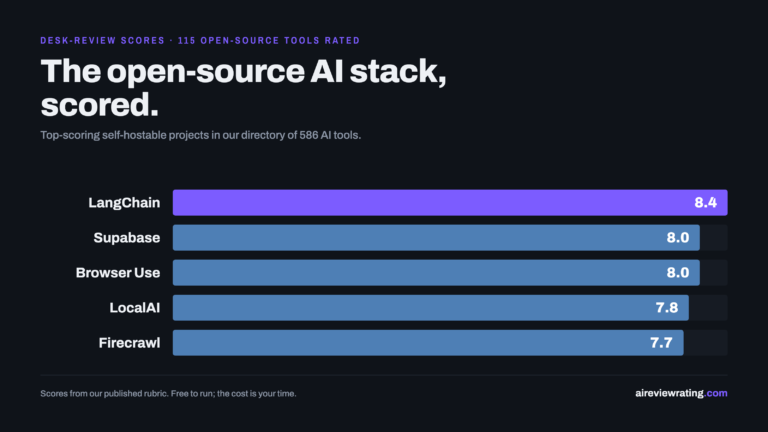
| LocalAI | MIT | Runs an OpenAI compatible API on your own hardware | hosted OpenAI compatible endpoints | 7.8 |
| Crawl4AI | Apache-2.0 | Crawls and extracts pages into model ready text | Apify | 7.7 |
| OpenHands | MIT | An agent that writes and fixes code from a prompt | agentic coding subscriptions | 7.7 |
| vLLM | Apache-2.0 | Serves open weight models at production throughput | managed inference endpoints | 7.5 |
| AnythingLLM | MIT | A private chat interface over your own documents | ChatGPT Enterprise, Glean | 7.5 |
| Ollama | MIT | Downloads and runs open weight models locally | ChatGPT Plus, hosted model APIs | 7.3 |
| VoxCPM | Apache-2.0 | Text to speech you run yourself | ElevenLabs | 7.0 |
| Qdrant | Apache-2.0 | A vector database for search and retrieval | Pinecone | 6.8 |
| GPT-SoVITS | MIT | Voice cloning from a short reference sample | ElevenLabs voice cloning | 6.2 |
| faster-whisper | MIT | Transcribes audio on your own hardware | paid transcription services | 5.0 |
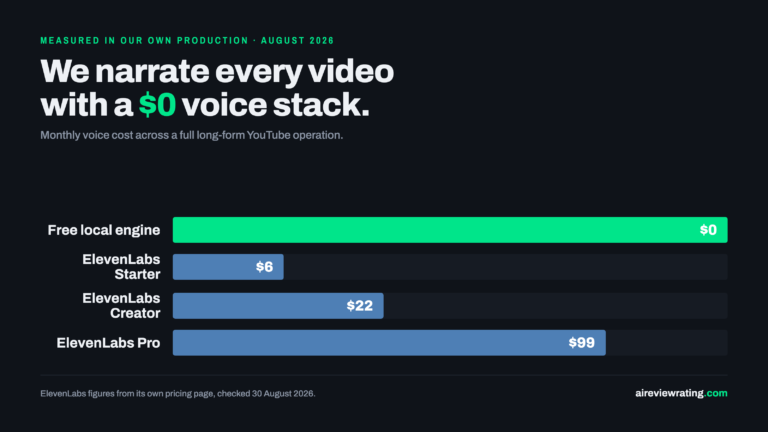
The voice pair at the bottom of that table is the one we can speak to directly rather than from a licence file. We narrate long form video every week on a local text to speech stack and the paid voice line on that pipeline is $0 a month. The swap in the top table values that at $22 a month against ElevenLabs Creator, the one line on this bill we have run both ways for a year. The paid side of that decision is set out in our guide to the AI voice generators worth paying for.
Five more swaps at other volumes
The stack in the first table picks one plan per job. Most teams are on a different rung. These are the same swaps priced at the other tiers the vendors publish, read on 3 September 2026.
| Job | Paid plan | Per month | Per year | Self-hosted replacement | Licence check |
|---|---|---|---|---|---|
| Web scraping and crawling | Apify Starter | $19 | $228 | Crawl4AI and Firecrawl | Depends which one |
| Web scraping at volume | Apify Scale | $199 | $2,388 | Crawl4AI | Sell what it makes |
| Vector database at scale | Pinecone Standard minimum | $50 | $600 | Qdrant | Sell what it makes |
| Site search at premium tier | Algolia Grow Plus at 100,000 searches a month | $157.50 | $1,890 | Meilisearch | Conditions apply |
| Workflow automation, multi seat | Zapier Team at 10,000 tasks | $253.50 | $3,042 | n8n | Conditions apply |
How we checked this
Prices were read from each vendor’s own pricing page in a real browser on 3 September 2026, not from an extracted copy of the page text, because the text and the rendered page disagree often enough to matter. ElevenLabs Creator reads as $11 a month in extracted page text and $22 a month in the rendered page. The $11 is a first month promotion. Every listicle quoting $11 for that plan copied a banner.
Where a page carries a control, we moved it and recorded the result rather than screenshotting the default: the Zapier ladder above is the slider stepped through nine positions, and every Datadog and ElevenLabs figure was taken with monthly billing selected rather than the annual view the pages open on. Datadog states both on the same card, and this article uses the on demand number: $18 per host a month, against $15 for the annual commitment.
Licences were read from each project’s LICENSE file, then compared against what GitHub’s API reports for the same repository. No review site, no aggregator and no other listicle is a source for anything on this page. Where a figure could not be read, it was cut rather than estimated, and the cuts are listed below rather than hidden.
What we could not verify, and therefore did not print
- Midjourney plan prices, and with them the Stable Diffusion pairing. midjourney.com returns no plan cards to a browser without a login, so the paid side of that swap could not be priced.
- ChatGPT plan prices could not be re-read on 2026-09-03: openai.com/chatgpt/pricing returns an empty document to a headless browser. The $20 a seat figure carries its 2026-08-31 verification date instead of today’s.
- n8n Cloud plan prices in dollars. That page prices in euros, and converting it would put an unverified number on this page.
- Any throughput, tokens per second, latency or accuracy comparison between a self-hosted tool and the paid service it replaces. We have not measured those on identical hardware, so there is no number to publish.
- Algolia’s free tier record allowance. It did not render on 2026-09-03 and the 2026-08-31 capture is not enough on its own for a figure this article would lean on.
Questions people ask about this
What is the best open source, free AI tool?
For a business the question resolves to a licence, and 10 of the 16 tools we checked on 3 September 2026 are MIT or Apache-2.0 with no added clause. Ranked by our desk score, the top three of those are LocalAI at 7.8, Crawl4AI at 7.7 and OpenHands at 7.7, out of 10. Which one is right for you depends on which invoice you are trying to stop, so use the table at the top of this page rather than a single winner.
How do you get paid AI tools for free?
You do not. You replace them, and the 6 swaps in the first table remove $560.50 a month of licence cost, $6,726 a year, verified 3 September 2026. What you take on in exchange is the hardware they run on and the time to keep them running. Anything offering the paid product itself at no cost is either a free tier with a licence that forbids commercial use, or it is routing your requests through somebody else’s paid account.
What is the strongest open source AI?
This article does not answer that, on purpose. Ranking model quality needs a benchmark run on identical hardware, we have not run one, and every number on this page is either measured by us or read from a vendor primary with a date. What we can tell you is which of these projects you may legally build a business on: 10 of 16, with 3 carrying conditions, checked 3 September 2026.
Is n8n really free for commercial use?
For your own operations, yes. For running workflows on behalf of paying clients, no. The Sustainable Use License grants use “only for your own internal business purposes or for non-commercial or personal use”, read from the licence file on 3 September 2026. That one sentence separates automating your own invoicing, which is permitted, from selling automation as a service, which is not.
Can I remove the Open WebUI branding?
Below fifty (50) end users within any rolling thirty (30) day period, yes. Above it, no, unless you hold written permission from the copyright holder, or an enterprise licence. Clause 4 of its licence, read on 3 September 2026, prohibits “altering, removing, obscuring, or replacing any Open WebUI branding” in any deployment past that threshold. This is the clause that decides whether a white labelled assistant is a product you can sell.
Is Meilisearch open source?
The core is MIT and the enterprise modules are Business Source License 1.1, which its own licence file states as MIT AND BUSL-1.1 on 3 September 2026. The BUSL files permit non-production use only: testing, development or evaluation. They convert to MIT four years from the date the licensed work is published.
How much does Zapier actually cost?
It depends entirely on task volume, which is why one number gets quoted and it is usually wrong. On monthly billing, read on 3 September 2026: $29.99 at 750 tasks a month, $133.50 at 5,000, $193.50 at 10,000 and $733.50 at 100,000. The full ladder is in the table above.
Does GPL or AGPL stop me using these tools in my company?
Not for internal use. Both licences attach duties to distribution, so running Firecrawl, paperless-ngx and Netdata on your own servers for your own staff triggers nothing at all. AGPL-3.0 goes one step further and treats offering a modified version over a network as distribution, which matters only if you modify it and run it as a public service.
Sources
- Zapier pricing: zapier.com/pricing, read on 3 September 2026.
- Pinecone pricing: pinecone.io/pricing, read on 3 September 2026.
- Algolia pricing: algolia.com/pricing, read on 3 September 2026.
- Datadog pricing: datadoghq.com/pricing, read on 3 September 2026.
- Apify pricing: apify.com/pricing, read on 3 September 2026.
- ElevenLabs pricing: elevenlabs.io/pricing, read on 3 September 2026.
- n8n licence: github.com/n8n-io/n8n LICENSE.md, read on 3 September 2026.
- Open WebUI licence: github.com/open-webui/open-webui LICENSE, read on 3 September 2026.
- Meilisearch licence: github.com/meilisearch/meilisearch LICENSE, read on 3 September 2026.
- Meilisearch Enterprise Edition licence: github.com/meilisearch/meilisearch LICENSE-EE, read on 3 September 2026.
- ChatGPT pricing: openai.com/chatgpt/pricing, read on 31 August 2026. It returns an empty document to a headless browser, so it could not be re-read on 3 September 2026.
- r/LocalLLaMA discussion, All the Open-source AI tools we love, position 2 in the organic results for this query. Cited, not quoted: reddit.com returns HTTP 403 to anonymous reads.
- OrcDev, 5 Open Source Tools That Feel Illegal To Be Free, 14:56. Surfaced in the video pack for this query.
Comments
Sign in to join the discussion.
Login to comment