Ultralytics
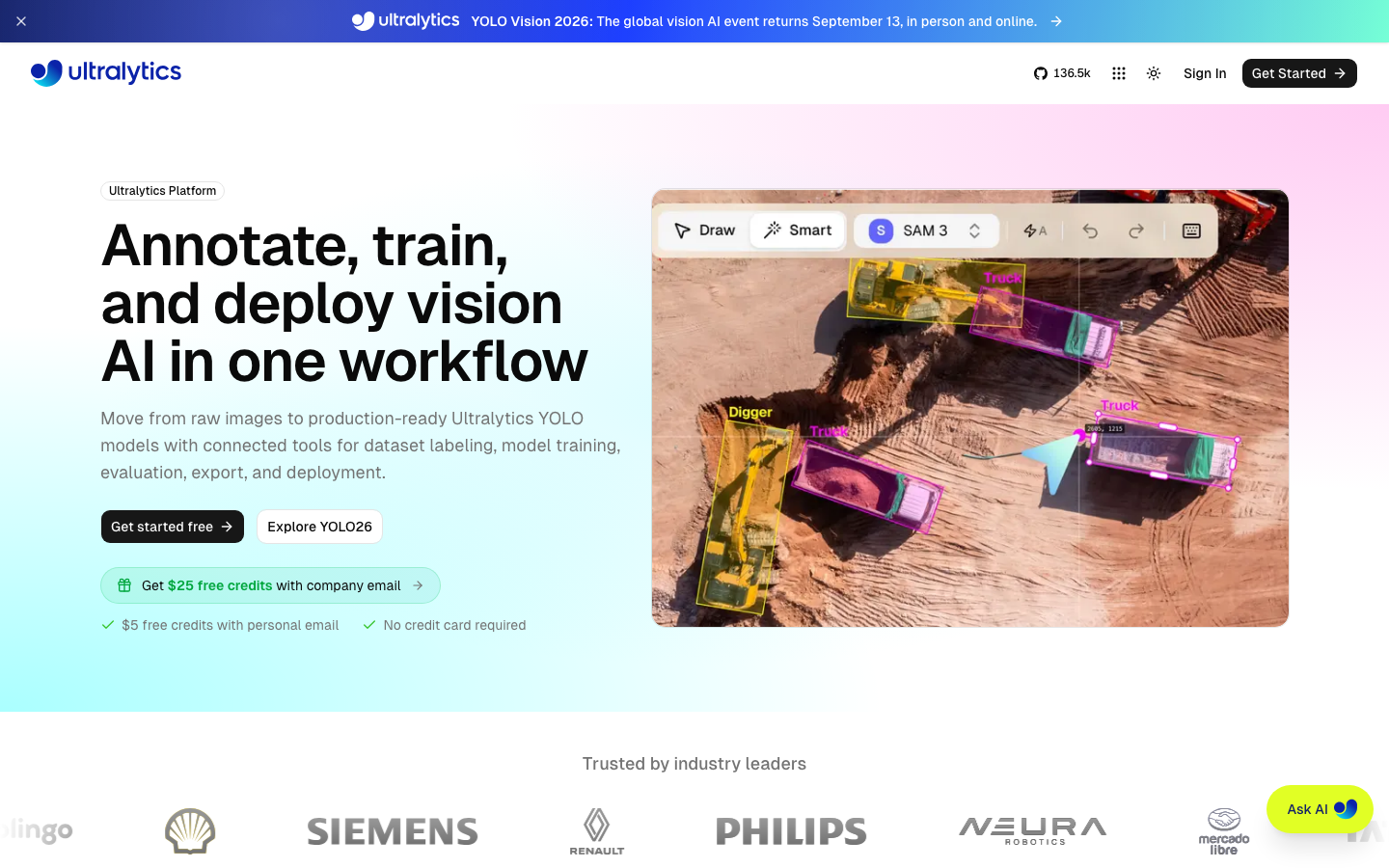
Ultralytics YOLO26, YOLO11, YOLOv8 - object detection, instance segmentation, semantic segmentation, image classification, pose estimation, object tracking
Our verdict
A well-maintained, widely adopted project. This assessment is derived from GitHub's own repository metrics on 2026-08-24, not from hands-on testing.
Ultralytics YOLO26, YOLO11, YOLOv8. It is written in Python. It has 60,922 stars and 436 contributors, and it was pushed to within the last few weeks. It is AGPL licensed, which is the detail to check first if you plan to build something commercial on top of it. The most recent tagged release is v8.4.127, from 2026-08-23. Figures come from the GitHub API on 2026-08-26 and refresh daily.
Reviewed by AI Review Rating from GitHub API data How we score
Repository
- Licence
- AGPL-3.0
- Language
- Python
- Last push
- 2026-08-24
Releases
-
v8.4.127v8.4.127 - Load exported YOLO models with the correct task across all 20 formats (#25886) -
v8.4.126v8.4.126 - Make restricted checkpoint loading thread-safe and 40% faster, simplify RLE prior (#25885) -
v8.4.125v8.4.125 - Speed up initial model loading (#25883) -
v8.4.124v8.4.124 - Restore dynamic image sizes for NMS exports (#25874) -
v8.4.123v8.4.123 - Accept existing depth dataset formats (#25859) -
v8.4.122v8.4.122 - Use canonical PNG depth maps (#25858)
Pros and cons
Pros
Cons
Pricing
- Free tierYes
- LicenceAGPL-3.0
- Self-hostYes, source is public
- Public price listNot published
Ultralytics does not publish a web price list. For consumer apps that usually means pricing appears inside the product; for enterprise tools it means talking to sales. Why we do this
Visit platform.ultralytics.comChangelog
On video
What users actually say
- YOLO26 double detection Reddit · N/A
We link to discussions rather than reproducing them. Opinions belong to their authors.
User reviews
No one has reviewed Ultralytics here yet. Reviews are moderated before they appear, and our own score is editorial and separate from user ratings, though once reviews land they do lift it.
Used Ultralytics? Review it.
Sign in to rate it. One account, one review per tool, so the score means something.
Requiring an account is how we keep this page free of drive-by spam. We never sell your address.
Ultralytics alternatives
 Roboflow Supervision
We write your reusable computer vision tools. 💜
🥈
Roboflow Supervision
We write your reusable computer vision tools. 💜
🥈  OCRmyPDF
 adds an OCR text layer to scanned PDF…
🥉
OCRmyPDF
OCRmyPDF adds an OCR text layer to scanned PDF…
🥉  Tesseract
 Open Source OCR Engine (main repository)
Tesseract
Tesseract Open Source OCR Engine (main repository)
 Frigate
NVR with realtime local object detection for IP cameras
Frigate
NVR with realtime local object detection for IP cameras
 PaddleOCR
Turn any PDF or image document into structured data…
PaddleOCR
Turn any PDF or image document into structured data…
 MediaPipe
Cross-platform, customizable ML solutions for live and streaming media.
MediaPipe
Cross-platform, customizable ML solutions for live and streaming media.
Side by side
Questions
Is Ultralytics free?
Yes. Ultralytics advertises a free tier on its own site.
How much does Ultralytics cost?
Ultralytics does not publish pricing openly, which usually means it is quote-based. You will need to contact the vendor.
Is Ultralytics open source?
Yes. Ultralytics is a public repository released under AGPL-3.0. You can self-host or inspect the source directly.
How is Ultralytics scored here?
Ultralytics scores 7.7 out of 10. That comes from a desk review of public evidence, which is capped at 8.5 out of 10: public pricing, documentation, maintenance signals and how much we could actually verify. Affiliate relationships are excluded from scoring entirely. The full rubric is published on our methodology page.