Caveman
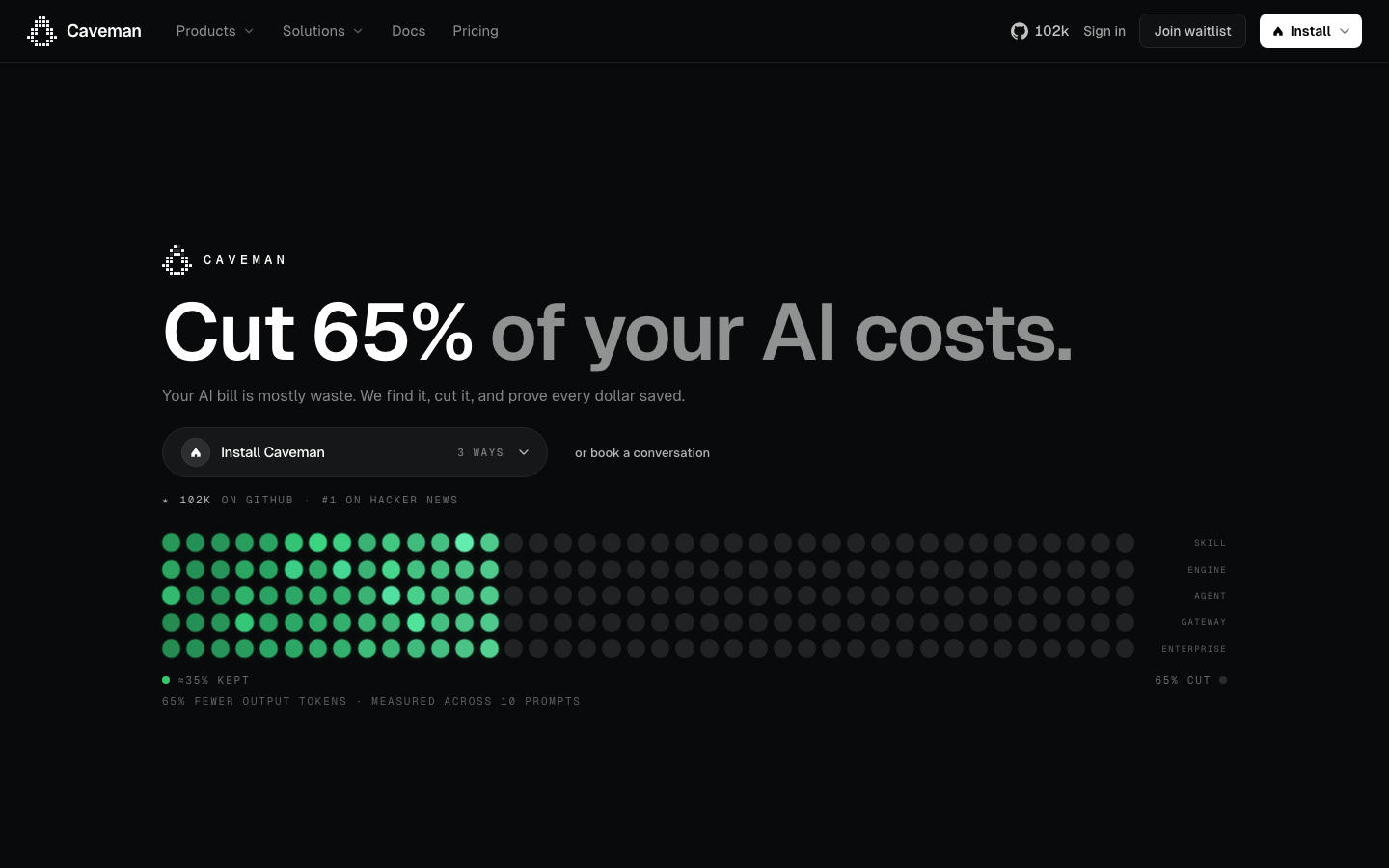
🪨 why use many token when few token do trick - Claude Code skill that cuts 65% of tokens by talking like caveman
Our verdict
A usable project with some maintenance caveats. This assessment is derived from GitHub's own repository metrics on 2026-08-24, not from hands-on testing.
Caveman bills itself as 🪨 why use many token when few token do trick, and it is written in Go. It has 100,681 stars and 35 contributors, and it was pushed to within the last few weeks. No recognised licence is declared, which leaves reuse on uncertain ground whatever the code quality. The most recent tagged release is v2.3.1, from 2026-08-23. Figures come from the GitHub API on 2026-08-26 and refresh daily.
Reviewed by AI Review Rating from GitHub API data How we score
Repository
- Licence
- Not declared
- Language
- Go
- Last push
- 2026-08-24
Releases
-
v2.3.1v2.3.1 -
v2.3.0v2.3.0 -
bin-v1.1.3bin-v1.1.3 -
v2.2.0v2.2.0 -
bin-v1.1.2bin-v1.1.2 -
bin-v1.1.1bin-v1.1.1
Pros and cons
Pros
Cons
Pricing
- Free tierYes
- LicenceNot declared
- Self-hostYes, source is public
- Public price listNot published
Caveman does not publish a web price list. For consumer apps that usually means pricing appears inside the product; for enterprise tools it means talking to sales. Why we do this
Visit caveman.soChangelog
On video
User reviews
No one has reviewed Caveman here yet. Reviews are moderated before they appear, and our own score is editorial and separate from user ratings, though once reviews land they do lift it.
Used Caveman? Review it.
Sign in to rate it. One account, one review per tool, so the score means something.
Requiring an account is how we keep this page free of drive-by spam. We never sell your address.
Caveman alternatives
 Spec Kit
💫 Toolkit to help you get started with SDD…
🥈
Spec Kit
💫 Toolkit to help you get started with SDD…
🥈  Supabase
The Postgres development platform. Supabase gives you a dedicated…
🥉
Supabase
The Postgres development platform. Supabase gives you a dedicated…
🥉  Gemini CLI
An open-source AI agent that brings the power of…
Gemini CLI
An open-source AI agent that brings the power of…
 Agent Skills
Production-grade engineering skills for AI coding agents.
Agent Skills
Production-grade engineering skills for AI coding agents.
 Context7
 Platform - Up-to-date code documentation for LLMs and…
Context7
Context7 Platform - Up-to-date code documentation for LLMs and…
 OpenHands
🙌 OpenHands: AI-Driven Development
OpenHands
🙌 OpenHands: AI-Driven Development
Side by side
| Tool | Our score | From | Free tier | Best for | |
|---|---|---|---|---|---|
| Caveman this page | 6.7 | - | Yes | ||
| 🥇Spec Kit | 8 | - | Yes | ||
| 🥈Supabase | 8 | - | Yes | ||
| 🥉Gemini CLI | 7.8 | - | Yes | ||
| Agent Skills | 7.7 | - | Yes | ||
| Context7 | 7.7 | - | Yes | ||
| OpenHands | 7.7 | - | Yes |
Questions
Is Caveman free?
Yes. Caveman advertises a free tier on its own site.
How much does Caveman cost?
Caveman does not publish pricing openly, which usually means it is quote-based. You will need to contact the vendor.
Is Caveman open source?
Yes. Caveman is a public repository released under Not declared. You can self-host or inspect the source directly.
How is Caveman scored here?
Caveman scores 6.7 out of 10. That comes from a desk review of public evidence, which is capped at 8.5 out of 10: public pricing, documentation, maintenance signals and how much we could actually verify. Affiliate relationships are excluded from scoring entirely. The full rubric is published on our methodology page.